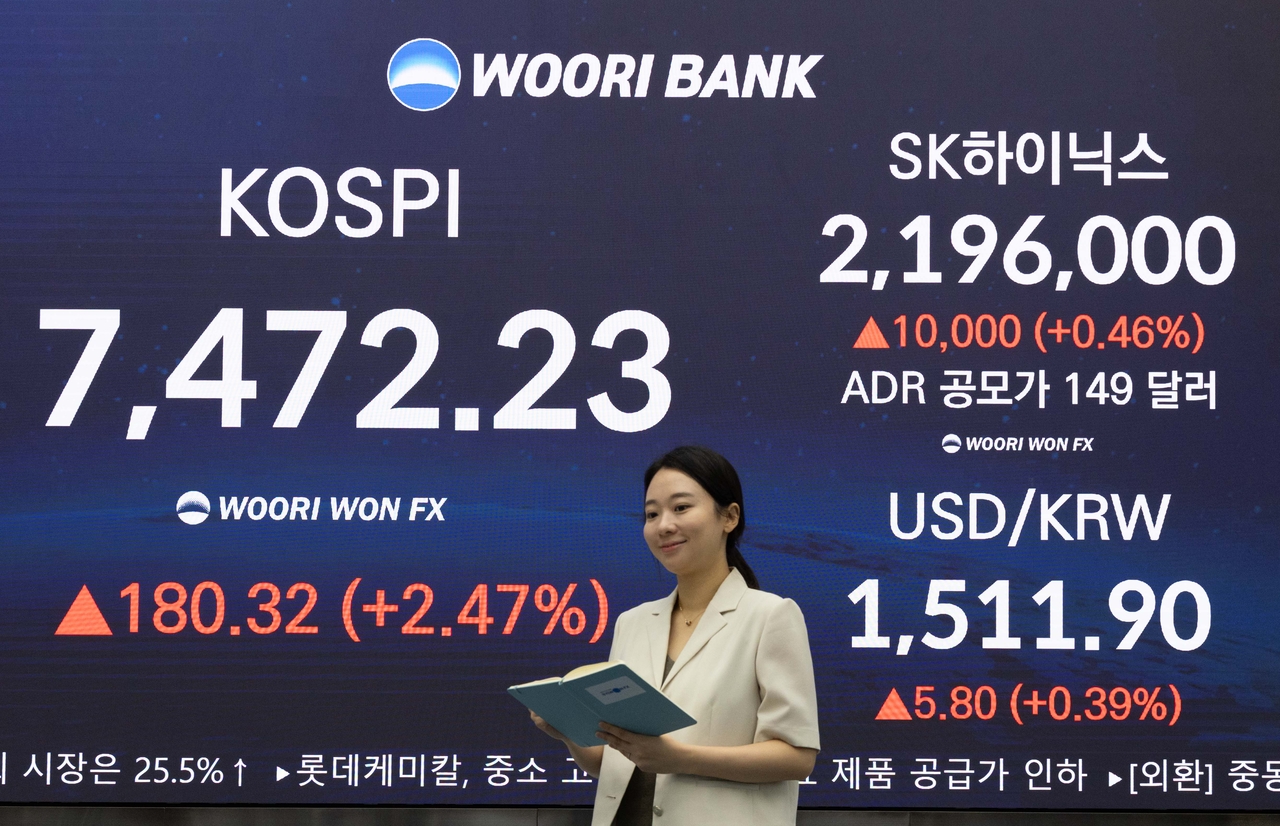
Banks need to go beyond simply maintaining their overall deposit base and instead manage deposits with greater precision — factoring in maturity structures, reinvestment rates and customers' sensitivity to interest rates — to counter deposit outflows driven by a rising Kospi, a new report has found.
Toss Insight, the financial research arm of fintech firm Toss, published the findings Friday in a report titled "Banking Industry Outlook and Response Strategies in an Age of Uncertainty." The report was prepared to assess potential risk factors for banks and explore response strategies at a time when volatility has increased across key variables — including interest rates, economic growth, housing prices and share prices — that significantly affect bank management.
The report identified the stock market boom's effect on bank deposits as a key variable for the second half of this year. Its analysis found that a 1 percentage point monthly rise in the Kospi noticeably slows the pace of fixed-term deposit inflows over the following three months. Based on fixed-term deposit balances as of February, that translates to a reduction in deposit inflows of between 600 billion and 930 billion won ($618 million). By contrast, demand deposit accounts — which allow withdrawals at any time — showed no meaningful change.
This suggests that when the stock market heats up, deposits do not exit all at once. Instead, funds gradually drain away as maturing fixed-term deposits go unreinvested and new inflows slow.
The report accordingly advised banks to look beyond defending their total deposit volume and to manage funds carefully by examining deposit maturity structures, reinvestment rates and individual customers' interest-rate sensitivity. It said banks should distinguish between funds at high risk of outflow and those likely to stay long-term, and tailor their response strategies accordingly rather than trying to retain all funds under identical conditions.
![[Provided by Toss Insight]](https://wimg.heraldcorp.com/news/cms/2026/07/10/news-p.v1.20260710.34adfa0983494c93bea26530d7d1cc59_P2.png)
Toss Insight's analysis of how economic volatility affects bank profitability, asset quality and growth concluded that banks should focus less on identifying the most favorable scenario and more on adjusting their capital and provisioning strategies as conditions change. The research found that actively adapting capital and loan-loss reserve strategies matters more than trying to determine which scenario benefits banks the most.
To conduct the analysis, Toss Insight built three scenarios — baseline, optimistic and pessimistic — covering the second half of 2026 through 2027, using eight key variables: interest rates, growth, inflation, exchange rates, household and corporate lending, share prices and housing prices. Researchers then estimated bank performance indicators for profitability, asset quality and growth under each scenario. The analysis went beyond simple average forecasts to diagnose, through probability distributions, how far indicators could deteriorate under extreme conditions — what the report called "tail risk."
The results showed no scenario was unambiguously favorable or unfavorable for banks. Rising interest rates and economic expansion boost interest income and loan growth, but also increase borrowers' debt burden, pushing up delinquencies and bad loans. Conversely, falling rates and slower growth ease repayment pressure but weaken banks' profitability and growth foundations.
Rather than judging which scenario is better or worse, the report recommended that banks regularly monitor how the balance among profitability, growth and asset quality shifts with circumstances. It added that banks should avoid relying on a single forecast and instead flexibly adjust their capital and provisioning strategies based on scenario-specific sensitivities.
The trade-off between gains and losses was particularly pronounced among internet-only banks. Because they serve a higher proportion of mid- to low-credit customers and rely heavily on personal unsecured loans, internet banks see a sharper improvement in profitability when interest rates rise than traditional commercial banks do — but they are also more vulnerable to asset-quality deterioration, as customer loan delinquencies surge at the same time. Their business model centered on household lending, combined with the regulatory environment, makes it difficult to significantly expand loan volumes even when economic conditions improve, the report found.
"As uncertainty grows, a bank's success depends not on how fast it can grow, but on which risks it chooses to take and whether it has the resilience to withstand them," Toss Insight researchers said. "We hope this report helps banks plan ahead and assess the balance between risk and return."
won@heraldcorp.com