![Traders monitor screens on the floor of the New York Stock Exchange. [AFP]](https://wimg.heraldcorp.com/news/cms/2026/07/10/news-p.v1.20260708.bcaaffb2fc0240e589899d2b1bc12403_P1.jpg)
Enthusiasm for US equities, which had cooled following the introduction of a domestic market return account program, is picking up again. As the Kospi has swung sharply in both directions in recent weeks, fatigue and anxiety among retail investors appear to be driving them back toward American markets.
Data from the Korea Securities Depository's Securities Information Portal (SEIBro) show that domestic investors net-purchased $897.79 million worth of US shares over seven trading days from July 1 through Thursday.
That figure already surpasses the entire net purchase total for June, which came to $632.95 million.
In January, domestic investors' net purchases of US stocks reached $5 billion. Buying momentum began to slow after the government announced plans to introduce the domestic market return account — known by its Korean acronym RIA — offering tax exemptions to investors who sell overseas holdings and repatriate the proceeds.
Net purchases fell from $3.95 billion in February to $1.69 billion in March, when the accounts formally launched. By April, sentiment had flipped to net selling of $468.92 million. In May — the final month in which investors could claim a full 100 percent capital gains tax deduction — net selling expanded further to $939.77 million.
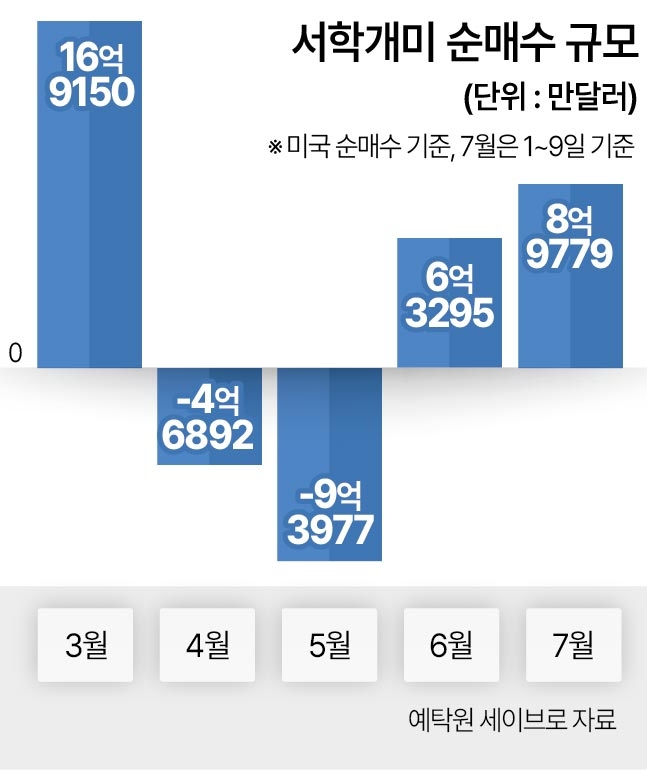
From June onward, as the tax benefits began to shrink, buying sentiment started to recover — and has accelerated further this month. The capital gains tax deduction rate on overseas stock sales was 100 percent through the end of May, steps down to 80 percent from June through the end of July, and falls to 50 percent from August through year-end.
The return of Korean retail investors to US markets is also tied to growing unease about domestic equities. As volatility on the Kospi reached extreme levels and the index tumbled, the relative appeal of US stocks has risen again.
The Kospi climbed as high as 9,385.59 during intraday trading on June 19 before closing at 7,291.91 on Thursday — a drop of 22.31 percent. The share prices of Samsung Electronics and SK hynix, the two largest stocks by market capitalization, fell 25.77 percent and 26.82 percent, respectively, from their recent peaks amid concerns that memory chip prices may have topped out. Single-stock leveraged exchange-traded funds introduced at the end of May also amplified market volatility.
The shift has begun to show in the behavior of retail investors, who had been a dominant buying force propping up the Kospi this year. According to Korea Exchange, retail investors net-sold 1.36 trillion won ($906 million) over the two trading days of Wednesday and Thursday. SK hynix alone saw net selling of 80.4 billion won during that period. Retail investors had net-purchased 99.17 trillion won on the Kospi from the start of the year through June, making the reversal all the more striking.
Still, the stocks drawing the most attention from investors pivoting to the US remain semiconductors. With Samsung Electronics, SK hynix and chipmakers worldwide broadly declining in share price, many appear to be treating the pullback as a buying opportunity.
The top net-purchased US security by domestic investors so far this month is the Direxion Daily Semiconductors Bull 3X Shares ETF — widely known by its ticker SOXL — a leveraged fund that seeks to deliver three times the daily return of the Philadelphia Semiconductor Index. Net purchases of SOXL reached $980.3 million, exceeding the total net purchase figure for all US stocks during the period ($897.79 million). Microsoft ranked second, with net purchases of $127.48 million.
On the selling side, domestic investors net-sold hundreds of millions of dollars' worth of stocks they had previously favored, including Tesla (minus $133.71 million) and Micron Technology (minus $107.98 million).

jiyun@heraldcorp.com