
![South Korea's exports surpassed $100 billion for the first time in June, setting a new milestone. Semiconductors led the way with more than $40 billion in shipments, while the trade surplus also broke the $30 billion mark for the first time, delivering a strong result in both volume and quality. The Ministry of Trade, Industry and Energy said June exports surged 70.9 percent year-on-year to $102.25 billion. Pictured are containers stacked at Pyeongtaek Port in Gyeonggi Province on July 1. [Yonhap]](https://wimg.heraldcorp.com/news/cms/2026/07/08/rcv.YNA.20260701.PYH2026070117280006100_P1.jpg)
The Asian Development Bank has raised its growth forecast for South Korea this year to 2.6 percent from 1.9 percent, citing strong semiconductor exports driven by global AI demand and the effect of government stimulus policies.
The ADB announced the revised figure Thursday in its Asian Development Outlook 2026, up 0.7 percentage points from its April projection. The bank also lifted its 2027 growth forecast by 0.1 percentage point to 2.0 percent.
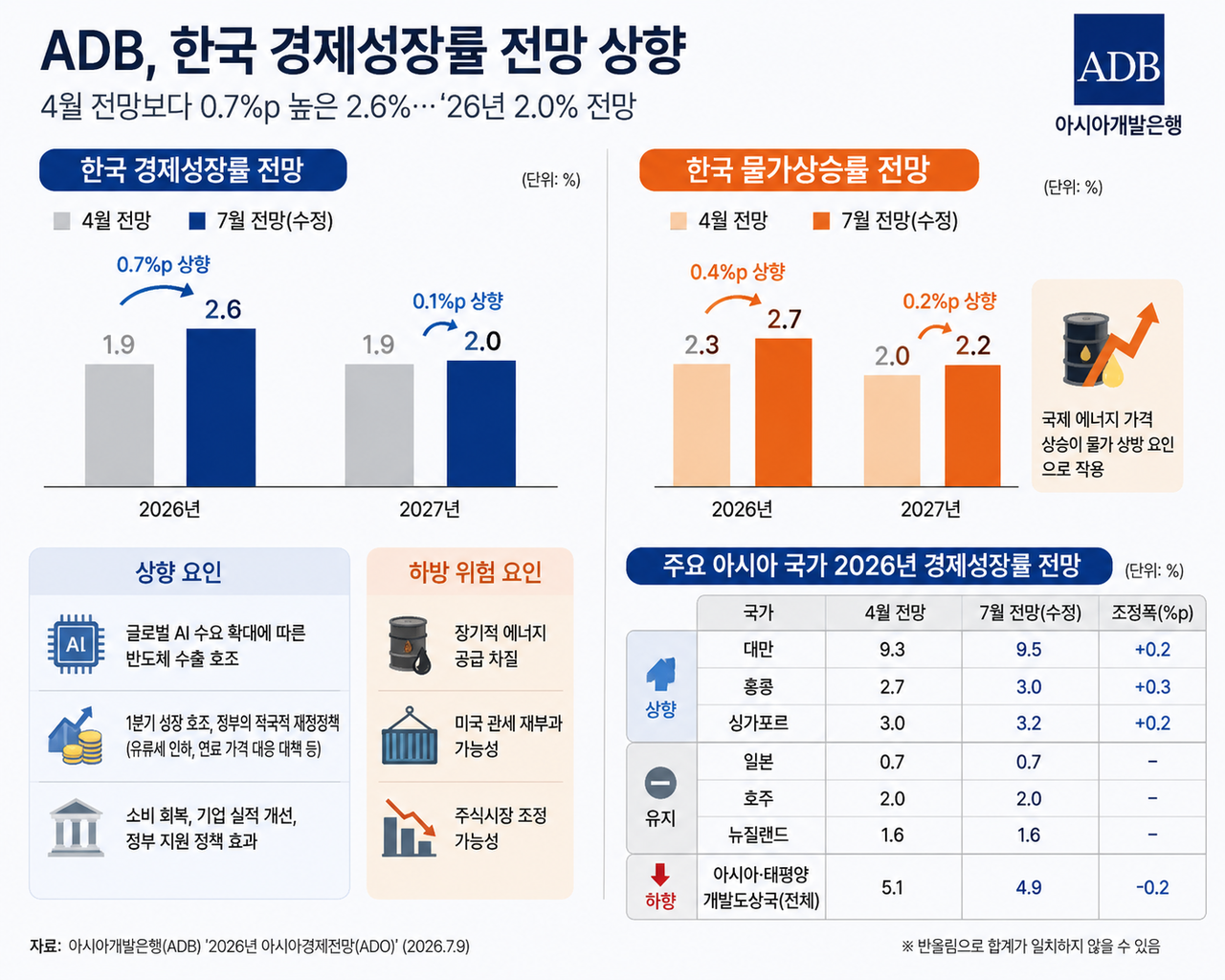
The ADB said stronger-than-expected first-quarter GDP growth, combined with the government's active fiscal policy, fuel tax cuts and various support measures to offset rising fuel costs, had underpinned the economy's momentum.
The bank identified growing semiconductor exports — fueled by a global surge in AI investment — as the key growth driver for South Korea in both 2026 and 2027. While higher energy prices and supply chain disruptions pose headwinds by raising production costs, the ADB said the semiconductor boom would largely offset those pressures.
Consumer spending is also expected to remain stable, supported by a recovering stock market, improving corporate earnings and government support programs. The ADB flagged prolonged energy supply disruptions, the potential reimposition of US tariffs and a possible stock market correction as downside risks.
South Korea's consumer price inflation is projected at 2.7 percent this year and 2.2 percent next year, reflecting the impact of rising international energy prices — up 0.4 percentage point and 0.2 percentage point, respectively, from the April forecasts.
Among other major Asian economies, growth forecasts for Taiwan (9.5 percent), Hong Kong (3.0 percent) and Singapore (3.2 percent) were also revised upward to reflect the strong semiconductor cycle. Japan (0.7 percent), Australia (2.0 percent) and New Zealand (1.6 percent), meanwhile, saw their outlooks held steady or trimmed slightly.
For developing economies across Asia and the Pacific, the ADB lowered its 2026 growth forecast by 0.2 percentage point to 4.9 percent, citing rising energy prices and prolonged supply chain disruptions that it said would weigh on production costs and economic activity. The 2027 forecast was kept at 5.1 percent, however, reflecting an easing of tensions in the Middle East.
fact0514@heraldcorp.com




