
![Ryu Ki-jung, executive director of the Korea Employers Federation and an employer representative on the Minimum Wage Commission, left, and Ryu Ki-seop, secretary-general of the Federation of Korean Trade Unions and a worker representative, listen with stern expressions at the commission's 12th plenary session held Tuesday at the Government Sejong Building. [Yonhap]](https://wimg.heraldcorp.com/news/cms/2026/07/08/rcv.YNA.20260707.PYH2026070714840001300_P1.jpg)
As the Minimum Wage Commission presses ahead with deliberations to set next year's minimum wage, data show that more than 74 percent of unpaid wages recorded from January through May were concentrated at small and micro businesses. The figures are expected to renew attention to the debate over whether small business owners and micro enterprises have the financial capacity to absorb a higher minimum wage.
According to the Ministry of Employment and Labor's labor portal, which published its "May 2026 Wage Arrears Status" report Wednesday, cumulative unpaid wages through May reached 772.7 billion won ($506 million), affecting 91,206 workers. Of that total, 720 billion won was recovered through ministry-led guidance. The wage arrears rate stood at 0.21 percent, and the arrears worker rate was 44.4 per 10,000.
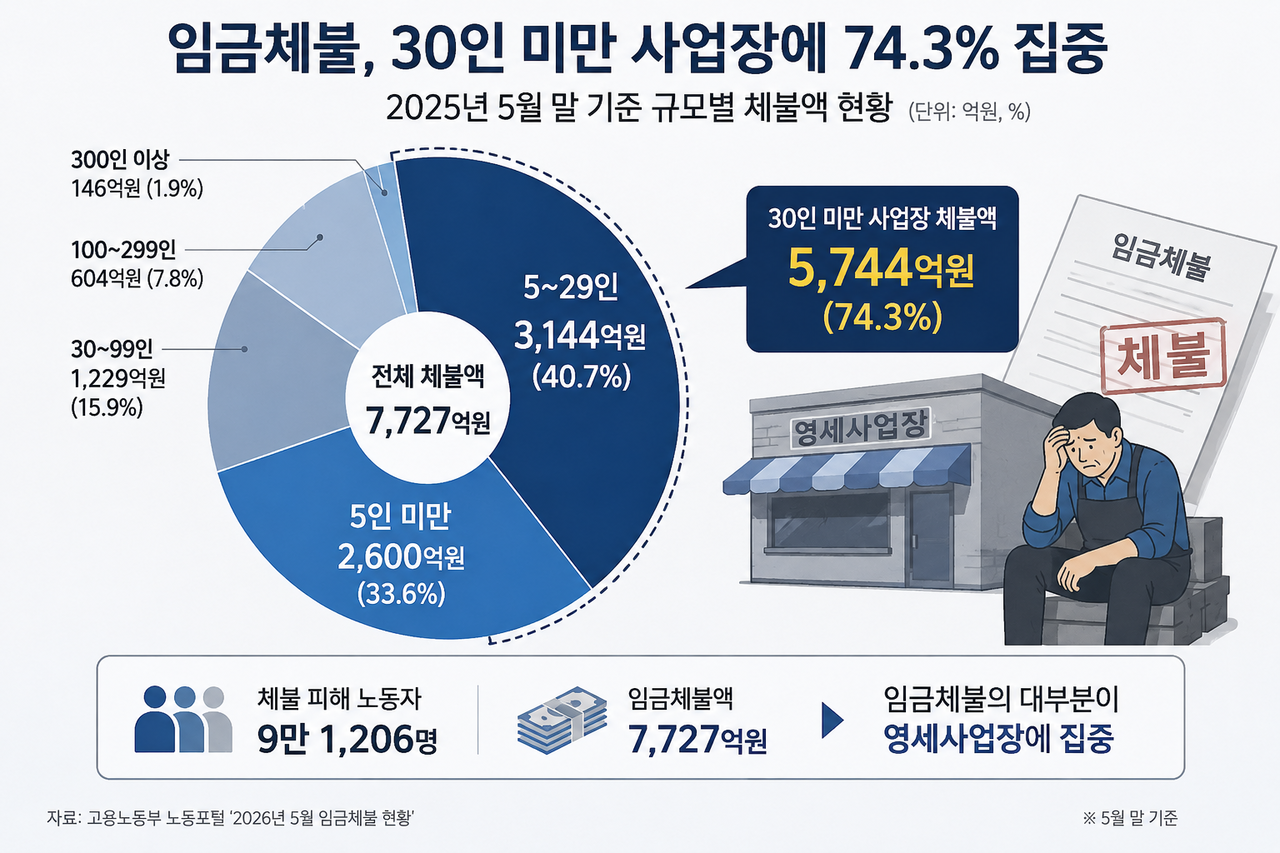
Broken down by workplace size, businesses with five to 29 employees recorded the highest unpaid wages at 314.4 billion won, followed by those with fewer than five employees at 260 billion won. Combined, workplaces with fewer than 30 workers accounted for 574.4 billion won — or 74.3 percent of the total — up 0.2 percentage points from 74.1 percent as of the end of April. The figures underscore that wage arrears remain heavily concentrated at micro and small businesses. By contrast, workplaces with 30 to 99 employees recorded 122.9 billion won in unpaid wages, those with 100 to 299 employees recorded 60.4 billion won, and those with 300 or more employees recorded just 14.6 billion won.
The data bolster the employer representatives' argument, raised during ongoing deliberations over next year's minimum wage level, that the payment capacity of small business owners must be taken into account.
Yang Ok-seok, head of the human resources policy division at the Korea Federation of SMEs, said at the commission's 12th plenary session held Tuesday: "Even though the statutory deliberation deadline has passed, we must not let time pressure push us into setting a level that small and medium-sized enterprises and small business owners cannot bear. Next year's minimum wage must be set at a level that the most vulnerable industries can actually afford to pay."
By industry, the manufacturing sector recorded the highest unpaid wages from January through May at 240.7 billion won. Construction followed at 144 billion won, then wholesale, retail, food and accommodation at 117.4 billion won, business services at 91.4 billion won, and transportation, warehousing and communications at 78.5 billion won.
By payment type, unpaid regular wages accounted for the largest share at 378 billion won, while unpaid severance pay reached 348.2 billion won and other unpaid benefits totaled 46.6 billion won. By region, Gyeonggi Province recorded the most at 228.9 billion won, followed by Seoul at 156.6 billion won, South Gyeongsang Province at 48.4 billion won, Busan at 45.6 billion won, and Incheon and Gwangju each at 37.5 billion won. Sejong recorded the least at 4 billion won. Unpaid wages owed to foreign workers totaled 62.7 billion won.
Meanwhile, the Minimum Wage Commission is set to hold its 13th plenary session Thursday for a final push to agree on next year's minimum wage level. At Tuesday's 12th session, labor representatives submitted a sixth revised proposal of 11,450 won per hour while management put forward 10,460 won, narrowing the gap between the two sides to 990 won. At Thursday's session, both sides are expected to submit further revised proposals, and if no agreement is reached, negotiations are expected to continue within a deliberation-facilitation range proposed by the public-interest commissioners.
fact0514@heraldcorp.com



