![The BMW 5 Series (left) and Mercedes-Benz E-Class [Herald DB, Mercedes-Benz Korea]](https://wimg.heraldcorp.com/news/cms/2026/07/07/news-p.v1.20250509.76dcdec77ca14ac1a7559afd102f3516_P1.jpg)
European brands have fallen below the 50 percent threshold in South Korea's imported car market for the first time in 16 years. With Tesla consolidating its position as the top-selling import brand and BYD rapidly expanding its sales, the center of gravity in a market long dominated by German nameplates is shifting toward American and Chinese electric vehicles.
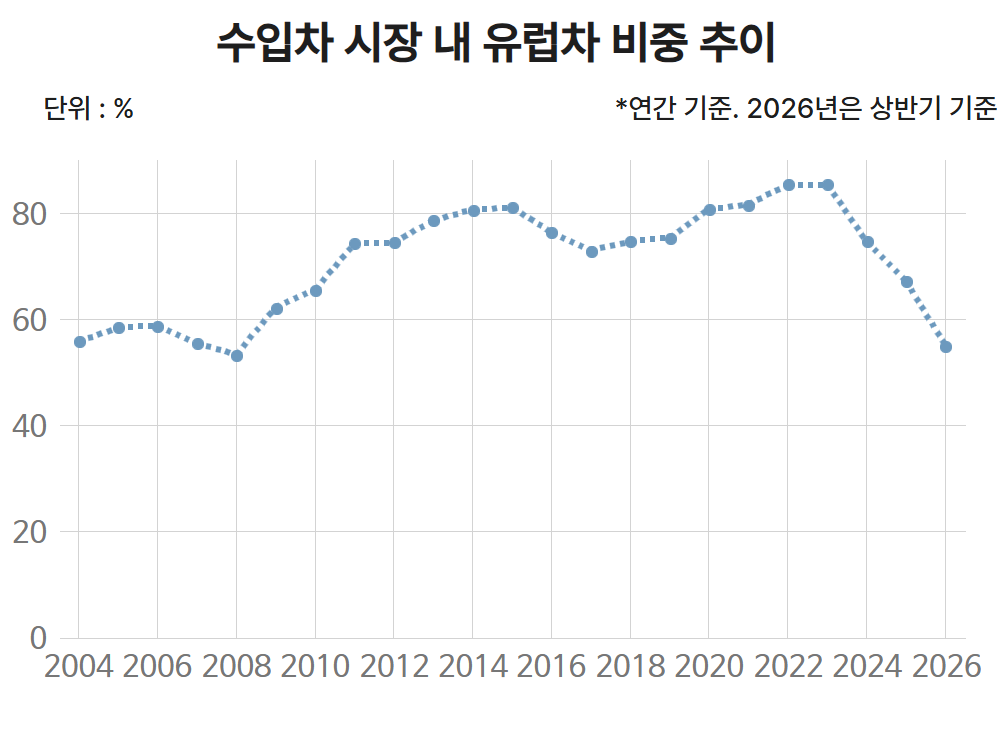
Data compiled Tuesday from the Korea Automobile Importers and Distributors Association and the Carisyou Data Research Institute showed that European brands registered 18,820 units in June, accounting for 49.4 percent of total imported passenger car registrations — down 16.3 percentage points from 65.7 percent in June last year.
It was the first time since December 2009 that European brands' monthly share had dropped below 50 percent. Their share had already slipped to 48.2 percent in April. The scale of the shift is striking: as recently as March 2022, European brands commanded 89.8 percent of the import market, meaning the landscape has been upended in just over three years.
European cars surged after Korea-EU FTA — now cracking under EV shift
European brands rapidly expanded their foothold in South Korea's import market after the Korea-EU free trade agreement took effect in 2011. German nameplates — BMW, Mercedes-Benz, Audi and Volkswagen — drove the popularization of imported cars, and by the early 2020s European brands held more than 80 percent of the import market. This year, however, the rise of electric vehicle competition has begun to fracture the order built around German premium brands.
The erosion is visible in the first-half figures as well. European brands registered 100,793 units from January through June, capturing 54.8 percent of total imported passenger car sales — down 17.2 percentage points from 72.0 percent in the same period last year.
![Tesla Model Y [Tesla Korea]](https://wimg.heraldcorp.com/news/cms/2026/07/07/news-p.v1.20260101.b6ab46134a9a418cbcce3e269947c190_P1.jpg)
Tesla and BYD fill the void, pushing US and Chinese brands past 40%
Tesla and BYD have moved in to fill the gap. The American brands' share of the import market jumped from 17.5 percent last year to 31.6 percent in the first half of this year, while Chinese brands climbed from 0.9 percent to 6.3 percent. The shift looks even sharper in June alone: American brands registered 11,445 units for a 30.1 percent share, while Chinese brands posted 4,652 units for a 12.2 percent share. Together, the two countries accounted for 42.3 percent of import registrations in June, up 15.8 percentage points from 26.5 percent a year earlier.
European brands did dip below 50 percent in the mid-to-late 2000s as well, but the driver then was the strength of Japanese brands such as Toyota and Lexus. This time, it is Tesla and BYD leading the charge on the strength of electric vehicles.
![BYD Dolphin Active [BYD]](https://wimg.heraldcorp.com/news/cms/2026/07/07/news-p.v1.20260417.cb4afbe4f89a49bf9a361f66eaedc37a_P1.jpg)
Import market grows even as European brands lose ground
Even as European brands lose share, the overall import market is expanding. Last year, total imported car registrations in South Korea exceeded 300,000 units annually for the first time, and the momentum has continued — first-half registrations this year surpassed 180,000 units, up 33.2 percent from the same period last year.
The sales growth of major European brands has already peaked and is slowing. Mercedes-Benz hit a high of about 90,000 units in 2022 before falling to 68,467 last year; its first-half sales this year came to roughly 30,000 units, down 8.6 percent year on year. BMW has stagnated since its 2022 peak of 78,545 units, with first-half growth this year limited to just 2.3 percent. Audi and Volkswagen have seen even steeper declines, with annual sales falling from 32,538 and 35,778 units respectively in 2015 to 11,001 and 5,125 units last year.
Brand rankings are shifting as well. Mercedes-Benz held the top spot among import brands through 2022, with BMW close behind. BMW then led the market from 2023 through 2025, but in the first half of this year Tesla overtook both to claim first place.
Imported EVs near half of market — pressure mounts on Hyundai Motor Group
The pace of change is even faster in the electric vehicle segment. Total EV registrations in South Korea reached 42,227 units in June, of which 19,453 were imported passenger EVs — accounting for 46.1 percent of all EV registrations that month. For the first half of the year as a whole, imported EVs reached 42.1 percent of the total.
The shift is creating new competitive pressure for Hyundai Motor Group. Hyundai Motor, Kia and Genesis still hold a commanding position in the domestic passenger car market: the three brands combined for 534,654 passenger car registrations in the first half of this year, representing about 69.8 percent of total passenger car registrations of 765,631 units.
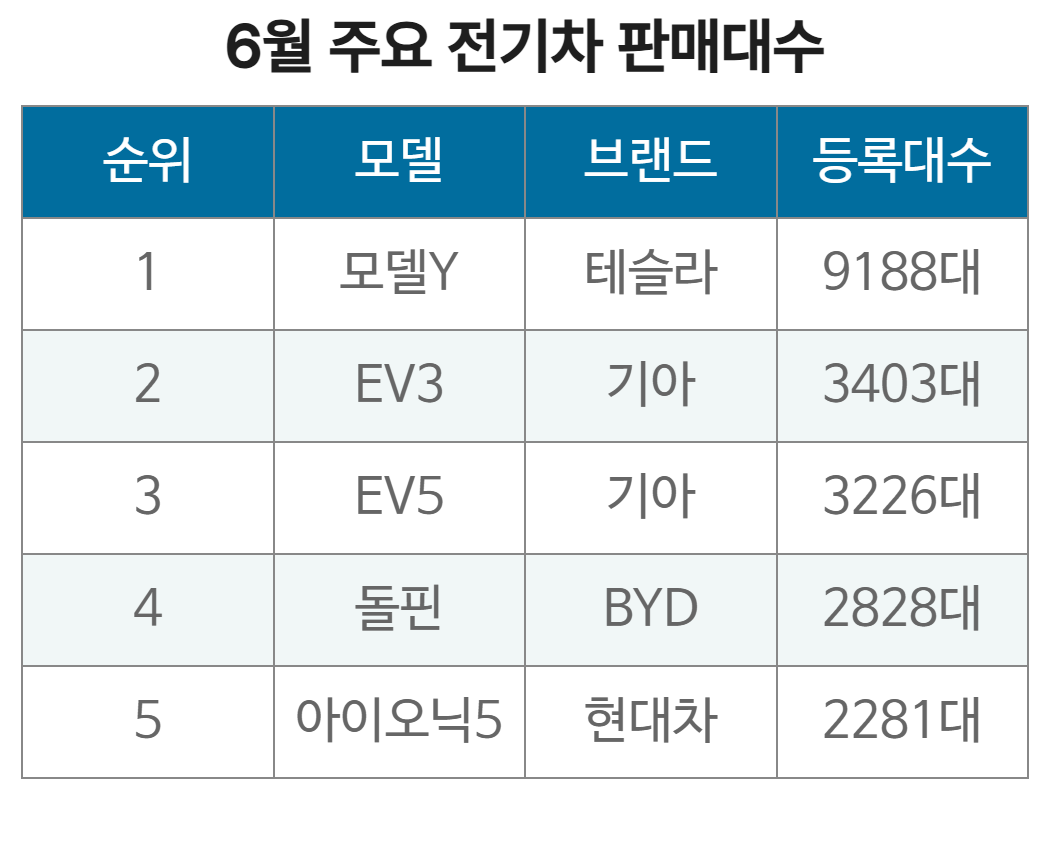
In the electric vehicle segment, however, the picture looks different. The Tesla Model Y led all imported models with 9,188 registrations in June. The BYD Dolphin came in second among imports with 2,828 units, surpassing both the BMW 5 Series and the Mercedes-Benz E-Class. In the same month, Kia's EV3 posted 3,403 registrations, the Kia EV5 recorded 3,226, and the Hyundai Motor Ioniq 5 tallied 2,281. Imported cars are no longer confined to the premium segment — they are now competing directly for the mass-market EV buyers that Hyundai Motor and Kia have long counted as their own.
In a recent report, Mohamed Shady, a researcher at the Al-Habtoor Research Center, an Egyptian think tank, wrote that European automakers "are simultaneously facing internal combustion engine regulations, high energy costs and battery supply chain disadvantages, while Chinese manufacturers are rapidly resetting the benchmarks for the EV market on the strength of their battery, critical mineral and software competitiveness." He added that if current trends continue, "European manufacturers are likely to be pushed into a defensive position, while the global penetration of Chinese brands will probably accelerate."
kwater@heraldcorp.com