LG Group is expanding its cooperative supply chain program to cover second- and third-tier suppliers, aiming to build a sustainable ecosystem across its entire supply chain. The conglomerate plans to raise its "trickle-down payment rate" — the share of mutual-growth payments made to first-tier suppliers that flow further down to second-tier and below — to 10 percent or more, the highest level among domestic conglomerates, while also broadening its co-growth fund support.
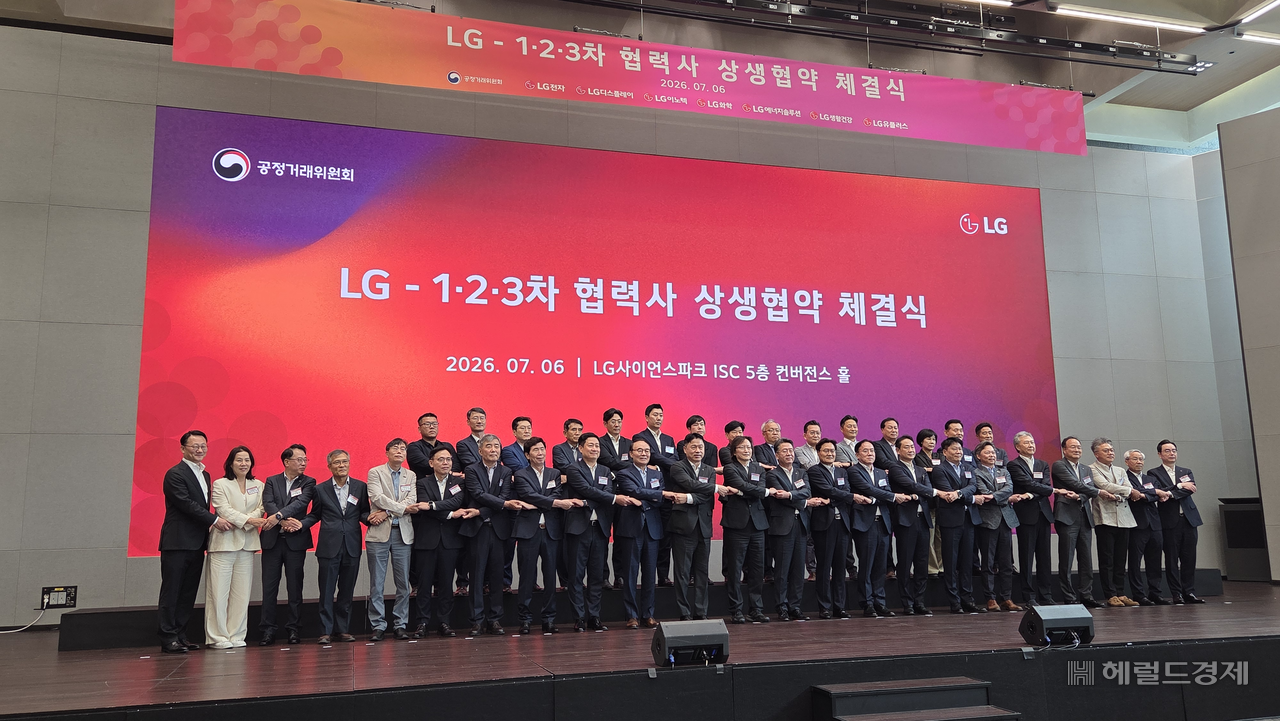
LG Group held a mutual-growth agreement signing ceremony with the Korea Fair Trade Commission at LG Science Park in Magok, Seoul, on Monday. The event drew about 170 attendees, including Korea Fair Trade Commission Chairman Ju Byung-gi; the CEOs of seven LG affiliates — Ryu Jae-cheol of LG Electronics, Jeong Cheol-dong of LG Display, Moon Hyeok-su of LG Innotek, Kim Dong-chun of LG Chem, Kim Dong-myeong of LG Energy Solution, Lee Seon-ju of LG Household and Hong Beom-sik of LG Uplus; Ha Beom-jong, president of LG Corp.'s management support division; and supplier executives and employees.
Under the agreement, LG Group will maintain a 100 percent cash-equivalent payment rate for first-tier suppliers while raising the trickle-down payment rate to at least 10 percent — the highest among domestic conglomerates. The trickle-down rate refers to the proportion of payments a large company makes to its first-tier suppliers that are subsequently passed on to second-tier and lower suppliers. The benefits of the agreement are expected to reach about 1,300 suppliers across LG's supply chain.
First-tier suppliers have typically been able to receive cash payments within an average of 10 days through the mutual-growth payment system, but second-tier and lower suppliers — where the payment culture is comparatively less developed — have faced settlement delays of up to 100 days or more. In some cases they have suffered losses from non-payment, creating a significant gap in transaction stability.
LG Group has actively used the mutual-growth payment system since the government introduced it in 2015. The group provides incentives to first-tier suppliers that use the system — including bonus points in regular evaluations and financial support — to help second-tier and lower suppliers receive payments smoothly.
Mirae Korea, a first-tier LG Electronics supplier that presented a best-practice case at the ceremony Monday, shared how it passed on the full 34.2 billion won ($22.2 million) it received in supply payments over the three years from 2023 to 2025 to 15 second-tier suppliers entirely through the mutual-growth payment system, with no promissory notes. Jang Geon-yeong, an executive vice president at Mirae Korea, said the arrangement allowed the company to focus on production and delivery through fast cash access and stable transactions, adding that "everyone is achieving mutual growth together."
LG Group paid about 13.5 trillion won to first-tier suppliers through the mutual-growth payment system last year. If a similar scale is maintained this year, the group estimates about 1.3 trillion won will flow through to second-tier suppliers.
Support for second-tier and lower suppliers will also be strengthened. LG Group plans to direct at least 10 percent of its roughly 900 billion won co-growth fund to second-tier and lower suppliers, and will open a dedicated welfare mall for supplier employees.
The ceremony also covered measures to strengthen fair-trade practices, including the supply-price linkage system and a dispute-resolution body for subcontract payments. LG Household was highlighted as a best-practice case for the supply-price linkage system, having integrated the linkage agreement process into its internal electronic contract system so that suppliers can request linkage terms as a matter of course, in a natural and straightforward way.
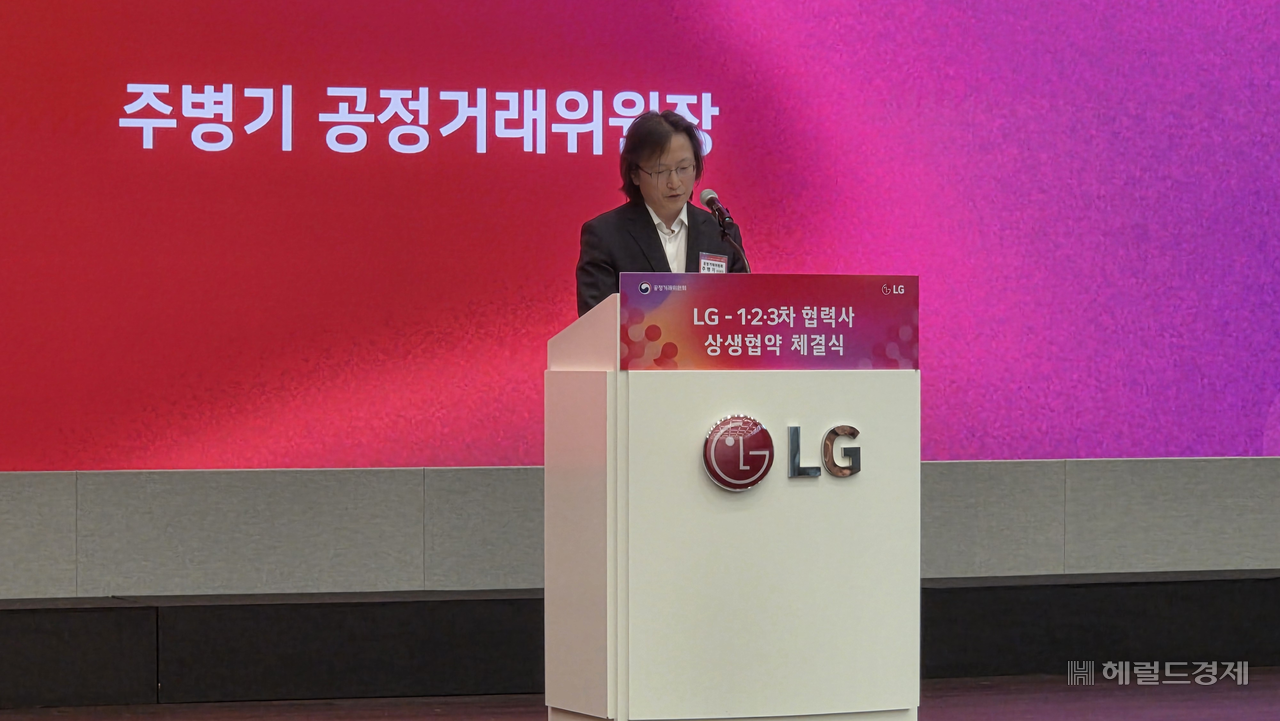
"The competitiveness and sustainable growth of large companies can only be achieved on the foundation of a healthy industrial ecosystem in which they grow together with their suppliers," Chairman Ju said. "I hope the warm culture of mutual growth — spreading evenly from LG to first-, second- and third-tier suppliers — can take deep root."
He went on to say that while companies engaging in unfair practices will face stricter discipline and stronger sanctions in line with advanced-economy standards, the government will spare no policy support to ensure that companies leading the way in mutual growth, focusing on innovation in their core businesses, and creating decisive competitive advantages are fairly rewarded by the market. "I hope that what LG and its suppliers have built together today becomes the starting point for transforming South Korea's entire industrial ecosystem into a healthier and more innovative one," he said.
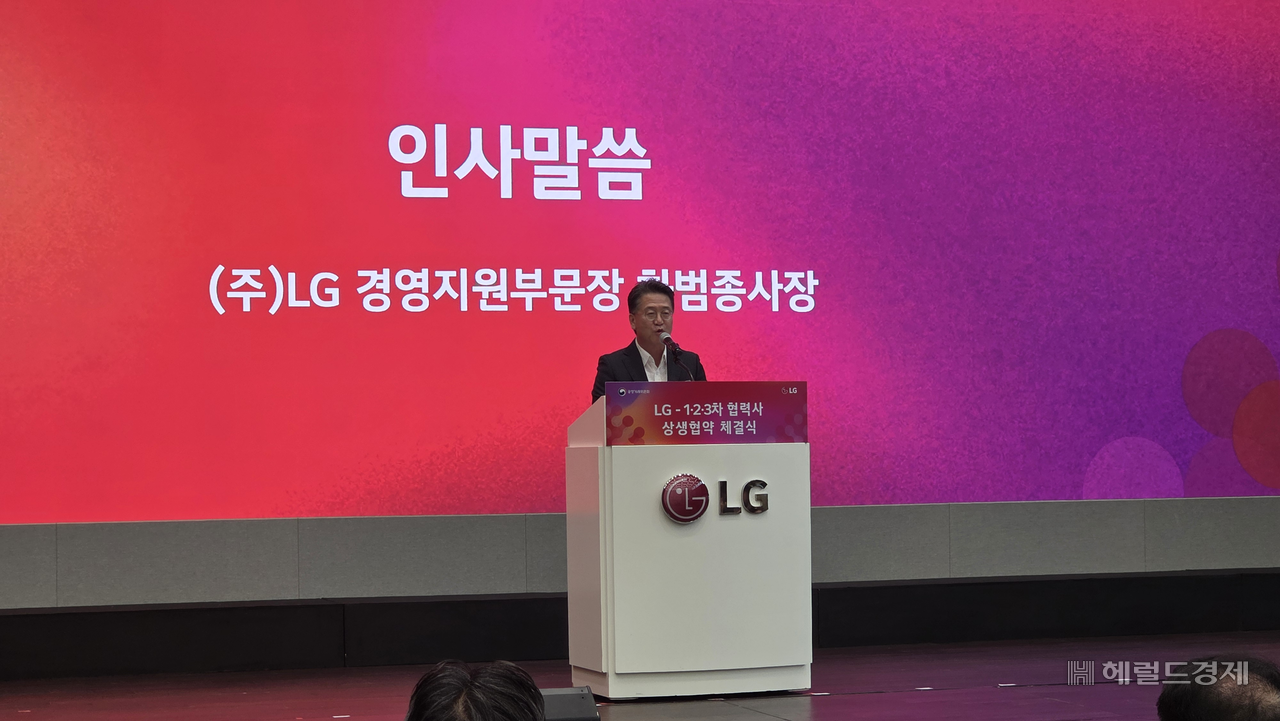
Ha said competition in the global market requires all players — from large companies down to first-, second- and third-tier suppliers — to move together as a single, organic value chain to survive. "We will work not only to spread the mutual-growth payment system and expand support for second-tier and lower suppliers, but also to help suppliers grow into companies with their own independent competitiveness, and to broaden the scope of mutual-growth cooperation to include local communities and youth," he said.
Support for technology competitiveness will also continue. LG Electronics has been helping more than 250 suppliers with digital transformation through a smart factory program since 2019. LG Display supports suppliers' technology capabilities through joint research and development, co-patent applications and free education programs.
Since 2023, LG Innotek has offered hands-on training through a supplier capability-building center, covering AI readiness, production technology know-how and expert personnel dispatch. The company also provides free analysis and testing courses at its technology research institute and CS campus, and runs technology seminars and technical support programs for suppliers to promote joint technological advancement.
LG Uplus covers the full cost of professional consulting for small and medium-sized enterprise suppliers seeking ISO certification, Innobiz certification and other business credentials, helping them strengthen their competitiveness.
LG Group is also deepening its ties with local communities. LG Electronics established the LG Electronics Glocal University Technology Center with Changwon National University in 2024 to link local students' education with employment opportunities. The company is also building a heating, ventilation and air conditioning research center with a total floor area of 13,000 square meters — the first of its kind on a regional university campus nationwide — with an investment of about 50 billion won.
LG Science Park is also contributing to the local startup ecosystem through its Super Start Incubator program, which nurtures promising startups by providing technology, networking and infrastructure support to innovative regional ventures.
go@heraldcorp.com