![The BYD Dolphin Active. [BYD]](https://wimg.heraldcorp.com/news/cms/2026/07/03/news-p.v1.20260417.cb4afbe4f89a49bf9a361f66eaedc37a_P1.jpg)
BYD's compact electric vehicle, the Dolphin, has become the Chinese automaker's top-selling model in Korea just four months after its local launch. In June, it leapfrogged the BMW 5 Series and the Mercedes-Benz E-Class to rank second among all imported passenger car models — and outsold the Hyundai Motor Ioniq 5, South Korea's flagship domestic EV. Analysts say its price starting in the 20 million won ($12,900) range, combined with a body size approaching that of a compact electric SUV, has resonated with consumers hunting for value-for-money electric vehicles..
According to data from Carisyou Data Research Institute and the Korea Automobile Importers and Distributors Association (KAIDA), the Dolphin recorded 2,828 registrations in June — second only to the Tesla Model Y (9,188 units) among imported passenger car models, and ahead of the BMW 5 Series (2,266 units) and the Mercedes-Benz E-Class (2,114 units).
A surge in supply contributed to the June spike. The Dolphin posted 652 registrations in March and 800 in April, but that figure collapsed to just 150 in May due to inventory shortages. Pent-up demand and fresh deliveries then converged in June, driving the sharp rebound.
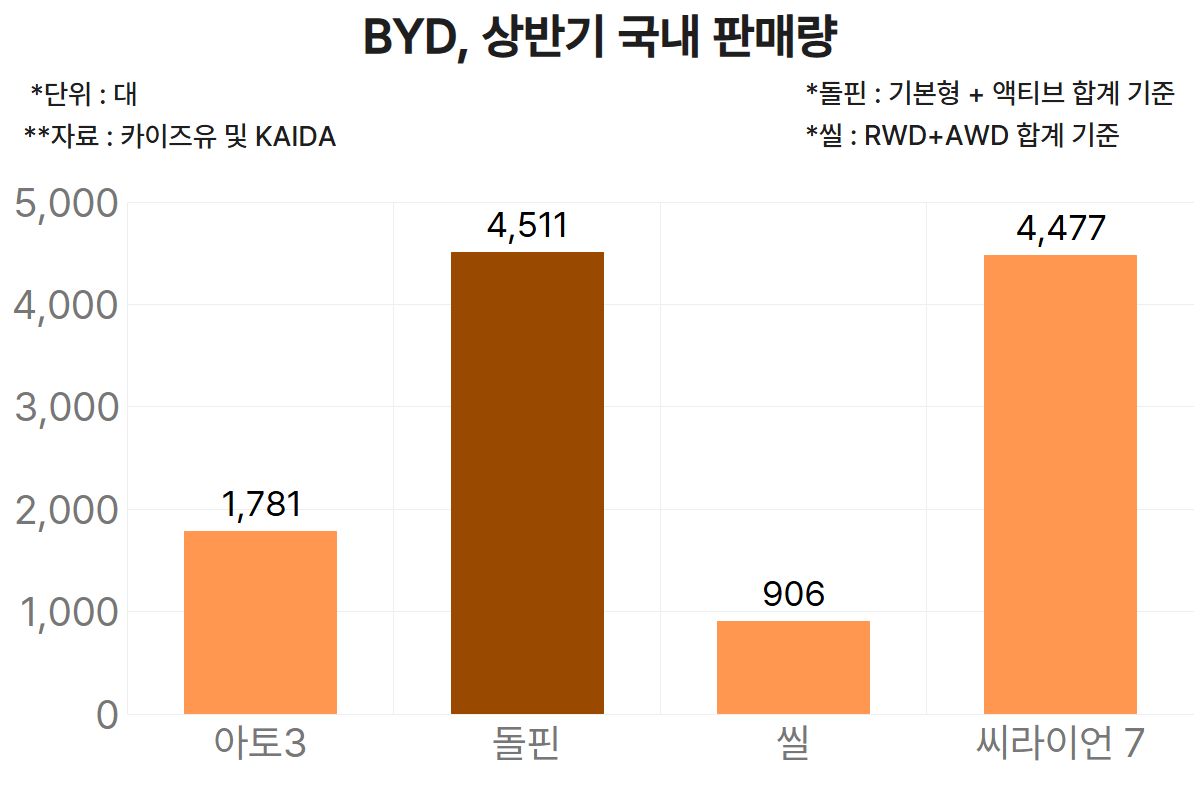
On a cumulative first-half basis, the Dolphin has also emerged as BYD's standard-bearer in Korea. The model recorded 4,511 registrations from January through June, narrowly edging out the Sea Lion 7 (4,477 units) to claim the top spot in BYD's passenger lineup just four months after its domestic debut. The Atto 3 followed with 1,781 units, while the Seal posted 906.
The Dolphin is also making its presence felt against domestic EVs. The Kia EV3 led with 3,403 units sold in the domestic market in June, followed by the Kia EV5 at 3,226 — both ahead of the Dolphin. The Hyundai Motor Ioniq 5, however, came in at 2,281 units, 547 fewer than the Dolphin. On a cumulative first-half basis, the gap with Korea's mainstream domestic EVs remains wider: the EV3 posted 18,009 units, the EV5 15,411 and the Ioniq 5 11,569.
The Dolphin's appeal lies in its size and value relative to its price. The vehicle measures 4,290 millimeters in length, 1,770 mm in width, 1,570 mm in height and has a 2,700 mm wheelbase — dimensions broadly comparable to the Kia EV3. After applying eco-friendly vehicle tax benefits but before government subsidies, the base model is priced at 24.5 million won and the Dolphin Active at 29.2 million won. The combination of a price point comparable to the Casper Electric — Korea's domestic subcompact electric SUV — with interior space on par with the EV3 appears to have captured consumer attention.
The model's feature set is also generous for its price tier. The Dolphin is built on BYD's dedicated EV platform, e-Platform 3.0, and equipped with a Blade Battery. The base trim pairs a 49.92 kWh battery with a 70 kW motor, earning a certified range of 307 kilometers on a single charge. The Dolphin Active steps up to a 60.48 kWh battery and a 150 kW motor delivering 204 horsepower and a certified range of 354 km. The two trims differ in battery capacity, motor output and rear suspension configuration, broadening the options available to buyers.
![BYD's Sea Lion 6 DM-i, a midsize plug-in hybrid SUV expected to launch in South Korea. [BYD Korea]](https://wimg.heraldcorp.com/news/cms/2026/07/03/news-p.v1.20260630.c3ae805374e54be8b555b5b037160cf3_P1.jpg)
The Sea Lion 7 is also holding its own. The model recorded 1,117 registrations in June, ranking sixth among imported car models. With 4,477 cumulative units in the first half, it stands alongside the Dolphin as one of BYD's two core volume sellers. The Dolphin targets urban drivers with its competitive pricing, while the Sea Lion 7 is aimed at demand for midsize electric SUVs.
Strong performances across its key models pushed BYD to fourth place among imported passenger car brands in June, behind Tesla, BMW and Mercedes-Benz. The brand recorded 4,652 registrations, a 350.8 percent increase from the previous month.
On a cumulative first-half basis, BYD sold 11,675 units — nearly double the 6,097 units it moved in the nine months following its domestic market entry last year. Its monthly average has grown from 677 units last year to 1,946 units in the first half of this year, roughly a threefold increase. June's registrations alone accounted for 76 percent of the brand's total sales for all of last year.
Buyer data from January through May showed that 93 percent of purchasers registered their vehicles as private cars, and more than 65 percent of individual buyers were in their 40s or 50s — pointing to strong end-user demand rather than fleet or corporate purchases.
Whether the steep upward trajectory will continue in the second half remains to be seen. BYD has been excluded from the government's electric vehicle subsidy program starting this month. Since subsidies directly affect the final purchase price, the price competitiveness that has driven Dolphin and Sea Lion 7 sales will inevitably be somewhat diminished.
A BYD Korea official said the company "respects the government's policy decision regarding the electric vehicle subsidy system," adding that "since expanding EV adoption is a goal that the government and industry must achieve together, we will work jointly toward the policy objectives, the development of the industry, and the protection of consumer interests."
![BYD Korea's vehicle lineup: the Dolphin (from left), Sea Lion 7, Atto 3 and Seal. [BYD]](https://wimg.heraldcorp.com/news/cms/2026/07/03/news-p.v1.20260414.18e45d02afdd49dfbd49af74a6d18789_P1.jpg)
BYD Korea has also introduced its own stopgap measure. For the month of July, the company will run a customer support program offering buyers an amount equivalent to the subsidy they would otherwise have received under the government scheme.
"This is a measure to ease the burden on customers and contribute to the spread of eco-friendly vehicles in Korea," a BYD Korea official said. "We will continue to develop a range of support measures so that customers can experience BYD's electrification technology under more reasonable conditions."
BYD's global expansion strategy is another variable that could shape its Korean trajectory. Chairman Wang Chuanfu told the company's recent annual shareholders meeting that BYD aims to become the world's largest automaker within five years through advances in battery technology and expanded overseas production. The company has set an overseas sales target of about 1.5 million vehicles this year, up more than 40 percent from approximately 1.05 million last year. In Europe, BYD plans to invest about 1.8 billion pounds in developing five-minute "flash charging" infrastructure.
External risks are mounting as well. The US Department of Defense added BYD to its list of Chinese military companies, raising security concerns and weighing on the company's share price.
kwater@heraldcorp.com