
Plan calls for expanded role of KIND, new infrastructure funds
Korea-US joint procurement team departs with Vice Minister Kim Yi-tak
![The government has launched a Korea-US joint procurement support team to promote the overseas construction industry. Shown is the Yongin semiconductor cluster construction site in Gyeonggi Province. [Yonhap]](https://wimg.heraldcorp.com/news/cms/2026/07/03/news-p.v1.20260628.71bfc391740c4ad588fda9dbfddfd385_P1.jpg)
South Korea has established its Fifth Basic Plan for Promoting Overseas Construction, aimed at developing the sector into a high-value industry grounded in technological capability and global finance.
To that end, the government will create new overseas construction infrastructure funds — including a corporate matching fund jointly invested by the Korea Overseas Infrastructure and Urban Development Support Corporation (KIND) and Korean companies, and country-specific strategic funds co-invested with foreign sovereign wealth funds and state-owned banks.
A Korea-US joint procurement support team led by Ministry of Land, Infrastructure and Transport First Vice Minister Kim Yi-tak will travel to the United States immediately after the plan's finalization to attend a memorandum of understanding signing ceremony for a lithium and boron plant construction project in Nevada, providing support for Korean firms seeking to win the contract.
The Ministry of Land, Infrastructure and Transport announced Friday that it had established the Fifth Basic Plan for Promoting Overseas Construction (2026–2030), laying out medium- and long-term policy directions and action items for the industry over the next five years.
The plan builds on the overseas construction policy direction announced in December and centers on developing the sector into a high-value industry backed by technological excellence and global finance. It reflects the government's national agenda of technology-led growth and a campaign pledge to dramatically expand overseas infrastructure funds.
The plan addresses a competitive landscape in which advanced construction firms hold dominant positions through superior technology and financial strength, while latecomers such as China and Türkiye are rapidly expanding their market share in key regions. It incorporates the assessment that Korean firms need to strengthen their standing by leveraging irreplaceable technology and global finance as core contract-winning tools, and by building an ecosystem that continuously attracts top companies and talent.
The plan sets three pillars — technology, global finance and support infrastructure — and targets a shift away from simple construction contracting toward a new project-winning model, with the goal of advancing into a developed-country-style industry.
To foster a technology-driven contracting model, the government will support full-lifecycle, package-type project entries — from engineering, procurement and construction (EPC) through operations and maintenance (O&M) — drawing on Korean firms' strengths in areas such as suspension bridges, supertall buildings and immersed tunnels. It will also explore new overseas construction models by applying construction technology to adjacent industries, including floating liquefied natural gas (FLNG) facilities, data centers and small modular reactors (SMR).
Korean-developed infrastructure such as railways and airports — where domestic firms hold proprietary technology — will be packaged as integrated products encompassing signaling, communications, security and operating systems. The government will also pre-export Korean urban development laws and systems to create favorable contracting environments abroad, while actively supporting exports of "AI City" development models.
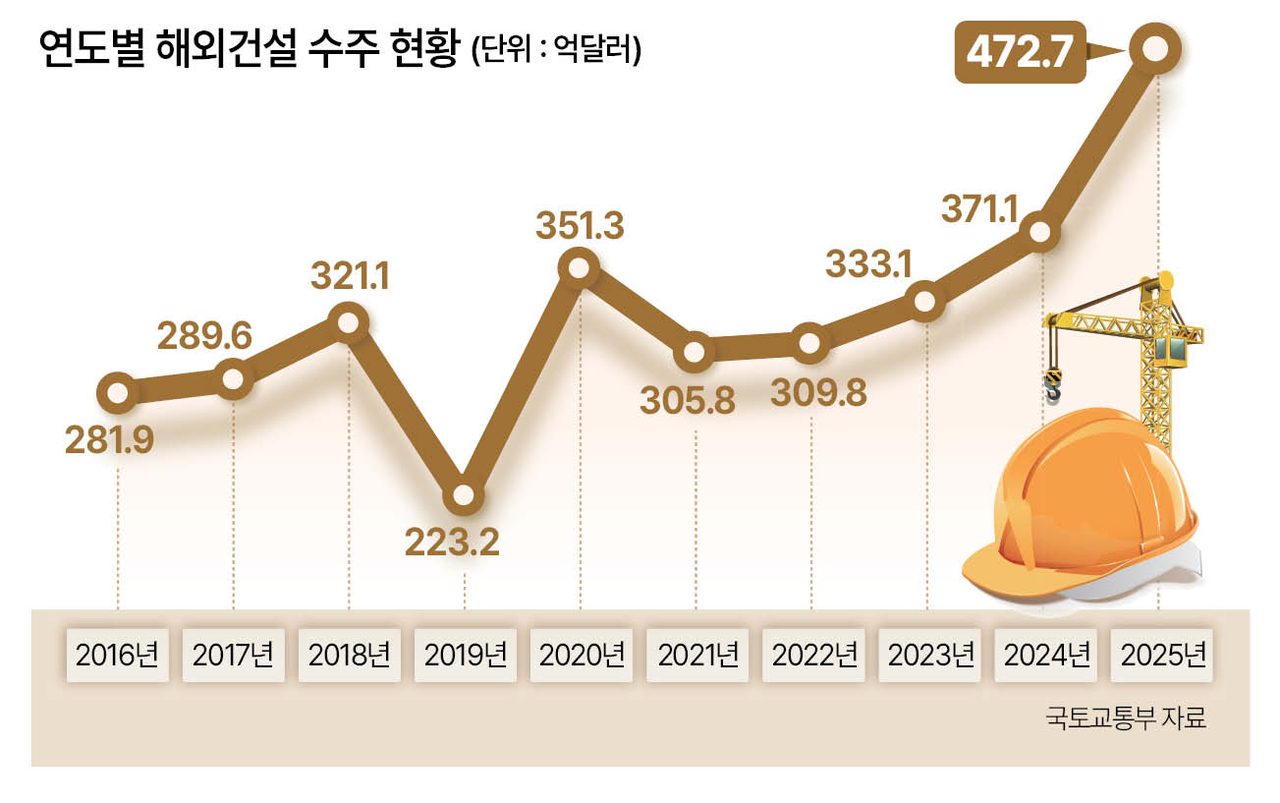
On the financial side, the plan pursues diversified financing support for investment development projects to strengthen competitiveness in global contract bidding. New overseas construction infrastructure funds will be established, including a corporate matching fund jointly invested by KIND and Korean companies, and country-specific strategic funds co-invested with foreign sovereign wealth funds and state-owned banks.
The government will also build cooperative networks with major global developers such as Macquarie and Sumitomo — which manage large-scale capital — to secure quality projects, and will actively support Korean firms' participation in multilateral development bank (MDB) projects, including by creating a dedicated MDB cooperation team.
KIND will be developed into a "global developer" that takes a leading role in originating quality projects, and the government will establish a risk management system for invested assets to ensure stable project execution.
The ministry will implement the global finance and Team Korea procurement support strategies outlined in the plan in the United States first. A Korea-US joint procurement support team based in Washington, D.C., led by First Vice Minister Kim, will be dispatched from Saturday through Wednesday local time to follow through on government-to-government infrastructure cooperation projects identified through ministerial-level meetings.
The team will attend a signing ceremony for a memorandum of understanding on a $1.6 billion lithium and boron plant construction project in Nevada — a cooperation initiative proposed by the US Department of Energy — to support Korean firms in winning the contract. KIND is seeking an equity stake in the project, while Hyundai Engineering is pursuing EPC participation. The project also has a loan commitment under the US Department of Energy's Energy Dominance Financing (EDF) policy. Lee Hye-jin, director of the overseas construction policy division, said the project "is significant as a case where the global finance and co-investment model is being realized, and where KIND is playing a leading role as a global developer by actively participating in project structuring negotiations — putting the plan's strategy into practice."
Vice Minister Kim is also scheduled to meet with a US Department of Energy deputy secretary to discuss identifying new government-to-government cooperation projects, with a Department of Agriculture deputy secretary on expanding the scope of infrastructure cooperation, with a Department of Housing and Urban Development deputy secretary on housing policy and systems, and with a World Bank vice president for infrastructure on broadening cooperation across the sector.
"The dispatch of the Korea-US joint procurement support team is the first global finance cooperation initiative undertaken following the establishment of the Fifth Basic Plan for Promoting Overseas Construction," Kim said. "We will strengthen government-level support to enable Korean firms to participate in the construction of key US supply chain plants, while actively identifying investment development projects linked to global finance to support the structural transformation of Korea's overseas construction industry."
smh@heraldcorp.com




