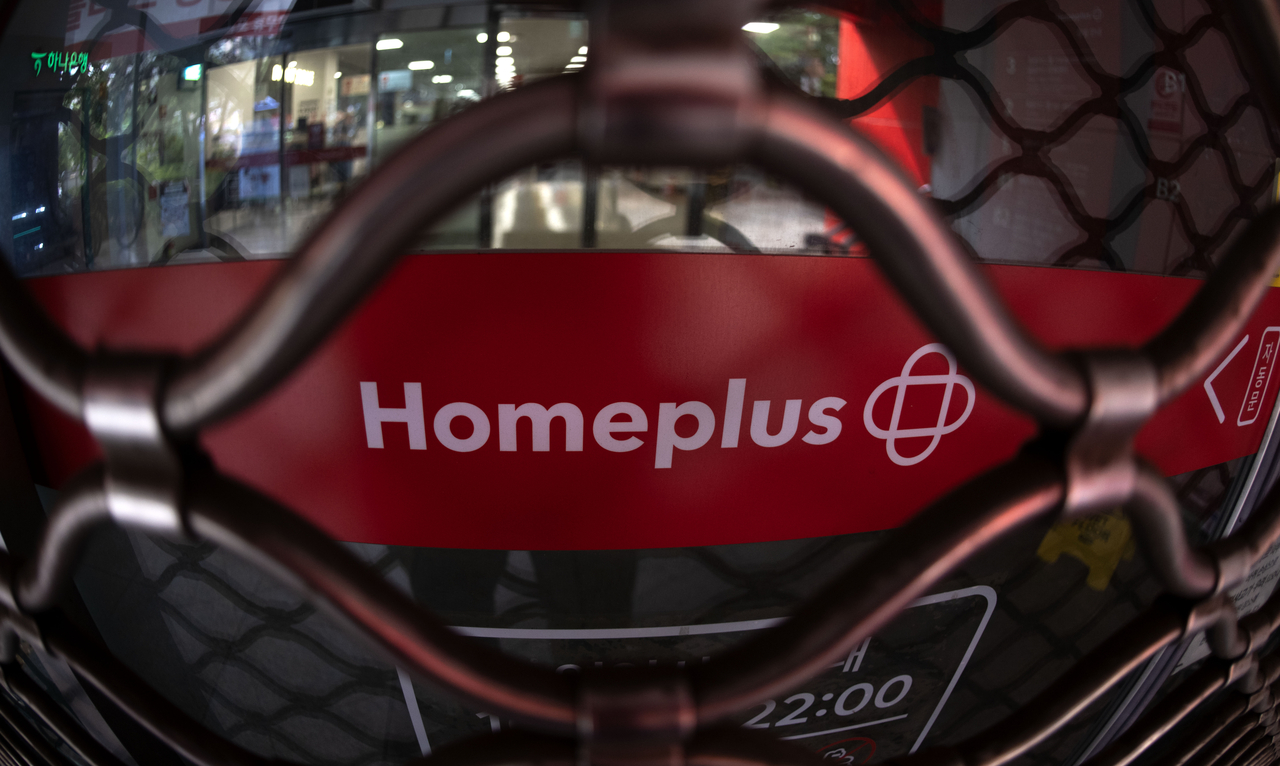
As Homeplus slides toward what amounts to bankruptcy, the fallout is landing not only on its largest shareholder, MBK Partners, but on South Korea's entire private equity industry. The collapse of the country's No. 1 private equity fund's bet on the No. 2 hypermarket operator is reigniting a debate over whether private equity firms can actually manage the businesses they acquire — and who should bear responsibility when they cannot.
Court terminates Homeplus rehabilitation
The Seoul Bankruptcy Court's Fourth Rehabilitation Division, presided over by Chief Judge Jeong Jun-yeong, on Thursday ordered the termination of Homeplus's court-led rehabilitation proceedings. Under the relevant law, a rehabilitation plan must be approved within one year of the commencement of proceedings, with a maximum six-month extension permitted.
Homeplus had been eligible for an extension through Sept. 4, but the court ruled that continuing the process would serve no purpose. "The rehabilitation plan has no feasibility and is therefore terminated without being submitted to a creditors' meeting for deliberation and resolution," the court said. While Homeplus could theoretically file for rehabilitation again, the court is unlikely to accept such a petition. In effect, the company is expected to proceed toward liquidation or bankruptcy.
The Homeplus acquisition had been a landmark deal for MBK Partners and a symbol of the domestic private equity market's growing ambitions. MBK Partners acquired a 100 percent stake in Homeplus from Britain's Tesco in 2015 for about 5.8 trillion won ($3.73 billion), taking on an additional 1.4 trillion won in debt for a total transaction value exceeding 7 trillion won. The deal set a record as the largest buyout in the Asia-Pacific region at the time, with MBK Partners beating out formidable rivals including the Carlyle Group and a consortium of Affinity Equity Partners and KKR.
![MBK Partners Chairman Kim Byung-ju (right) and Homeplus CEO Kim Gwang-il appear as witnesses at the National Assembly's Political Affairs Committee during the 2025 Korea Fair Trade Commission national audit in October last year. [Yonhap]](https://wimg.heraldcorp.com/news/cms/2026/07/03/news-p.v1.20260703.369654ac7bc54499936c9227bab000f1_P1.png)
At the time of the acquisition, Homeplus was the second-largest hypermarket operator in South Korea, trailing only E-mart. Under MBK Partners' ownership, however, the company struggled against the rise of online retail, a broader slowdown in the hypermarket sector and the disruption caused by the COVID-19 pandemic. It ultimately filed for court receivership in March last year after a credit rating downgrade triggered a liquidity crisis. Homeplus attempted to find a way out through a pre-approval merger and acquisition process and the sale of its Homeplus Express convenience store chain, but both efforts ultimately failed.
The failure of Homeplus's rehabilitation is expected to deal a blow not just to MBK Partners but to the broader domestic private equity ecosystem. The buyout — the core strategy of private equity, in which a firm acquires a controlling stake, restructures operations and improves efficiency to boost enterprise value, then exits through a sale or listing years later — has come under renewed scrutiny.
Private equity firms have faced criticism along the way for workforce restructuring, asset sales and extracting interim returns through dividends, but a growing track record of successful turnarounds had gradually softened public skepticism. IMM Private Equity's revival of Taihan Cable & Solution and Pine Tree Partners' rescue of cosmetics brand Skinfood are cited as examples of firms acquiring distressed or insolvent companies and restoring them to health. UCK Partners nurtured Gong Cha Korea and Medit into global businesses, while VIG Partners consolidated the fragmented funeral and memorial services industry to build Freed Life into a trillion-won-scale enterprise.
The MBK Partners-Homeplus failure, however, has put private equity's management credentials back in the dock. The domestic industry is already feeling the aftershocks of the Homeplus crisis, as the Financial Services Commission announced a package of regulatory reforms for the private equity sector in December last year. The key measures include canceling a general partner's registration upon a serious legal violation (a one-strike-out rule), introducing a major shareholder suitability review for GP registration, and establishing internal control standards on par with those required of financial institutions.
Tighter rules, uneven burden — and a chill on consumer-facing deals
![Financial Supervisory Service Governor Lee Chan-jin poses for a photo with attendees at a meeting with CEOs of institutional private equity fund managers at the FSS office in Yeouido, Seoul, on June 20. [Yonhap]](https://wimg.heraldcorp.com/news/cms/2026/07/03/rcv.YNA.20260120.PYH2026012013510001300_P1.jpg)
The industry's biggest concern is that the regulatory burden will fall disproportionately on domestic fund managers. If the new rules apply only to GPs registered in South Korea — exempting globally based private equity firms — homegrown managers could face what the industry describes as reverse discrimination. "A significant portion of MBK's capital comes from overseas, which makes it closer to a global private equity firm," said one domestic private equity chief. "The regulations are aimed at MBK, but only domestic managers will feel the impact. Global private equity funds are already moving into mid-market deals worth hundreds of billions of won, so competition has intensified — and the regulatory burden makes things even harder."
The concern is not hypothetical. KKR last year acquired a 100 percent stake in Samhwa, a domestic cosmetics packaging specialist, for 730 billion won. Blackstone secured a controlling interest in hair salon chain Juno Hair, and Carlyle this year committed 200 billion won and 1 trillion won to acquire KFC Korea and Cheongho Naice, respectively. While homegrown private equity firms have been watching the regulatory developments cautiously and pulling back, global funds have been sweeping up quality assets.
Institutional investors are also sounding the alarm. From the perspective of limited partners, domestic private equity funds offer easier access to investment opportunities and a more direct channel for contributing to the growth and restructuring of Korean companies. "Domestic managers were already pulling back well before the regulatory measures took concrete shape," said a former chief investment officer at a pension fund or mutual aid association. "If global private equity funds dominate the large deals, we could see the 'foreign capital hit-and-run' controversy resurface a few years down the line."
A tightening of LP appetite for new commitments is adding to the pressure. Buyout investments in business-to-consumer companies — those serving ordinary consumers, as Homeplus did — are expected to face particular scrutiny. "For now, GPs will inevitably factor in reputational risk when evaluating investments in B2C companies," said a current CIO at a pension fund or mutual aid association. "LPs will also take a more conservative approach to committing capital to project funds targeting B2C businesses."
On the other side of the ledger, analysts expect the restructuring and credit markets to become more active. With large-scale buyouts under pressure, debtor-in-possession financing, non-performing loans and special situation funds could emerge as alternatives. Strategies focused on providing senior capital and pursuing stable returns are expected to gain traction, opening up a new growth avenue for the private equity industry.
Data from the Financial Supervisory Service's "2025 Institutional Private Equity Fund Management Status" report supports this shift. Investment execution by non-control-oriented private equity funds — covering corporate lending, mezzanine investments and minority stake acquisitions — reached 4.4 trillion won, a sharp increase from 1 trillion won the previous year. By contrast, investment execution by control-oriented funds fell to 23.7 trillion won from 24.1 trillion won a year earlier.
park.jiyeong@heraldcorp.com