Elected administration 9 launches; challenges and outlook — South Gyeongsang Province under Gov. Park Wan-soo
Physical AI and manufacturing transformation headline early agenda; first industrial visit targets LG Electronics' Changwon Smart Park
Provincial assembly's 44-seat PPP majority provides legislative muscle, but floor organization talks test coalition governance
Administrative merger with Busan, coordination with Ulsan and uncertain central government support pose external hurdles
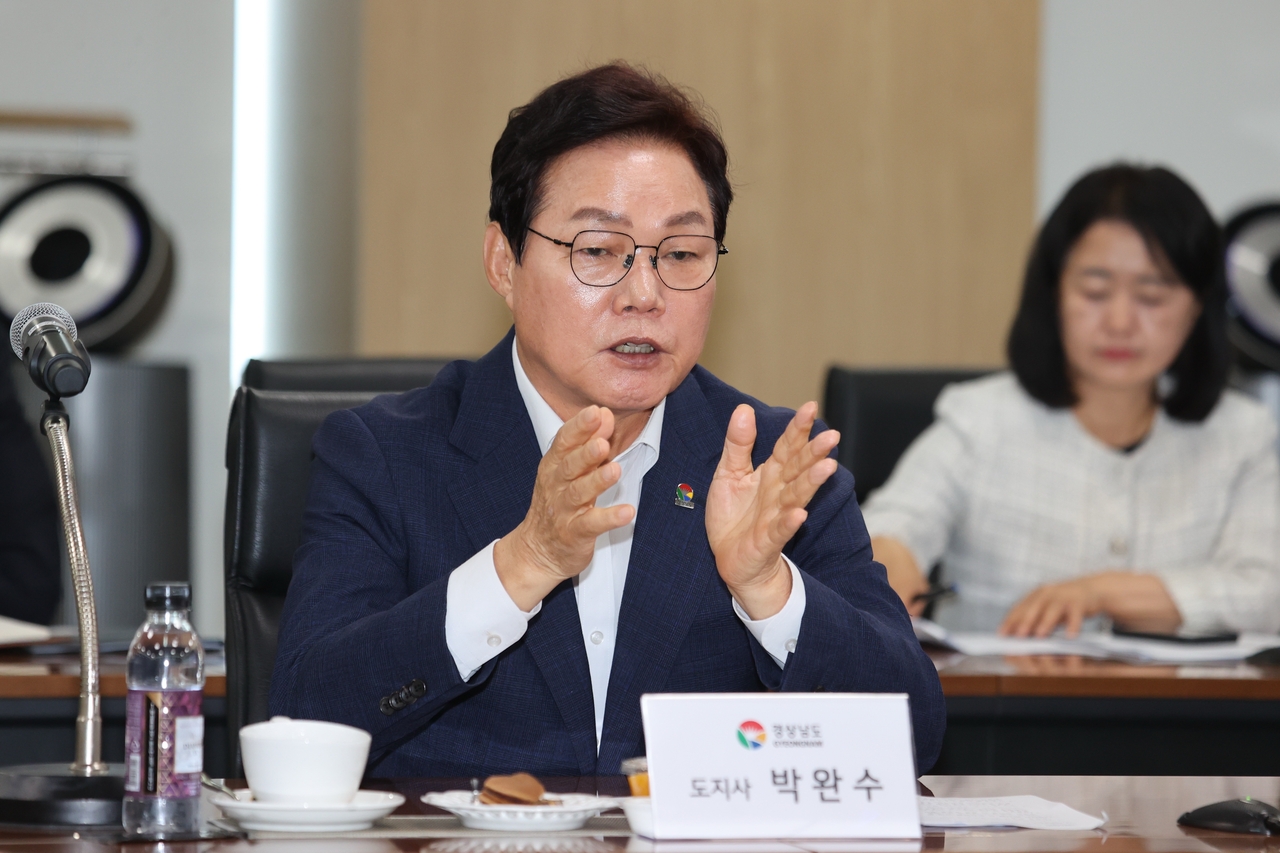
South Gyeongsang Province's ninth elected administration under Gov. Park Wan-soo launched Tuesday under the banner "A Great Leap Forward for South Gyeongsang, Together with Its People." After paying his respects at the National March 15 Democratic Cemetery and the Loyalty Tower, Park held a provincial vision ceremony attended by some 700 residents, pledging to "focus the province's full capacity on translating the industrial foundation built during the eighth elected administration into jobs and tangible improvements in people's livelihoods."
The centerpiece of Park's early agenda is "physical AI" — the integration of artificial intelligence into manufacturing. The day after his inauguration, on Wednesday, he visited LG Electronics' Changwon Smart Park, touring production lines where AI-powered quality inspection systems and autonomous transport robots are already in operation, and discussed ways to extend the technology across the province's broader manufacturing sector.
South Gyeongsang Province plans to sharpen the competitiveness of its core industries — defense, shipbuilding, aerospace and nuclear power — while cultivating physical AI and small modular reactors as future growth engines. The province aims to build a full-cycle industrial ecosystem combining AI and robotics through smart factories and AI-enabled plants, and to spread LG Electronics' co-prosperity smart factory model as a foundation for manufacturing innovation that allows large enterprises and small and medium-sized enterprises to grow together.
Within the provincial government, there is a sense that Park's administration has entered a stable orbit. As a re-elected governor, he has a precise grasp of the province's direction and pressing issues, and the composition of the provincial assembly reinforces that position. The People Power Party holds 44 of 68 seats in the 13th South Gyeongsang Provincial Assembly, giving the administration strong legislative momentum to advance its key campaign pledges and push through budget bills.
Tensions between the ruling and opposition parties over the assembly's floor organization remain a concern, however. The PPP has signaled it intends to elect the speaker and standing committee chairs unilaterally. With the assembly at risk of operating as a one-way street, Park's ability to foster cooperation and communication across party lines has become critical — and observers say the burden on him has grown accordingly. Connecting provincial achievements to livelihood outcomes that residents can feel directly, such as youth employment and small and medium-sized enterprise growth, is also a central task for the ninth elected administration.
While the internal picture looks relatively stable, the external dynamics surrounding the southeastern region have emerged as a new set of challenges. As the province pursues its core vision in aerospace, defense and nuclear power, closer cooperation with Busan and Ulsan has become essential. The most immediate external priority is administrative integration with Busan. The two jurisdictions jointly submitted a special bill on Busan-South Gyeongsang administrative integration to the National Assembly in April. If the bill clears the Assembly, further steps — including a public referendum — still lie ahead.
The political landscape has shifted since the ninth elected administration took office, however. Park must now establish a fresh working relationship with Busan Mayor Jeon Jae-soo on the integration question, and the two sides are expected to need considerable time to align their differing positions. Adding to the uncertainty, the central government signaled shortly after the June 3 local elections that further administrative mergers would be difficult to pursue before the next round of local elections, casting doubt on both its commitment and the prospect of budgetary support.
South Gyeongsang Province's position is that any integration that cedes the province's initiative would yield little benefit, given its solid manufacturing base and independent growth potential. Ultimately, Park faces a structural challenge: carefully coordinating positions with the newly launched Busan city government while also effectively drawing out policy decisions and administrative support from the central government.
"Re-election and an opposition-majority assembly are strengths, but they must be premised on governance that genuinely incorporates the voices of the ruling party and residents," a local political insider said. "Along with the internal task of connecting new-industry achievements to people's livelihoods, external capabilities — securing government support and gaining the upper hand in the administrative integration talks with Busan — will ultimately determine whether South Gyeongsang's great leap has real substance."
ook967@heraldcorp.com