Anthropic follows Tesla in signaling foundry partnership with Samsung
2nm process competitiveness on display, with more orders expected
Taylor, Texas factory set to begin full operation next year
TSMC supply bottlenecks open door for Samsung as credible alternative
![An aerial view of Samsung Electronics' new foundry factory in Taylor, Texas. [Getty Images]](https://wimg.heraldcorp.com/news/cms/2026/07/03/news-p.v1.20260703.c7f375a3e32646ca87ab02920544ff28_P1.jpg)
Samsung Electronics is edging closer to securing a chip manufacturing order from US AI company Anthropic, fueling growing optimism about a turnaround at its foundry division.
Industry watchers have described the ongoing discussions with Anthropic over a 2-nanometer process as an encouraging sign. If the talks result in an actual order, Samsung Electronics stands to gain momentum in winning additional customers by demonstrating the competitiveness of its 2nm process technology.
The potential deal also positions Samsung Electronics as a credible alternative at a time when AI chip orders are flooding into TSMC, the world's top foundry, causing supply bottlenecks — a dynamic that could translate into higher sales and improved profitability for Samsung.
According to foreign media reports and industry sources, Anthropic — best known for its generative AI model Claude — is finalizing details to have Samsung Electronics manufacture its proprietary AI chips.
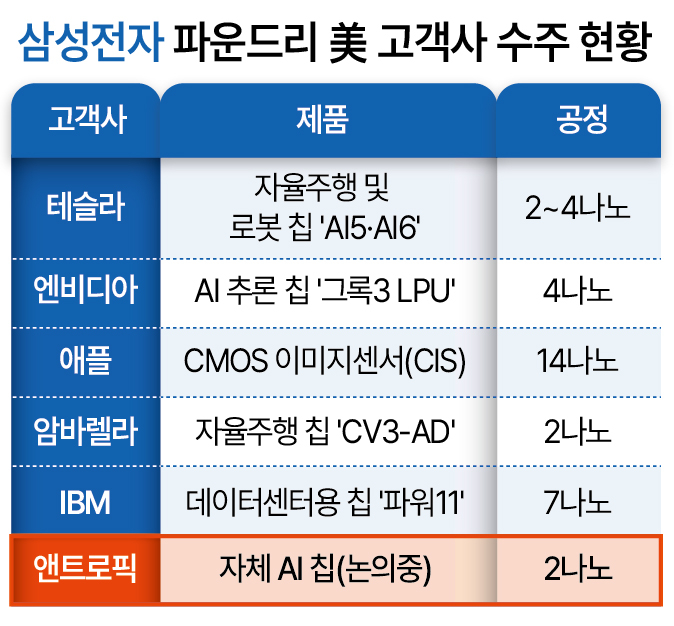
Samsung Electronics has recently landed a string of major orders, including Nvidia's AI inference chip, the Groq3 Language Processing Unit, as well as orders from Tesla and Apple, and now appears on the verge of adding yet another major customer to its roster.
Anthropic is a startup that has rapidly climbed the ranks in the generative AI model market, competing against OpenAI, the developer of ChatGPT, and Google, which offers Gemini, by pushing its Claude model to the forefront.
Samsung Electronics had already taken note of Anthropic's growth potential last May, joining SK hynix and Micron as a "strategic infrastructure partner" in an investment round.
Among the three memory chip companies, Samsung Electronics is the only one that also operates a foundry business, which led analysts to predict early on that Anthropic would eventually expand its collaboration with Samsung by entrusting it with the production of its own AI chips.
If Anthropic selects Samsung Electronics as its partner — as the market has widely anticipated — it would be a green light for the foundry division, which is currently fighting to secure additional customers with the goal of returning to profitability by 2028.
Han Jin-man, president and head of the foundry division, said at a recent internal business briefing that "a return to profitability next year looks difficult, but the chances of achieving it by 2028 are high."
The foundry division signed a 22.8 trillion won ($14.7 billion) AI chip supply agreement with Tesla in July last year, and is now banking on the full effect of that order materializing next year as a springboard for a complete recovery the year after.
The new foundry factory Samsung built in Taylor, Texas, is also set to begin full-scale operation in early next year, further raising the prospect of a rebound. The Taylor plant is slated to produce and supply Tesla's AI chips using the 2nm process.
Samsung Electronics is actively highlighting its ability to manufacture chips using leading-edge processes at its US factory as it works to attract additional big-tech customers in the American market.
Landing Anthropic after Tesla would further bolster confidence in the reliability of Samsung's 2nm foundry process, the company believes, giving its US order-winning efforts additional firepower.
At the "Safe Forum 2026" held Tuesday, Samsung Electronics also cited its next-generation 2nm process technology as one of its key innovation strategies for enhancing the product competitiveness of AI chip customers.
As actual orders accumulate, the 2nm process line is expected to grow increasingly active. Samsung Electronics is also developing the base die for its eighth-generation HBM5 high-bandwidth memory using its own foundry's 2nm process.
Having developed the base die for its sixth-generation HBM4 — the first to ship to Nvidia in mass production in February — using an in-house 4nm foundry process, Samsung is now applying the more advanced 2nm node to HBM5 in a bid to widen its technology lead.
Securing external customers while simultaneously expanding internal HBM shipments is expected to contribute to improved profitability at the foundry division going forward.
"Samsung Electronics will earn recognition from the market as a genuine alternative to TSMC by winning the Anthropic order," an industry official said. "It could serve as the starting gun for the revival of Samsung's foundry business, which has been struggling for some time."
joze@heraldcorp.com