'Seoul Medical Tourism Policy Forum' held Wednesday
Discussions cover VAT refund system, visa rules, advertising regulations
Experts stress quality growth combining medicine, tourism, beauty and ICT
Permanent public-private council and 'Han River Medical Tourism Belt' proposed
South Korea's medical tourism industry must move beyond simply growing the number of foreign patients and transition toward a high-value ecosystem integrating medicine, tourism, beauty and information and communications technology, experts said Wednesday.
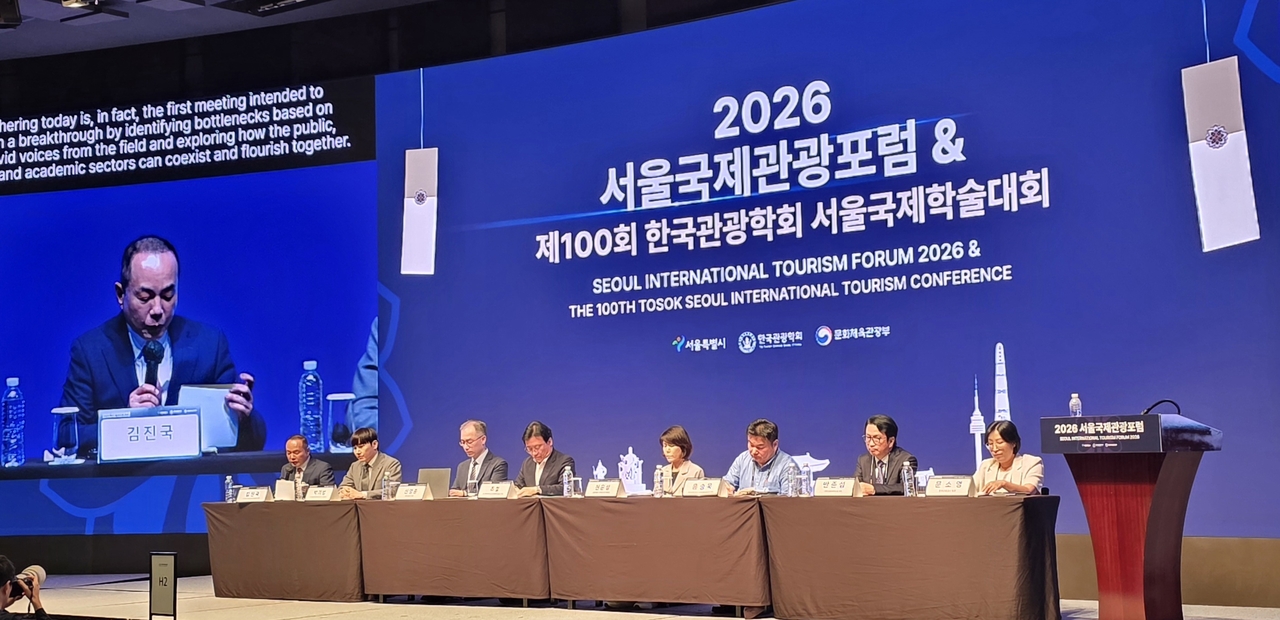
The Seoul Medical Tourism Policy Forum — billed as the K-Medical Tourism Roundtable 2026 — was held at the Grand Ballroom of the Westin Chosun Hotel in Jung-gu, Seoul.
The forum was organized as a special session of both the 100th International Academic Conference of the Korea Tourism Research Association and the 2026 Seoul International Tourism Forum. Co-hosted by the Korea Tourism Research Association and the Korea Medical Tourism Promotion Association, it brought together officials from the government, the Seoul Metropolitan Government, related agencies, the medical sector, the tourism industry and foreign patient recruitment firms to discuss South Korea's global competitiveness in medical tourism and the regulatory reforms needed to strengthen it.
Despite recent growth in foreign patient numbers, participants identified several structural problems: an overconcentration of patients in the skin care and plastic surgery sectors and in the Greater Seoul area, the expiration of the VAT refund system for foreign patients, restrictions on visa issuance and medical advertising, management of recruitment agencies, and the handling of illegal brokers and medical disputes.
Kim Jin-guk, chairman of the Korea Medical Tourism Promotion Association, delivered the keynote address on enhancing Seoul's global competitiveness in medical tourism and ensuring the long-term sustainability of its ecosystem.
Kim said medical tourism should be treated not as an industry confined to hospitals and foreign patient recruitment agencies, but as a comprehensive service industry linking upstream and downstream sectors — including tourism, accommodation, beauty, finance and ICT. He also proposed establishing a permanent public-private-academic consultative body through which the government, the Seoul Metropolitan Government, public institutions, the medical community, platforms and recruitment firms could continuously share on-the-ground perspectives.
The forum also introduced a concept for a "Han River Medical Tourism Belt" connecting Gangnam and the areas north of the Han River. The idea is to link medical facilities with tourism, shopping and cultural content centered on the Han River, extending foreign patients' length of stay and boosting their spending while building a medical tourism brand unique to Seoul.
Hong Seung-wook, head of the foreign patient recruitment division at the Korea Health Industry Development Institute, presented the achievements of the foreign patient recruitment industry and outlined a path forward under the theme of a new leap for South Korea's medical tourism sector.
Hong said the industry needs a qualitative growth strategy focused on attracting high-value patients and maximizing the economic ripple effects of medical tourism, rather than simply increasing patient numbers. He also proposed building a self-sustaining industrial ecosystem connecting medicine, tourism, pharmaceuticals, medical devices, finance and digital healthcare, and expanding the reach of foreign patients beyond the Greater Seoul area through regionally specialized medical tourism offerings.
Ban Jun-seop, chairman of the Korean Society of Plastic and Reconstructive Surgeons, presented on the competitiveness and on-the-ground challenges of the K-plastic surgery sector. Ban said the concentration of plastic surgery clinics, specialists and related services in the Gangnam and Seocho areas — a cluster he called the "K-Plastic Surgery Valley" — gives South Korea a globally distinctive competitive edge.
However, he said the expiration of the VAT refund system for foreign patients has raised the out-of-pocket cost of procedures, potentially weakening the price competitiveness of medical institutions and recruitment agencies. He added that some cosmetic and plastic surgery clinics had seen a decline in foreign visitors compared with the previous year since the system ended.
Shin Young-jong, chief executive of Mediround, outlined the practical difficulties foreign patients encounter throughout their entire journey — from arriving in the country and consulting with doctors, to receiving treatment, sightseeing and departing. He said the fragmentation of booking, payment, interpretation and follow-up care, combined with information asymmetry and an opaque fee structure, risks eroding market trust.
Participants call for VAT refund system reform, other policy changes
The subsequent roundtable was chaired by Kim Jin-guk and included Hong Seung-wook, Ban Jun-seop, Shin Young-jong, Moon So-yeon, head of the medical wellness team at the Korea Tourism Organization, Park Ki-beom, co-chief executive of Healing Paper, Ju Cheol, director of the overseas health industry expansion division at the Ministry of Health and Welfare, and Hyeon Yun-seong, head of the tourism industry support team at the Seoul Metropolitan Government.
Participants identified key areas for reform: the VAT refund system for foreign patients, visa application procedures, medical advertising regulations, accreditation of recruitment agencies, management of illegal brokers, and the framework for handling medical accidents and disputes. They also called for a medical tourism control tower and a permanent communication channel to coordinate policies pursued by individual ministries and agencies.
Participants further urged a shift away from treatment-focused medical tourism toward an integrated model combining wellness, culture, shopping and sightseeing, with the aim of increasing return visits and extending foreign patients' length of stay. A regionally cooperative model was also proposed — one that would connect Seoul's medical tourism infrastructure with specialized local resources such as hot springs, coastal areas and forests.
The forum's discussions centered on the need to move beyond competing on patient numbers alone, and instead raise the quality and trustworthiness of services while strengthening cooperation among related industries — medicine, tourism, beauty and ICT — to put South Korea's medical tourism sector on a path of sustainable growth.
7toy7@heraldcorp.com