Wage talks resume after 20-day break
Company tables first comprehensive offer
Base pay hike at half of union's demand
Performance bonus about 10 million won below last year's deal
Union calls offer 'far short of expectations'
Overtime ban could drag on
![Representatives of Hyundai Motor and its union hold their opening session for this year's wage negotiations at the Ulsan factory on May 6. [Hyundai Motor]](https://wimg.heraldcorp.com/news/cms/2026/07/02/rcv.YNA.20260506.PYH2026050607740005700_P1.jpg)
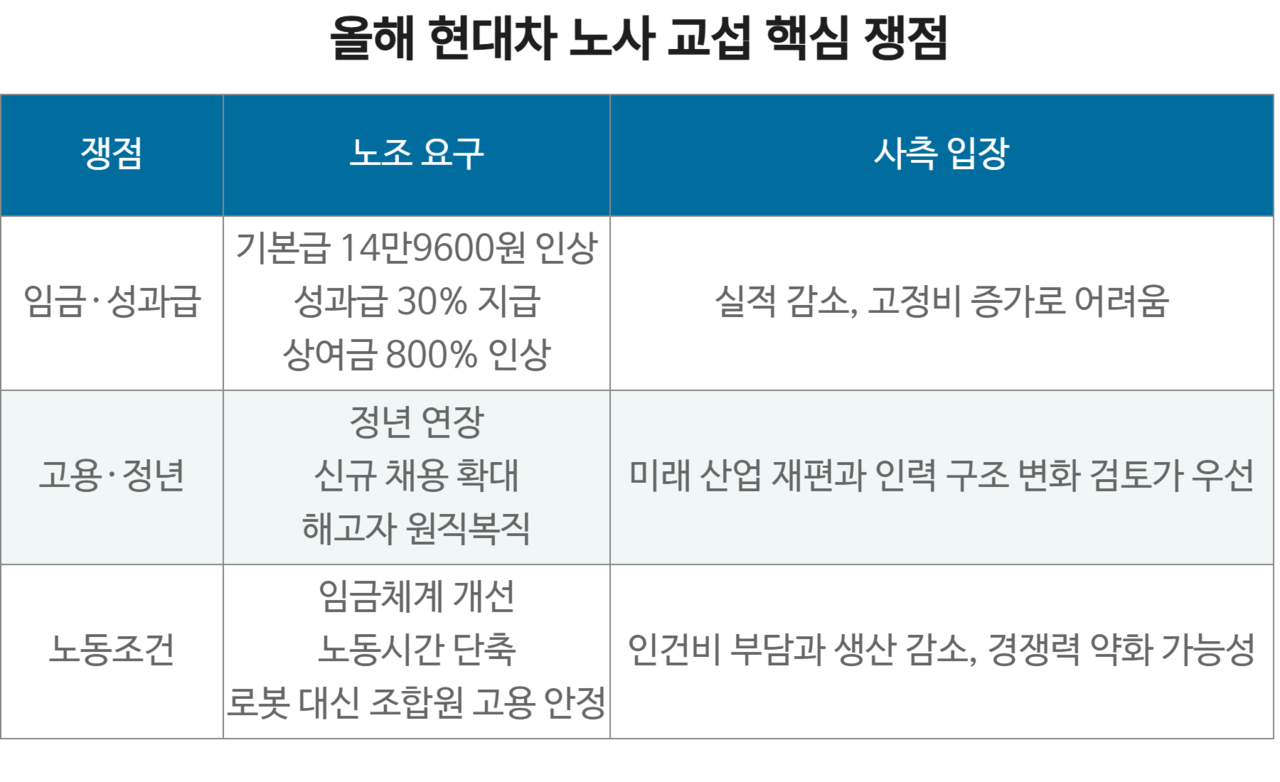
Hyundai Motor has tabled its first comprehensive wage offer of the year, proposing a base pay increase of 79,000 won ($51) per month alongside a performance bonus package of 350 percent of base salary plus 9 million won in cash and 10 shares of company stock. The offer is just over half the 149,600-won monthly raise the union has demanded. The company also declined to meet the union's central demand — a performance bonus equal to 30 percent of last year's net profit. The union immediately fired back, saying the proposal "falls far short of expectations."
Hyundai Motor and its union held their 12th round of wage negotiations at the Ulsan factory on Wednesday. The session resumed talks roughly 20 days after the union declared negotiations had broken down on June 12, when it said management had failed to put forward a concrete offer at the 11th round. Earlier, Hyundai Motor CEO Choi Young-il visited the union office on June 29 to convey his intention to restart the stalled talks.
The wage package management presented Wednesday calls for a 79,000-won monthly base pay increase and a performance bonus of 350 percent of base salary plus 9 million won in cash and 10 shares of stock. It is the first formal comprehensive offer the company has put on the table this year.
The gap with the union's demands, however, remained wide. The union is seeking a 149,600-won monthly base pay increase. Management's offer of 79,000 won amounts to 52.8 percent of that figure — 70,600 won less per month.
The two sides were equally far apart on performance bonuses. The union has demanded a bonus equal to 30 percent of last year's net profit. Based on Hyundai Motor's net profit of 10.36 trillion won last year, 30 percent would come to roughly 3.11 trillion won. Divided equally among the company's 73,335 domestic employees as of the end of last year, that works out to roughly 42.4 million won per person.
Management's offer combines a 350-percent performance bonus, a 9-million-won lump sum, and 10 shares of stock. The 350-percent bonus translates to roughly 18.8 million to 26.6 million won per employee depending on individual pay structures. Adding the 9-million-won lump sum and the value of 10 shares — worth about 4.82 million won based on Wednesday's closing price of 482,000 won per share — the total performance-related compensation under the company's proposal comes to an estimated 32.6 million to 40.4 million won per person.
That is up to about 10 million won less per person than the roughly 42.4 million won the union's 30-percent profit-sharing formula would yield.
The gap between the two sides remains wide on another front as well: management declined to adopt the union's preferred method of tying bonuses to net profit, instead keeping the existing formula that links performance pay to base salary.
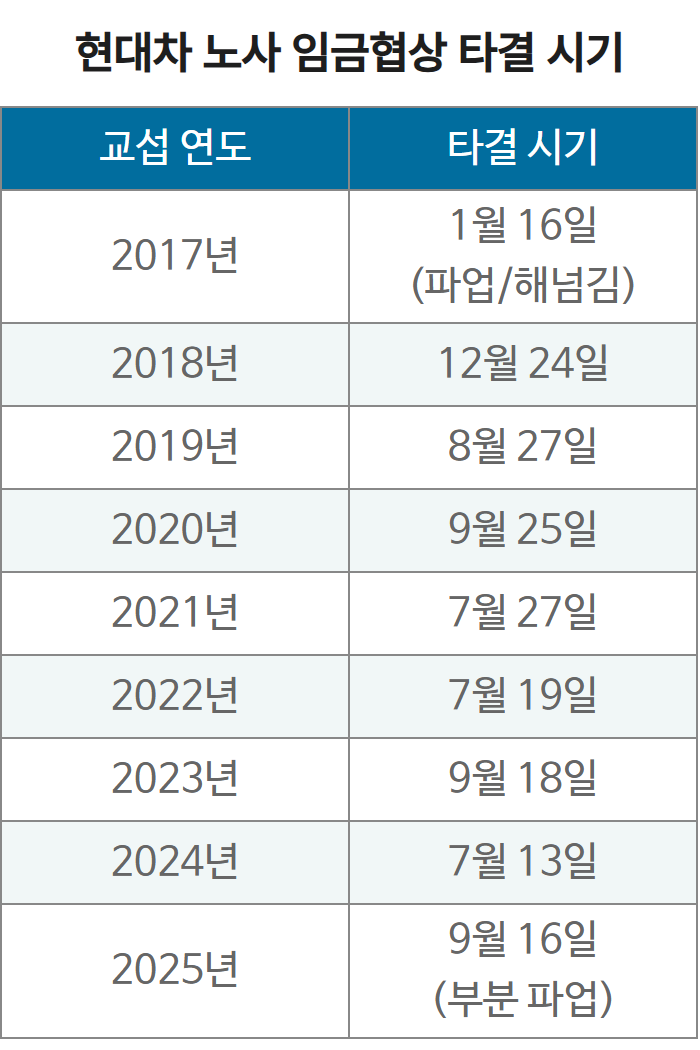
This year's offer also falls short of last year's final tentative agreement. In 2025, Hyundai Motor and its union settled on a 100,000-won monthly base pay increase, a performance and incentive bonus of 450 percent plus 15.8 million won in cash, and 30 shares of stock.
Even accounting for the fact that this is an opening offer, the base pay increase is 21,000 won below last year's agreed amount, the performance bonus is down 100 percentage points, the cash lump sum is 6.8 million won less, and the stock grant is 20 shares fewer.
The company's proposal focuses solely on wage-related items, as this round is a wage negotiation. Non-wage demands the union has put forward separately — including an extension of the retirement age, employment and working-condition guarantees tied to AI adoption, new hiring, and shorter working hours without increased workloads — were not included in the offer.
The union made clear it cannot accept the proposal. Lee Jong-cheol, head of the Hyundai Motor union chapter, said at Wednesday's session that "a fair distribution of the fruits of our labor must be achieved" and that the company's offer was too thin on wage substance to meet members' expectations. He called on management to come back with a more forward-looking proposal at the next session.
Hyundai Motor CEO Choi said resuming talks and wrapping them up quickly on the basis of mutual trust and respect was important, and pledged to do his best to ensure smooth negotiations. He also asked the union to take the current business environment into account, saying the offer represented the best the company could do given present conditions.
Negotiations are now likely to remain difficult for some time. While management's first offer has reopened the door to talks, the two sides remain far apart on both the size of the base pay increase and the method for calculating performance bonuses. With the union judging the offer to be below what its members expect, the overtime and weekend work ban could also drag on longer.
The union has already voted to refuse overtime and Saturday work starting July 6, exempting only work covered by essential agreements. If management fails to table a meaningfully improved offer at the next session or the two sides cannot narrow their differences, the union is expected to consider extending the work ban or escalating to a partial strike.
The union has also secured the legal right to strike. On June 24, members voted 92.03 percent in favor of industrial action among those who cast ballots, with 86.65 percent of all eligible members voting yes. The following day, the National Labor Relations Commission ruled that the gap between the two sides was too wide to bridge through mediation and suspended its conciliation process, clearing the way for a legal strike.
The prospect of a prolonged work ban and a potential strike is a serious concern for Hyundai Motor. Production and sales were already under pressure in the first half of this year due to parts supply disruptions, recalls, and logistics burdens stemming from instability in the Middle East. With a string of major new model launches — including the new Avante, the new Tucson, the GV80 facelift hybrid, and the Genesis flagship electric SUV GV90 — scheduled for the second half, minimizing production disruptions has become critical.
kwater@heraldcorp.com