Study to analyze social value of free transit and propose cost-sharing framework among national, local and operator levels; findings to be made public through National Assembly policy forum in September, with push to pass pending Urban Railway Act amendment
Six urban railway operators across the country, which have absorbed hundreds of billions of won in annual free-ride losses, are joining forces on a research project aimed at establishing a legal basis for government support.
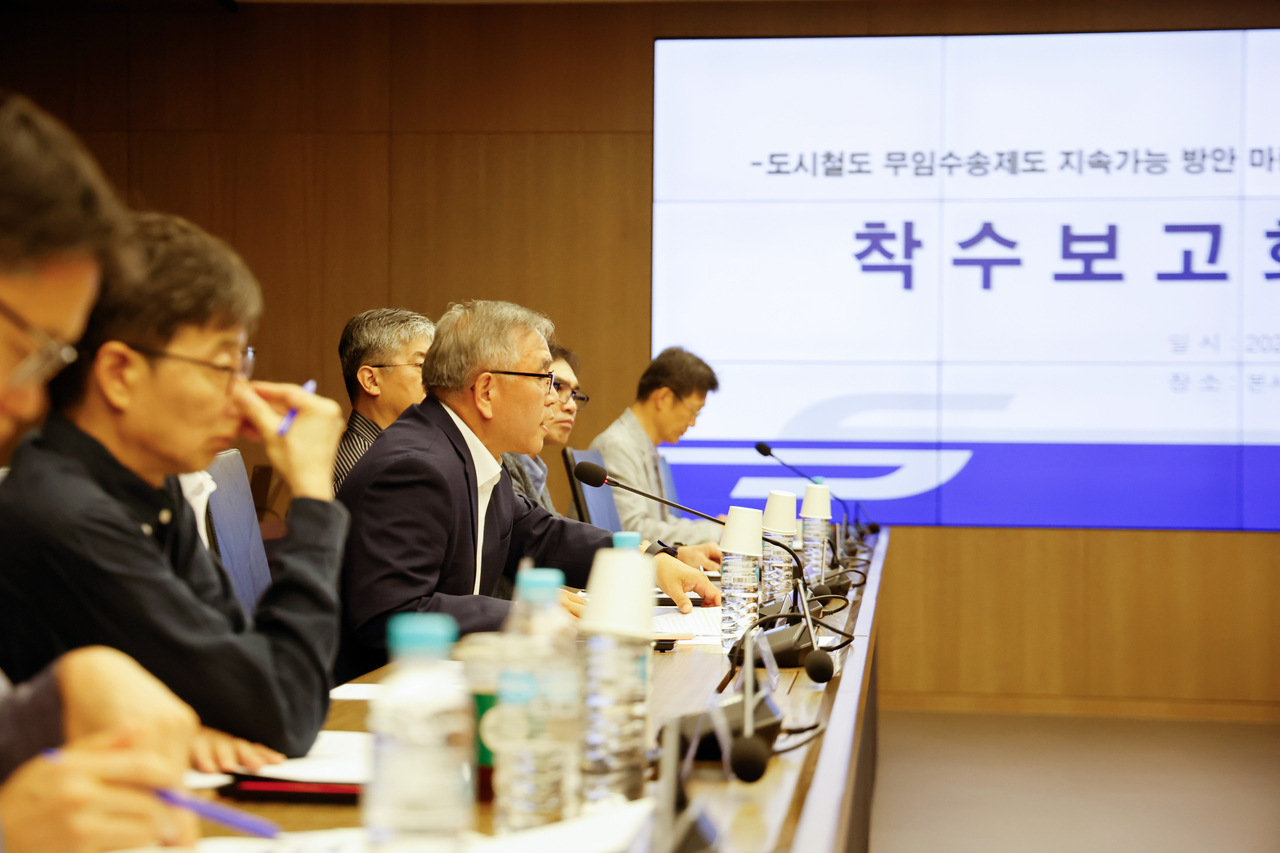
Seoul Metro said it held a kickoff briefing Wednesday afternoon at its headquarters for a jointly commissioned study titled "Research on Sustainable Solutions for the Urban Railway Free-Ride System." The briefing began at 2 p.m.
The six urban railway operators — Seoul, Busan, Daegu, Incheon, Gwangju and Daejeon metro corporations — are sharing the research costs under a consolidated contract arrangement.
The study is designed to develop a rigorous analytical framework and concrete action plan to persuade the government to cover free-ride losses with national funds.
The key tasks include a comparative analysis of domestic and international public service obligation regimes for public transit, an objective assessment of the operators' fiscal conditions and the causes of their deficits, a social-value and cost-benefit analysis of free-ride service, and simulations and a roadmap for cost-sharing arrangements among the national government, local authorities and the operators.
Specifically, the study will isolate free-ride losses from fare structures that fall below operating costs in order to clearly identify the sources of the deficit. It will also analyze the scope of free-ride beneficiaries and cost-benefit ratios in light of the government's balanced regional development policy and the trend toward expanded urban rail networks, comparing the scale of losses against social benefits.
The approach also responds to a call made at a May expert forum hosted by the National Assembly Research Service, which urged researchers to clearly identify the causes of deficits and obtain specific figures for each policy alternative. The six operators plan to use the study to produce objective and workable alternatives.
Reference: National Assembly Research Service, NARS Brief No. 163 (May 24, 2026).
The Korea Transport Institute, which is conducting the research, plans to carry out the study over approximately four months — beginning with the kickoff report in July, followed by interim reports in August and September, and a final report in October.
Immediately after the kickoff briefing, labor and management representatives from the six operators held a joint working-level meeting to discuss follow-up measures.
The findings will be made public through a National Assembly policy forum and other channels in the second half of the year. The operators plan to build public consensus and push for the swift passage of a pending amendment to the Urban Railway Act.
Amendments to the Urban Railway Act to secure national funding for free-ride losses have been repeatedly introduced and scrapped since the 17th National Assembly. In November 2025, a public petition to the National Assembly calling for legislation to cover free-ride losses reached 50,000 signatures ahead of schedule, confirming broad public support. An amendment that would make national compensation for free-ride losses a mandatory provision is currently pending before the Land and Transport Committee.
The urban railway free-ride system was introduced in 1980 as a national transportation welfare policy. Under laws including the Welfare of Older Persons Act, passengers aged 65 and older, people with disabilities and national merit recipients ride free of charge. However, because there is no legal basis for compensating operators for those losses, the operators have had to absorb the costs themselves.
By contrast, sections of the same urban rail network managed by Korail receive annual national reimbursement for free-ride losses under the Framework Act on Railroad Industry Development.
As South Korea enters a super-aged society, free-ride losses are mounting rapidly. The combined free-ride losses of the six operators jumped from 445.6 billion won ($287 million) in 2020 to 775.4 billion won in 2025 — roughly 1.7 times the earlier figure in just five years.
According to population projections from the Ministry of Statistics, the share of the population aged 65 and older is forecast to rise from 21.2 percent in 2025 to 25.3 percent by 2030, meaning one in four South Koreans will be elderly.
Han Yeong-hui, head of Seoul Metro's planning division, said the urban railway free-ride system has guaranteed the mobility of transit-dependent passengers for more than 40 years as a national transportation welfare policy, but that shifting the cost burden entirely onto operators has depleted the funds needed for safety facility investment. "Through this research project, we will do our utmost to develop a rational cost-sharing framework under which the national government, local authorities and operators can all benefit, and to ensure that national funding support is secured without fail," Han said.
seouldream01@heraldcorp.com