Three core directions — resident communication, timeline reduction and intensive management — underpin nine strategic initiatives
Redevelopment, reconstruction and Moa Town projects to advance rapidly in pursuit of a livable, happy Gwangjin
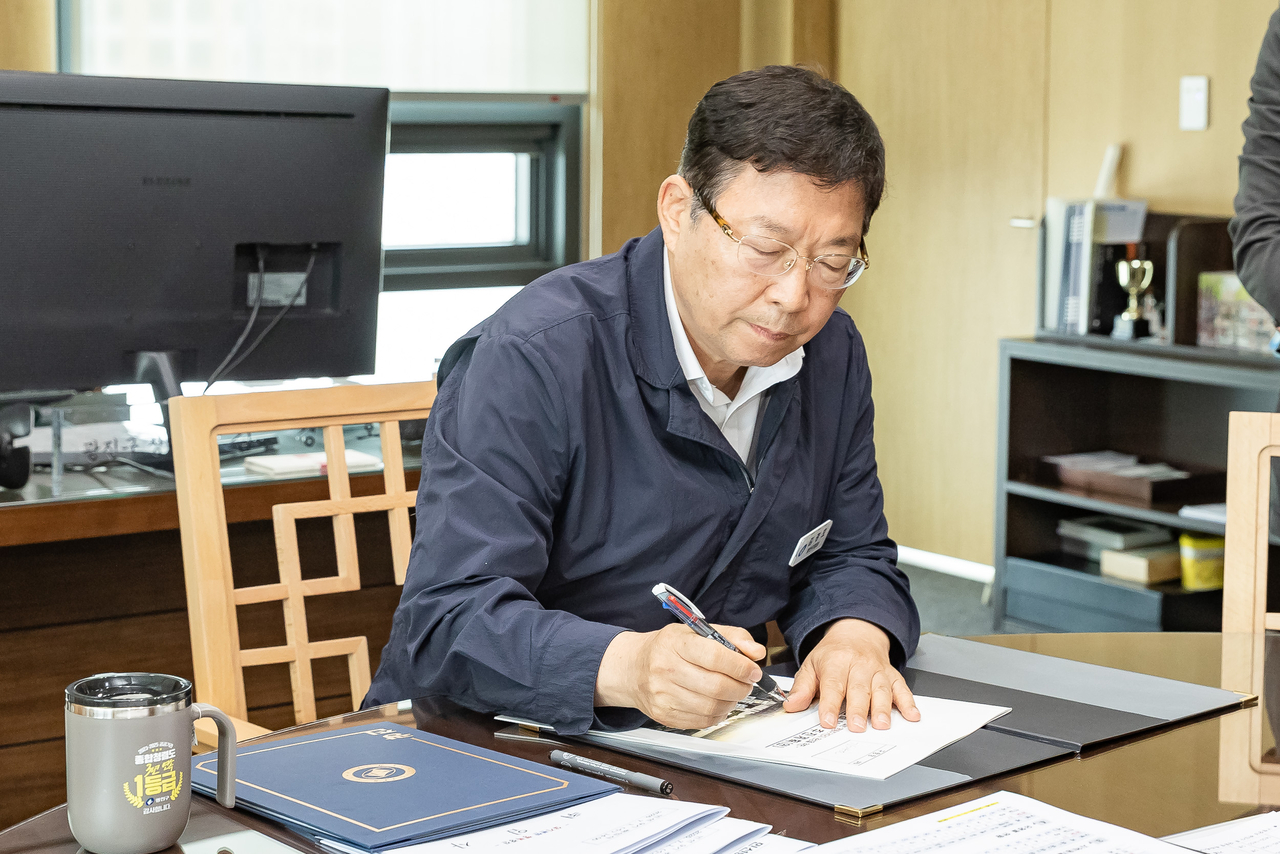
Gwangjin-gu District Mayor Kim Kyung-ho signed the "Residential Improvement Project Implementation Plan for the Completion of a Premium Residential Complex" on Tuesday as his first official act of the ninth elected term, marking the opening policy move of his new administration.
The approval sets out the core policy direction for the ninth term: accelerating redevelopment, reconstruction and Moa Town residential improvement projects in a systematic manner to build a premium residential complex, strengthen the district's urban competitiveness and realize a "livable, happy Gwangjin."
To sharpen execution of residential improvement projects, the district office plans to move quickly on three core directions — resident communication, timeline reduction and intensive management — with the aim of delivering housing environment improvements that residents can feel directly.
To boost resident participation and expertise, the district will expand its improvement project academy and operate zone-specific consultation centers staffed by specialists on a permanent basis. It also plans to hold outreach information sessions targeting low-rise residential areas with redevelopment potential, deepening residents' understanding of the projects and laying the groundwork for medium- and long-term improvement work.
In addition, the district office will restructure its organization to strengthen dedicated improvement project functions. Large-scale projects will be handled exclusively by the Housing Projects Division, while Moa Town and small-scale improvement projects will fall under a newly established Moa Housing Division, raising both the expertise and efficiency of project delivery.
The district will also build a rigorous progress-management system using the Seoul Metropolitan Government's standard processing deadline framework and will hold regular improvement project status review meetings to monitor each stage of development closely. An inter-district process innovation council will be operated to share best practices and continuously identify ways to shorten project timelines.
For project sites experiencing conflict or delays, the district will activate an intensive management system. The district mayor will hold regular on-site meetings to communicate directly with residents, and a communication forum with project stakeholders will be run to actively resolve difficulties encountered during the process. The Seoul Metropolitan Government's conflict management officer and Gwangjin-gu's improvement project advisory support team will also be dispatched to individual sites to provide tailored advice and conflict mediation.
Through this implementation plan, Gwangjin-gu is targeting ground-breaking at 23 project sites — approximately 19,000 households — and completion at 11 sites — approximately 3,000 households — by 2030. On that foundation, the district aims to improve aging residential environments and expand the supply of quality housing, building Gwangjin into a more livable city.
"The ninth elected term is a critical period for Gwangjin's future, and we will improve residents' quality of life through residential improvement projects carried out with real momentum," Kim said. "We will communicate constantly with residents, resolve on-site conflicts swiftly, and do our utmost to create a premium residential city where everyone wants to live — a livable, happy Gwangjin."
seouldream01@heraldcorp.com