
Union sets overtime ban starting Monday as pressure tactic
Overtime and Saturday shifts suspended except under essential agreements
Talks to resume Wednesday, with strike level to hinge on management's offer
Bonuses, retirement age, AI job security remain key sticking points
![Hyundai Motor union members hold a rally to kick off this year's wage negotiations on the lawn in front of the main building of the Ulsan factory on May 13. [Yonhap]](https://wimg.heraldcorp.com/news/cms/2026/06/30/rcv.YNA.20260513.PYH2026051318710005700_P1.jpg)
The Hyundai Motor union will begin refusing overtime shifts next week as wage negotiations stall. The two sides have agreed to resume talks this week, signaling a period of parallel pressure and bargaining ahead.
According to industry sources Tuesday, the Hyundai Motor branch of the Korean Metal Workers' Union convened its central dispute committee that day and decided to halt overtime and Saturday shifts starting Monday. The union said it would suspend all extra work except shifts required under essential agreements, using the move to squeeze management.
In a union newsletter, the branch said it would "crush the company with a powerful show of force and overwhelming crisis" and "advance without wavering toward victory in collective bargaining." The union also said it would respond immediately if management engaged in unfair labor practices such as inducements or threats.
The overtime refusal is a pressure tactic short of a full strike. Hyundai Motor has relied on weekend shifts at some lines of its Ulsan factory to meet production targets. With output and sales already under strain in the first half of the year from parts shortages, recalls and logistics burdens, a halt to overtime could complicate the company's plans to recover utilization rates in the second half.
The Ulsan factory had originally scheduled weekend overtime across its lines throughout July. Plant 1's Kona and Ioniq 5 lines had four to five sessions each planned; Plant 2's GV70, GV80, GV60, Santa Fe and Palisade lines had four sessions each; and Plant 3's Avante, Kona and Tucson lines also had four sessions scheduled. Plant 4's Palisade and Staria lines had five sessions planned, the Porter line two, and Plant 5's G90, G80, G70, Palisade, Tucson and Nexo lines had three to four sessions each on the calendar.
The union has decided not to launch an immediate strike and will continue negotiations. Hyundai Motor's labor and management are set to resume wage talks Wednesday — about 20 days after the union declared the talks broken down on June 12, when it said management had failed to present a separate proposal at the 11th round of bargaining.
Earlier, Hyundai Motor CEO Choi Young-il visited the union office Monday to convey his intention to restart the suspended talks. Management communicated its desire to resume negotiations quickly and minimize production disruptions, citing last year's decline in operating profit and the earnings pressure in the first half of this year.
The union has already secured the legal right to strike. On June 24, a strike authorization vote passed with 92.03 percent support among those who voted and 86.65 percent of all eligible members. The following day, the National Labor Relations Commission ruled that the gap between the two sides was too wide to bridge and suspended its mediation, formally granting the union the right to strike.
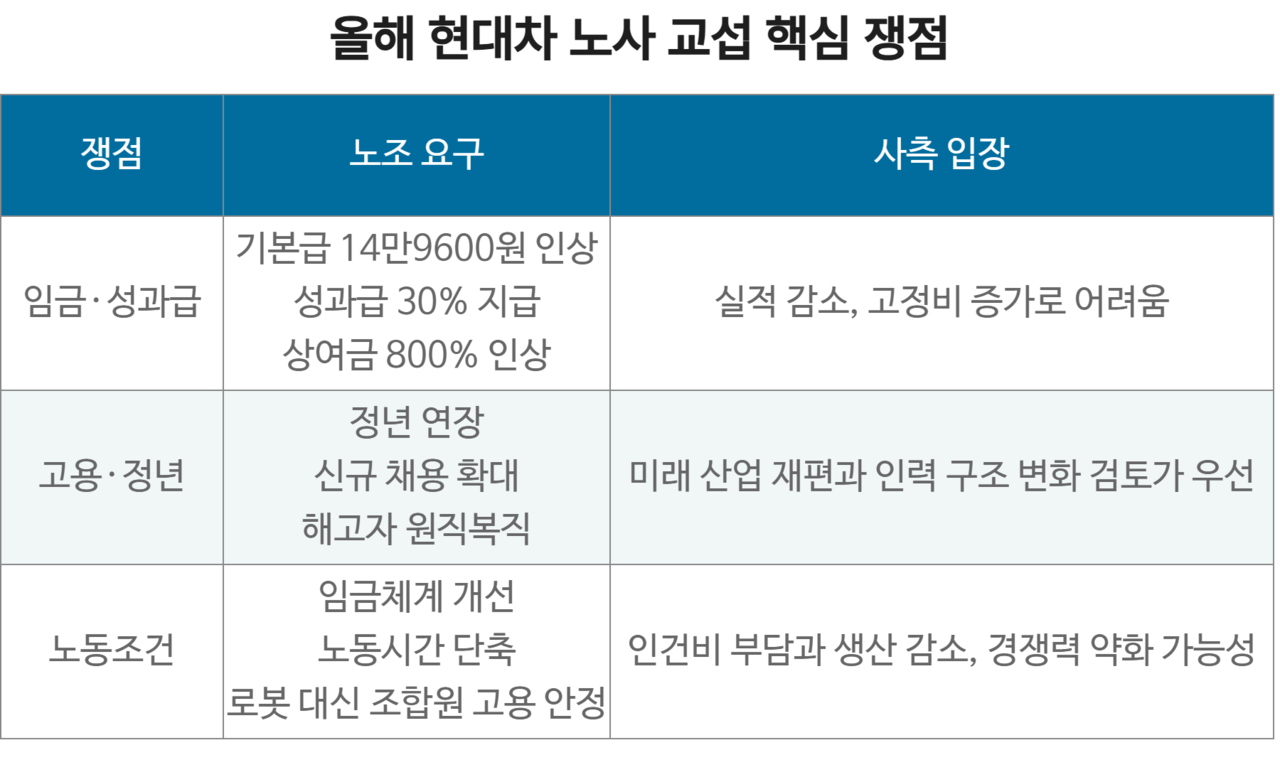
The central issues in this year's negotiations are wage increases, job security and the response to industrial transition. The union is demanding a monthly base pay raise of 149,600 won ($97), a performance bonus equal to 30 percent of last year's net profit, and guarantees on employment and working conditions in the face of AI adoption. Its demands also include a full monthly salary system, an increase in bonuses from 750 percent to 800 percent, shorter working hours without intensified workloads, an extension of the retirement age tied to the national pension eligibility age, and new hiring.
Management says it must account for global economic uncertainty, potential sales volatility and rising fixed costs. It has also stressed that changes to the production system and workforce efficiency are unavoidable as the company transitions toward electrification and AI-driven automation.
Even after securing strike rights in past years, the union has often used the threat as leverage to reach a tentative agreement without actually walking out. This year, however, analysts say the negotiations are unusually complex, with disputes extending beyond wages to retirement age extension, AI job guarantees, and plans to reconstruct domestic factories and restructure production.
The union plans to convene its next central dispute committee on July 8 to reassess its course of action based on the progress of talks and any proposals management puts forward.
kwater@heraldcorp.com



