
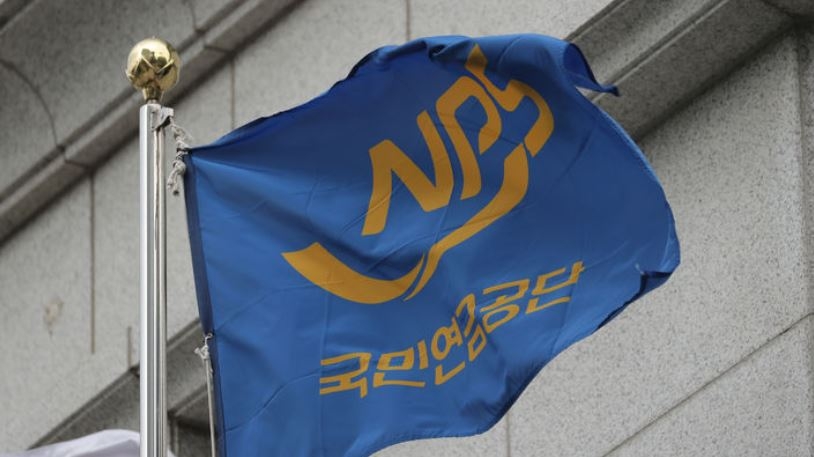
Markets are closely watching the impact on domestic stock supply and demand as the National Pension Service prepares to resume rebalancing its domestic equity holdings next month. Concerns are growing that potential selling of up to 74 trillion won ($48 billion) could amplify short-term volatility if it coincides with continued foreign selling.
According to Daishin Securities, the national pension fund's domestic equity allocation stood at approximately 30 percent as of June 26, based on the Kospi's closing price of 8,411.21 that day. That is 9.2 percentage points above its target allocation of 20.8 percent for this year. With the Kospi slipping only 0.2 percent the following session, analysts said the fund's allocation likely remains at a similar level.
The National Pension Service conducts rebalancing under its medium- and long-term asset allocation plan, adjusting the weighting of each asset class toward its target. When a particular asset's share deviates significantly from the target, the fund sells the excess or buys underweighted assets. The mechanism allows the fund to lock in gains during market rallies and accumulate assets during downturns, supporting long-term returns and portfolio stability.
The sharp rise in the Kospi this year prompted the fund's investment committee to convene in January and temporarily suspend rebalancing through the end of June. Last month, the fund raised its domestic equity target allocation from 14.9 percent to 20.8 percent and widened the permitted band under its strategic asset allocation from plus or minus 3 percentage points to plus or minus 6 percentage points. An additional tactical asset allocation allowance of plus or minus 2 percentage points brings the maximum permitted range to plus or minus 8 percentage points.
Those adjustments raised the upper limit on domestic equity holdings to as much as 28.8 percent. Even so, Daishin Securities estimated that the fund's current domestic equity holdings exceed its target by about 164 trillion won. Even if the fund uses the full 6-percentage-point strategic asset allocation band, it would still need to sell roughly 57.06 trillion won worth of domestic shares.
Deploying the tactical asset allocation allowance in full would reduce the estimated selling requirement to around 21 trillion won. Market sources said the pension fund is considering not making full use of the tactical allocation buffer.
Shinyoung Securities also warned in a recent report that if the Kospi surpasses 9,000, the fund may need to sell as much as 74.4 trillion won in domestic equities.
Without applying the tactical asset allocation — leaving the permitted domestic equity ceiling at 26.8 percent — the estimated selling requirement would be about 27.9 trillion won at a Kospi level of 8,000, rising to 51.2 trillion won at 8,500 and 74.4 trillion won at 9,000. Should the index climb to 9,500, the required selling would reach 97.7 trillion won, and at 10,000 it would swell to 120.9 trillion won.
Conversely, if the fund fully deploys its 2-percentage-point tactical asset allocation allowance, it would actually have room to make net purchases of 7.9 trillion won at a Kospi level of 8,000. At 9,000, the estimated selling requirement would shrink to 37.3 trillion won, falling further to 59.9 trillion won at 9,500 and 82.6 trillion won at 10,000.
"If the Kospi exceeds 8,175 points at end of June, the fund's domestic equity holdings are estimated to breach the maximum combined strategic and tactical asset allocation ceiling of 28.8 percent," said Jo Yong-gu, a researcher at Shinhan Securities. "That would lead the National Pension Service to sell domestic equities and buy bonds."
Market participants, however, largely believe the risk of an actual "selling bomb" is limited. Because the fund has reduced the daily scale of rebalancing execution to cushion market impact, analysts expect it to spread sales over an extended period.
"Interpreting this as the National Pension Service dumping a selling bomb in a short period is an overreach," Jo said. "The immediate selling pressure has eased with the index pulling back, and there has already been preemptive movement — the pension fund posted net selling of around 2 trillion won in May and June combined."
He added that the fund has signaled plans to reduce the caps on annual, monthly and daily rebalancing, while the actual scale and pace of execution remain undisclosed, allowing for flexible responses.
National Pension Service Chairman Kim Sung-joo also stressed the principle of minimizing market disruption at an online press briefing on June 23.
"It is well known that while the National Pension Service accounts for about 6 percent of the domestic stock market, its heavy concentration in large-cap stocks means its buying and selling has an outsized impact on the market," Kim said. "We must minimize the shock to the market." He added: "A private investor whose only goal is profit would dump shares and buy back at lower prices, but we will proceed cautiously."
The National Pension Service has been net selling domestic equities for six consecutive months in preparation for the rebalancing resumption, accumulating net sales of 8.7 trillion won over that period.
Samsung Electro-Mechanics was the most heavily sold stock this year, with net selling of 1.32 trillion won, followed by SK hynix at 970.1 billion won, Samsung Electronics at 967.3 billion won and Hyundai Motor at 770.1 billion won.
"The fund is likely to focus selling on semiconductor stocks that have posted steep gains, given their high market cap weighting and strong returns," a financial investment industry official said.
While the rebalancing could act as a near-term supply-demand variable, analysts said the actual market impact could be substantially cushioned depending on the pace and manner of execution. Investors should monitor not just the total selling volume but the actual execution schedule and shifts in supply and demand centered on large-cap semiconductor stocks.
rainbow@heraldcorp.com




