
Income tax and securities transaction tax rise on overseas stock investment and market rally
Cumulative tax revenue through May reaches 199.9 trillion won, up 27.5 trillion won year on year
Collection rate of 48.1% against supplementary budget target exceeds five-year average
![The signboard of the Ministry of Finance and Economy building at the Government Sejong Complex. [Yonhap]](https://wimg.heraldcorp.com/news/cms/2026/06/30/news-p.v1.20260525.07d5a248aa2a49208b5c5577066ec2ef_P1.jpg)
South Korea's national tax revenue for the first five months of this year approached 200 trillion won ($130 billion), rising sharply from the same period last year. The increase was driven by gains in income tax, securities transaction tax and the special tax for rural development, fueled by growing overseas stock investment, a buoyant equity market and improved corporate earnings.
The Ministry of Finance and Economy released its "National Tax Revenue Status for May 2026" on Tuesday, showing cumulative national tax revenue from January through May reached 199.9 trillion won, up 27.5 trillion won from a year earlier. The collection rate against the supplementary budget target of 415.4 trillion won stood at 48.1 percent, outpacing the five-year average of 46.6 percent by 1.5 percentage points.
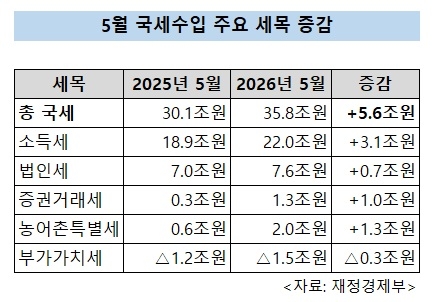
Income tax and securities transaction tax led the revenue gains. Income tax for the January–May period totaled 66.7 trillion won, up 9 trillion won from a year ago, driven by higher wage income tax from expanded performance bonuses, capital gains tax on overseas stock disposals and increased real estate transactions. Income tax for May alone reached 22 trillion won, up 3.1 trillion won year on year.
Securities transaction tax climbed to 5.4 trillion won for the first five months, a 4.1 trillion won increase from the prior year, reflecting a sharp rise in equity trading volume and the restoration of the previous tax rate. For May alone, collections reached 1.3 trillion won, up 1 trillion won from a year earlier. The special tax for rural development also rose 4.8 trillion won on a cumulative basis to 7.7 trillion won, buoyed by higher Kospi trading volume.
Corporate tax continued to benefit from improved business earnings. The January–May total came to 46.6 trillion won, up 3.9 trillion won year on year, while May alone brought in 7.6 trillion won, an increase of 700 billion won. Contributing factors included installment payments from December fiscal-year corporations and higher withholding tax on dividend income.
Value-added tax on a cumulative basis rose 4.5 trillion won to 42.9 trillion won, and the transportation, energy and environment tax also increased by 400 billion won. For May alone, however, value-added tax fell 300 billion won due to higher refunds, while the transportation, energy and environment tax and tariffs declined by 200 billion won and 100 billion won, respectively.
fact0514@heraldcorp.com




