
First time crossing 50 trillion won mark, three years after surpassing 40 trillion won
Kia also seen posting first-ever quarterly sales above 30 trillion won
Revenue grows but operating profit expected to fall 9%
New model launches and factory recovery key to second-half outlook
![A view of the Hyundai Motor and Kia headquarters in Yangjae, Seoul [Hyundai Motor Group]](https://wimg.heraldcorp.com/news/cms/2026/06/30/news-p.v1.20260618.9ea90d69c8ad4f27bfc57187ff7484d3_P1.jpg)
Attention is turning to whether Hyundai Motor will achieve quarterly sales of 50 trillion won ($32.4 billion) for the first time in its history. If it does, the automaker would become only the third major Korean company to join the "50 trillion won quarterly sales club," after chipmakers Samsung Electronics and SK hynix.
According to FnGuide, a financial data provider, the consensus estimate for Hyundai Motor's consolidated second-quarter sales stands at 50.02 trillion won — up 3.6 percent from 48.29 trillion won in the same period last year. If results come in line with market expectations, it would mark the first time the company has posted more than 50 trillion won in sales in a single quarter since its founding.
Second-quarter results could come in slightly below market forecasts, however, due to production disruptions caused by a fire at a domestic parts supplier and a decline in exports to the Middle East. In the second half, the rollout of major new models and a recovery in factory utilization rates are expected to keep a quarterly sales figure above 50 trillion won within reach.
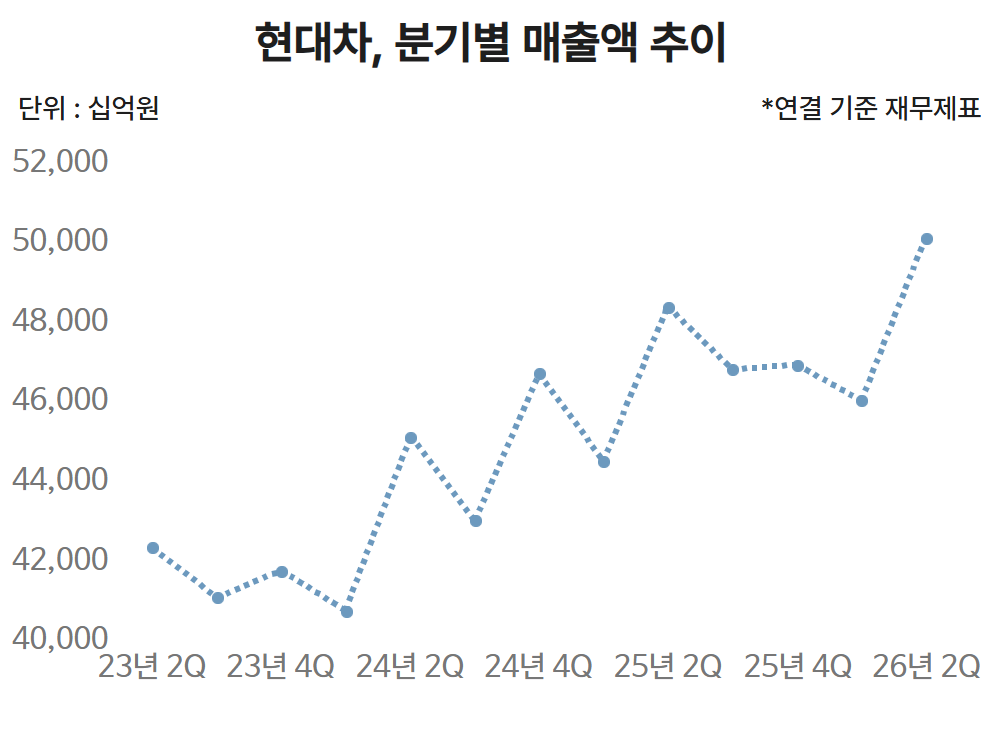
Hyundai Motor first crossed the 40 trillion won mark in quarterly sales in the second quarter of 2023, recording 42.25 trillion won. Revenue then grew rapidly as the company expanded sales of high-value vehicle models, benefited from rising demand for hybrid cars, and enjoyed favorable exchange rate effects. In roughly three years, quarterly sales have grown by nearly 10 trillion won.
Among major Korean companies, Samsung Electronics was the first to surpass 50 trillion won in quarterly sales. It crossed that threshold in the third quarter of 2012 with consolidated sales of 52.18 trillion won, then broke the 60 trillion won barrier in the second quarter of 2017 and is now approaching the 180 trillion won range.
SK hynix also crossed the 50 trillion won mark for the first time in the first quarter of this year, posting consolidated sales of 52.58 trillion won, as explosive demand for HBM chips for AI servers drove a broad recovery in the semiconductor industry.
If Hyundai Motor clears the 50 trillion won threshold in any quarter this year, it would become in effect the first automaker to join the ranks of companies posting that scale of quarterly revenue — a club that has until now been the exclusive domain of chipmakers.
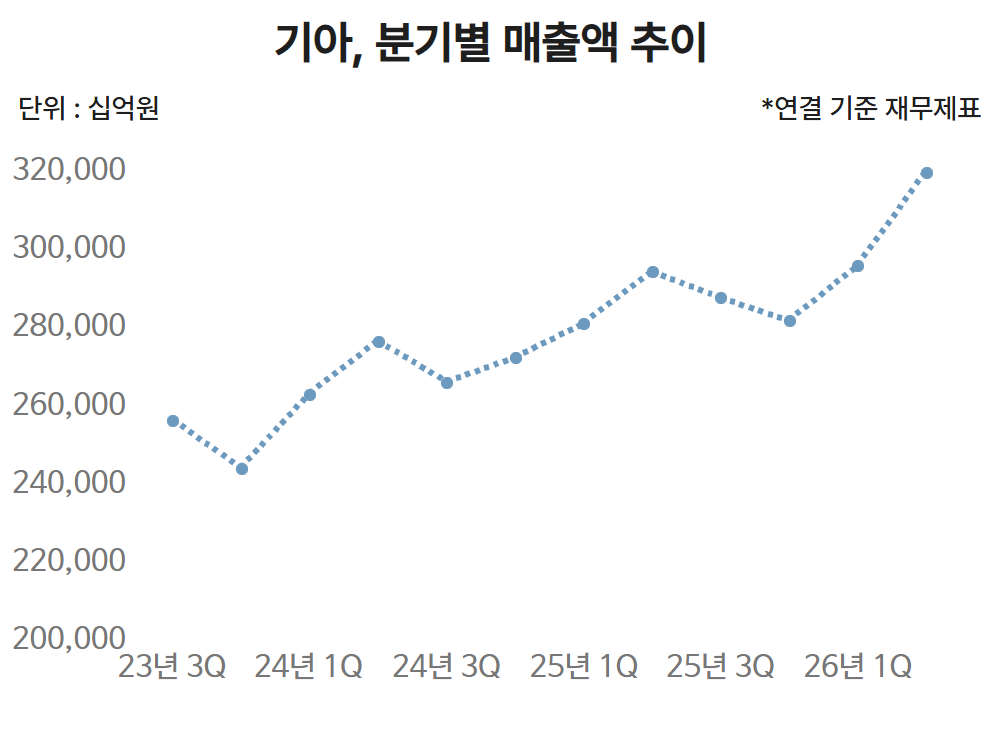
Kia, the other pillar of Hyundai Motor Group, is also expected to continue expanding its revenue base. The consensus estimate for Kia's second-quarter sales stands at 31.89 trillion won, which would be the first time the company has surpassed 30 trillion won in a single quarter. Having first broken the 20 trillion won quarterly sales mark in the second quarter of 2022, Kia would have grown its quarterly revenue by roughly 10 trillion won in four years.
Record-breaking sales, however, do not automatically translate into improved profitability. The consensus estimate for Hyundai Motor's second-quarter operating profit is 3.29 trillion won, down 8.6 percent from the same period last year. The operating profit margin is expected to narrow from 7.5 percent in the second quarter of last year to around 6.5 percent this year. Analysts attribute the squeeze to weaker vehicle sales, production disruptions, tariffs, slowing global demand, and rising incentive costs — even as overall revenue has grown.
Kia is expected to show a relatively resilient earnings performance. Its second-quarter operating profit consensus stands at 2.78 trillion won, up 0.7 percent from a year earlier. Analysts say Kia's sales mix — weighted toward SUVs and eco-friendly vehicles — gives it stronger profit protection than Hyundai Motor.
In the second half, the key variables for both companies will be the timing of major new model launches and whether factory utilization rates recover. Hyundai Motor plans a series of launches starting with the new Avante, followed by the new Tucson, a GV80 facelift hybrid, and the Genesis flagship electric SUV GV90. If the new models drive a sales recovery, the company could see revenue growth and margin improvement at the same time.
"In the second half, the full effect of regional new model launches centered on eco-friendly vehicles will kick in, giving Hyundai Motor Group's earnings a pattern of a weak first half and a strong second half," said Kim Seong-rae, an analyst at Hanwha Investment & Securities. "Hyundai Motor is expected to offset the first-half sales slowdown through the new Avante and Tucson, as well as the launch and local production of the Ioniq 3 in Europe, while Kia is expected to sustain sales growth led by the Telluride and Sportage Hybrid in North America and the EV2 in Europe."
kwater@heraldcorp.com



