
![[Herald DB]](https://wimg.heraldcorp.com/news/cms/2026/06/29/news-p.v1.20260629.678a098a3f2a4bcca20b92f6319157da_P1.png)
Inverse ETFs and AI semiconductor ETFs split the top of South Korea's ETF performance rankings in June. Products betting on declines in secondary battery stocks, the Kosdaq and crude oil prices dominated the upper tier, while among long-side funds only semiconductor and IT ETFs — holding HBM, AI memory chip and domestic large-cap IT stocks — managed to crack the top 10.
According to Koscom ETF Check data released Monday, seven of the 10 best-performing domestic ETFs over the past month (based on closing prices Friday) were inverse products betting on weakness in secondary batteries, the Kosdaq and crude oil. Only three top-10 ETFs were positioned for gains, and even those were concentrated in HBM, AI memory and domestic large-cap IT-related products.
The top performer was KB Asset Management's RISE 2차전지TOP10인버스 (synthetic), which returned 39.19% over the past month. The product tracks the inverse of moves in leading secondary battery stocks. Secondary battery shares have weakened this month amid concerns over delayed electric vehicle demand recovery and profit-taking pressure.
Half of the top 10 ETFs by one-month return were products betting on Kosdaq weakness or underperformance relative to large-cap benchmarks.
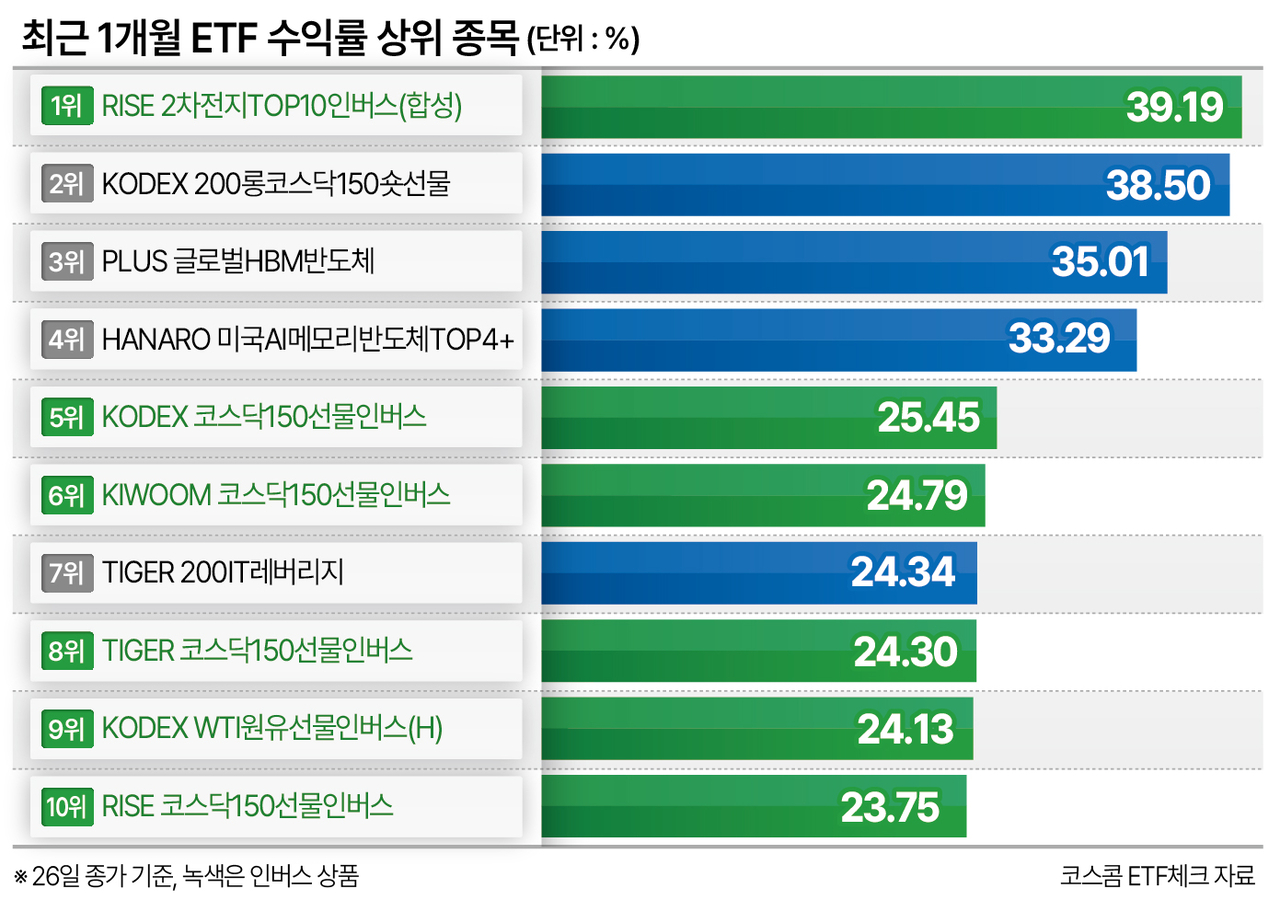
KODEX 200롱코스닥150숏선물, which returned 38.50% to rank second, profited from the widening performance gap between large-caps and the Kosdaq during June's volatile trading. The product uses a long-short structure — buying KOSPI 200 futures while selling Kosdaq 150 futures — and gains when the Kosdaq 150 underperforms the KOSPI 200. It can generate returns even when both indexes fall, as long as the Kosdaq 150 drops more steeply.
Four Kosdaq 150 inverse products also made the top 10: KODEX 코스닥150선물인버스 (25.45%), KIWOOM 코스닥150선물인버스 (24.79%), TIGER 코스닥150선물인버스 (24.30%) and RISE 코스닥150선물인버스 (23.75%).
On the domestic market, investor flows have continued to pile into large-cap semiconductor stocks rather than rotating into the Kosdaq. Samsung Electronics and SK hynix share prices rose 7.10% and 14.57%, respectively, from end of last month, sustaining their upward momentum even amid heightened volatility and sharp swings.
"We are still far from a peak-out in the leading stocks," said Kim Jun-young, a researcher at iM Securities, adding that a large-cap-led rally is likely to continue until then. On the prospects for a rebound in sidelined sectors such as the Kosdaq and biotech, he said it would not be too late to consider that once "the index reaches around the 11,000-point level."
Among long-side products, large-cap AI semiconductor ETFs stand out by far. PLUS 글로벌HBM반도체, the third-best performer with a 35.01% return, allocates roughly 80% of its holdings to core memory chip companies including Samsung Electronics, SK hynix, Micron and SanDisk. The fourth-ranked HANARO 미국AI메모리반도체TOP4+ (33.29%) similarly targets US memory and storage stocks such as Micron, SanDisk, Seagate and Western Digital.
TIGER 200IT레버리지 (24.34%, seventh place) was the only leveraged product to crack the top 10, tracking twice the daily return of the KOSPI 200 information technology index. It is also structured to amplify gains when domestic semiconductor and IT large-caps — including SK hynix, Samsung Electronics, SK Square and Samsung Electro-Mechanics — rise.
Industry observers expect the strong performance of AI semiconductor ETFs to continue for now. Securities analysts are forecasting further upside for Samsung Electronics and SK hynix, the two stocks that most directly drive returns in AI chip ETFs.
"The second-quarter earnings improvement at Samsung Electronics is already priced in," said Jeong Woo-seong, a researcher at LS Securities. "If expanded HBM supply is confirmed through customer certification and yield improvements, upward earnings revisions and a narrowing of the valuation discount could happen at the same time." On SK hynix, he said commodity DRAM prices have risen roughly three times his firm's estimates, which leaves room for price increases in year-end HBM average selling price negotiations. He added that the company achieved speeds of up to 16 Gbps on its 12-layer HBM4E samples — easing concerns about next-generation product competitiveness — and is likely to maintain its position as the dominant HBM supplier to Nvidia through 2027.
kacew@heraldcorp.com



