New market rates kick in when lease renewals expire, normalizing 1 million won monthly rent
Newlyweds buy in; elderly and non-homeowning long-term tenants head for the periphery
![The Sanggye Jugong apartment complex in Sanggye-dong, Nowon-gu. [Herald Business DB]](https://wimg.heraldcorp.com/news/cms/2026/06/25/news-p.v1.20260127.f01ec2858fdb4f67bbd6b169010f1e37_P1.png)
"Until last year, a one-room monthly rental was around 500,000 won. This year it suddenly jumped past 1 million won. One of the tenants at Sanggye Jugong Complex 10 moved to Uijeongbu after their renewal contract expired. Some were pushed to the outskirts near Suraksan, still within Nowon. Others gave up on apartments altogether and moved into villa monthly rentals."
Small apartments renting for under 1 million won a month are rapidly disappearing from the Sanggye-dong and Junggye-dong neighborhoods of Nowon-gu — long regarded as one of Seoul's most affordable residential areas for ordinary residents. Even older apartment complexes dominated by small and mid-size units now carry monthly rents of 900,000 won to 1.2 million won, with deposits of 20 million to 50 million won.
On a visit to the area Wednesday, real estate agents said it had become commonplace for long-term tenants to be pushed out to the periphery as jeonse and monthly rent prices surge.
The head of Agency A in Sanggye-dong said a unit that went for a 20 million won deposit and 400,000 to 500,000 won in monthly rent until late last year now commands a 30 million won deposit and 900,000 to 1 million won. "There are tenants in the rental market who simply cannot sign a jeonse contract and can only do monthly rent," he said. "When you think about their monthly income, they have to hand over more than half of what they earn just for rent."
According to local agents, jeonse and monthly rental listings have effectively vanished from small- and mid-size complexes such as Junggye Jugong, Sanggye Jugong, Byeoksan Apartments, Junggye Green and Junggye Mujigae. With the shortage of available units persisting, properties that come onto the market after renewal rights expire routinely exceed 1 million won a month.
<style ref="s1">"Even in large complexes of 2,000 to 3,000 units, there is barely one rental listing per unit size,"</style> the agency head said. He added that an 18-pyeong (about 60-square-meter) unit at Sanggye Jugong Complex 7 is listed at a 40 million won deposit with 1.1 million won monthly rent, while the smallest two-bedroom unit at Sanggye Jugong Complex 9 is going for a 50 million won deposit and about 900,000 won a month.
"A year ago, monthly rent in this neighborhood was around 500,000 to 600,000 won on a deposit of 20 million to 30 million won," he said. <style ref="s2">"Prices rose sharply from late last year, and now even the smaller units are too expensive for ordinary people to pay month after month."</style>
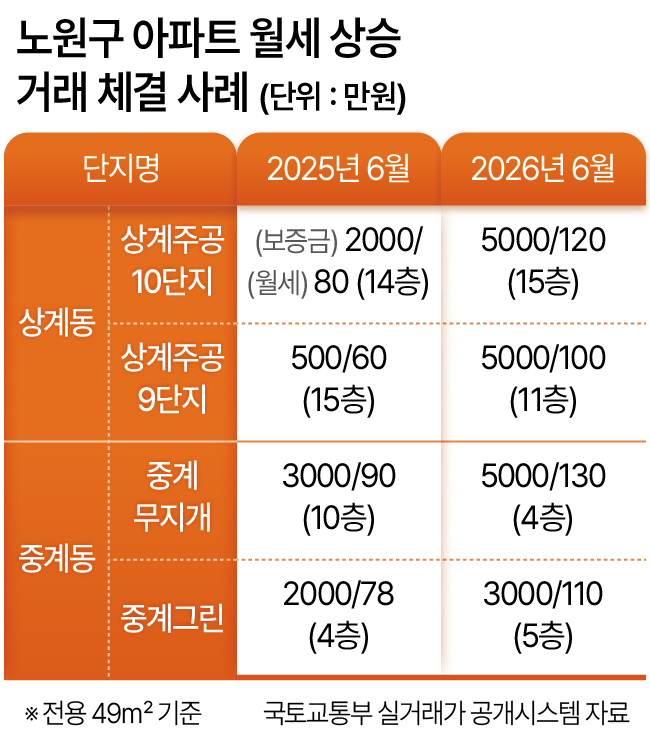
According to the Ministry of Land, Infrastructure and Transport's actual transaction price disclosure system, a 49-square-meter unit (exclusive use area) at Sanggye Jugong Complex 10 was newly contracted June 9 at a 50 million won deposit and 1.2 million won monthly rent. The same unit size traded at a 30 million won deposit and 900,000 won monthly rent on Jan. 3 last year. Both the deposit and the monthly rent rose within six months. A year earlier, on June 21 last year, the same unit size had traded at a 20 million won deposit and 800,000 won monthly rent.
The Junggye Mujigae apartment complex in Junggye-dong shows a similar trend. A 49-square-meter unit there was contracted June 12 at a 50 million won deposit and 1.3 million won monthly rent. On Jan. 16, it had been contracted at a 20 million won deposit and 890,000 won monthly rent, and on June 17 last year it traded at a 30 million won deposit and 900,000 won monthly rent. <style ref="s3">Even as the deposit grew larger, the monthly rent rose by roughly 40 percent.</style>
Statistics confirm the trend. Ham Yeong-jin, head of Woori Bank's real estate research lab, analyzed Ministry of Land, Infrastructure and Transport actual transaction data and found that among monthly rent transactions in Nowon-gu from Jan. 1 through June 21, <style ref="s4">the share of deals where monthly rent exceeded 1 million won stood at 16.43 percent this year</style> — up from 10.23 percent in 2024 and 13.98 percent in 2025.
<style ref="s5">On the ground, agents point directly to a shrinking supply of rental listings as the cause of rising monthly rents.</style> Sanggye-dong and Junggye-dong in Nowon-gu once had a sizable stock of jeonse and monthly rental units owned by multi-home landlords and private rental business operators. But as owners sold off their rental properties — driven by the burden of the capital gains tax surcharge, reduced tax benefits for private rental operators, and deposit insurance regulations — the number of homes available for jeonse or monthly rent has fallen.
The buyers who picked up those converted properties were mostly young newlyweds and other owner-occupiers without existing homes, agents said. Nowon-gu had a relatively large supply of small and mid-size homes priced under 600 million won, making it accessible to buyers using government policy loans. But as buying demand concentrated there, prices rose.
"Until early this year, even 21-pyeong units here had a KB market price of around 570 million to 580 million won at times," said the head of Agency B in Sanggye-dong. "Many newlyweds who had been planning to go jeonse decided to buy instead, taking out loans like the Bogeumjari mortgage because they thought prices would rise — and people were lining up to buy homes right up to May 9," he added.
The bigger problem lies with existing tenants. <style ref="s6">Young buyers came in and purchased the units, but those buyers were not the people who had been living there as jeonse or monthly rent tenants — meaning rental listings disappeared while long-term tenants were left with nowhere to go.</style>
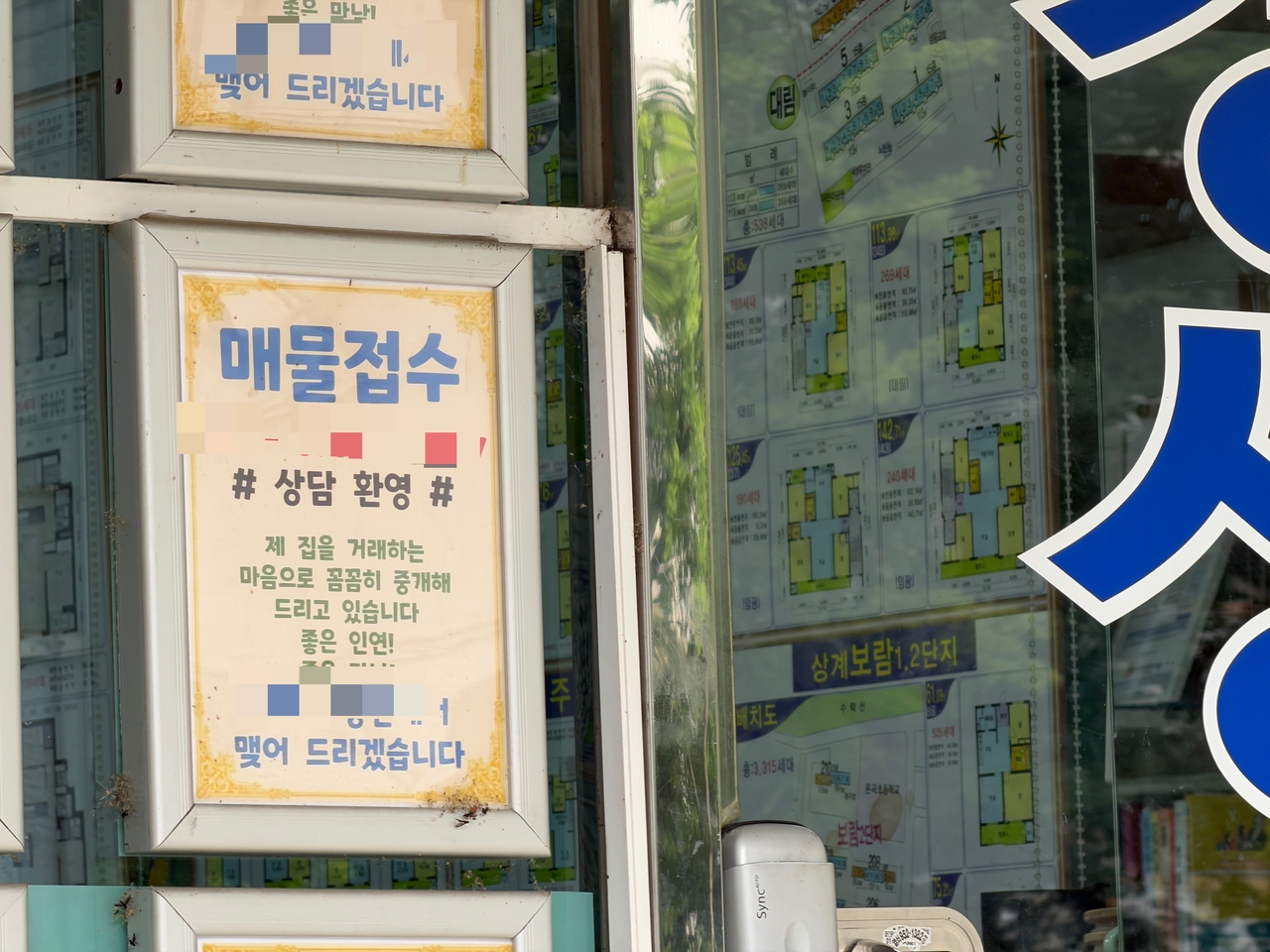
<style ref="s7">"Young newlyweds took out loans and bought homes, but existing jeonse and monthly rent tenants have nowhere to go,"</style> the Agency B head said. "Someone who was paying 600,000 to 700,000 won a month simply cannot hold on when they're suddenly facing rents of over 1 million won."
"Young people borrowed and bought, but the non-homeowning tenants who were already living here find it hard to buy and face a shortage of jeonse and monthly rental units — so they ultimately cannot bear the new rent levels and are leaving for the outskirts," he added. "Rental supply has shrunk while demand has stayed the same, so the people with the least financial cushion are the first to absorb the burden."
Yun Ji-hae, head of the PropTech Research Lab at HDC Labs, said of the rising monthly rents in outer districts: "The rental market is made up almost entirely of genuine end-users, so the balance of supply and demand is itself the price. When supply falls short of demand, rents have no choice but to rise."
"The higher the share of monthly rent in the rental market, the heavier the housing cost burden becomes," Yun said. "Now that the government has made clear it is effectively moving to phase out the jeonse system, some speed adjustment is needed to prevent a sharp spike in monthly rents — but the current trajectory looks more like a hard landing than a soft one."
quq@heraldcorp.com