New unit to handle legal support, complaints and child abuse reports
Human rights groups demand retraction of remarks on special forces-trained supervisors
By Kim Yong-jae, The Herald Business
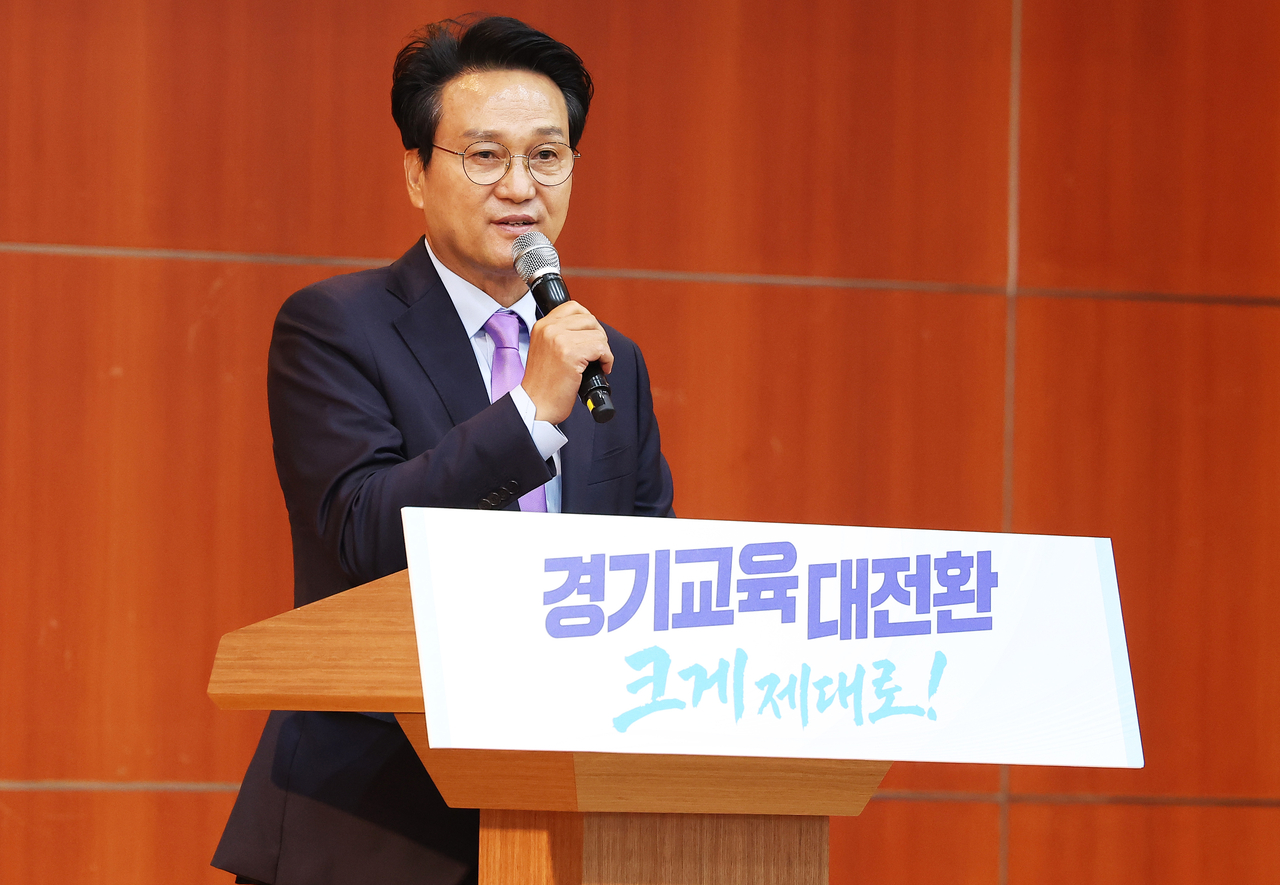
Gyeonggi Province education superintendent-elect Ahn Min-seok has formally announced plans to establish a dedicated bureau to protect teachers' educational activities, to be called the Gyeonggi Educational Activity Protection Bureau. The initiative aims to shift responsibility for handling rights violations and malicious complaints away from individual teachers and place it under the direct oversight of the provincial education office, which would centralize legal and emergency support.
Ahn's transition committee held a public forum Thursday at the National Assembly members' office building in Seoul, under the theme "The Gyeonggi Educational Activity Protection Bureau — why and how to create it," to discuss the need for the bureau and its operational direction.
In his opening remarks, Ahn said protecting teachers' educational activities "can no longer be left to individual teachers," adding that he would establish a bureau directly under the superintendent to consolidate functions such as complaint handling in one place.
"A structure in which teachers must handle complaints, respond to reports and manage conflicts with parents all on their own is not sustainable," he said. He called for a unified school complaint window, a dedicated education office team to deal directly with repeat and malicious complaints, and the operation of a 119-style call center for educational activity protection.
Education office, not individual teachers, to take responsibility; legal reforms planned
Ahn also raised the prospect of amending the Child Welfare Act and the Act on Punishment of Child Abuse Crimes. He said he would work with the National Assembly to pursue immunity legislation shielding teachers from liability when there is no intent or gross negligence in the course of their educational duties. He also announced plans to hold a joint press conference with education superintendents nationwide and three major teachers' organizations on July 15, ahead of the third anniversary of the death of a teacher at Seoichon Elementary School.
Presenters at the forum said the current structure — in which individual teachers must manage counseling, student guidance, malicious complaints, child abuse reports and litigation on their own — makes normal educational activity nearly impossible. Teacher Gu Gal-jung, one of the presenters, said a self-deprecating phrase has spread among teachers: "Don't work too hard — you'll only get complaints and reports filed against you." He described a chilling atmosphere in classrooms. Education critic Lee Beom proposed that South Korea follow the example of countries such as Britain and France, which have laws governing how teachers may discipline disruptive students, and called for the introduction of immediate disciplinary tools to replace corporal punishment.
Representatives of students and parents said the bureau should serve not only teachers but as a safety net to restore trust across the entire school community. Jeon Su-min, a first-year student at Suwon Foreign Language High School, said creating an environment where good teachers can focus on education "is ultimately about protecting students' growth and future." Shin Hye-jeong, head of the School Violence OUT Parents' Civic Group, said teacher protection and student protection "must go hand in hand."
Human rights groups demand retraction of special forces remarks, public apology
Meanwhile, human rights organizations held a press conference outside the National Assembly on Thursday, demanding that Ahn retract his remarks about deploying supervisors with special forces backgrounds and issue a public apology. Six groups — including Politicking Moms and the Youth Green Party — criticized the proposal, saying that having a supervisor with a special forces background enter a classroom would not restore trust between students and teachers.
The groups said teachers' rights, students' rights and parental participation "are not in competition with one another," and argued that what is needed now is not a new organization with a new name, but an examination of how the systems already in place are actually functioning in schools.
Ahn said that "if there are problems that have gone unresolved until now, we must question the methods used until now," and called for "a decisive shift to a new approach to protecting educational activities."
brunch@heraldcorp.com