Labor bloc demands 12,000-won minimum wage for next year, up 16% from this year; 'Workers' Basic Rights Act' would expand social insurance burden; overdue loans by sole proprietors reach 14.6 trillion won
![A closure notice hangs outside a fish stall at a traditional market in Seoul. [Yonhap]](https://wimg.heraldcorp.com/news/cms/2026/06/25/news-p.v1.20260327.27e65de6f9c54da1869a793c50d44c8e_P1.png)
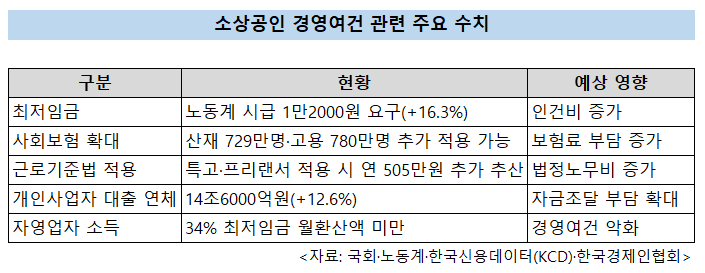
One in three self-employed workers earns less per month than the current minimum wage, a new survey shows. Amid that strain, labor groups are demanding a 16.3 percent increase in next year's minimum wage — to 12,000 won ($8) per hour — while a proposed "Workers' Basic Rights Act" that would extend social insurance to platform workers and freelancers is gaining legislative momentum, piling fresh costs onto small business owners. Overdue loans held by sole proprietors swelled to 14.6 trillion won in the first quarter of this year, deepening fears that the combined burden of labor costs, social insurance and debt has pushed small businesses to a breaking point.
According to the National Assembly and labor groups, the Workers' Basic Rights Act would grant basic labor rights and social security protections to non-wage workers — including platform workers, special-employment workers and freelancers. Proponents say the legislation is meant to close gaps in the social safety net as the labor market undergoes rapid change.
Labor groups argue that an automatic enrollment principle for social insurance is essential to give the law real teeth. If mandatory enrollment were introduced, about 7.29 million additional workers could be brought under industrial accident insurance and about 7.8 million under employment insurance, according to the Working Citizens Research Institute. The institute noted that while roughly 8.69 million people are registered with the National Tax Service as business income earners subject to 3.3 percent withholding, only about 890,000 are covered by employment insurance — leaving a vast protection gap.
The central concern is cost. Employment insurance premiums are split equally between employers and workers, while industrial accident insurance is paid entirely by employers. Labor groups contend that broader enrollment would help stabilize insurance fund finances, but small business owners worry about rising costs. The employment insurance fund ran a deficit of nearly 600 billion won last year. Year-end reserves for unemployment benefits stood at 1.7275 trillion won, but once borrowings from the Public Fund Management Fund are excluded, the real reserve position is a deficit of 5.9933 trillion won.
In practice, small business associations argue that if the Workers' Basic Rights Act passes and protections for special-employment and freelance workers are expanded, employers could face an additional annual cost of 5.05 million won per worker. The Korea Federation of Micro Enterprise has responded by forming a task force to oppose the legislation and has gone public with its objections.
The minimum wage debate is adding to the pressure. Labor groups have submitted an opening demand of 12,000 won per hour for next year — 16.3 percent above this year's rate of 10,320 won. Business groups, by contrast, opened with a demand to freeze the wage. At the Minimum Wage Commission's eighth plenary session on Monday, employer-side members representing small businesses were initially reported to have pushed for a cut, but ultimately unified their position around a freeze.
The fact that small business representatives even considered arguing for a wage cut reflects how sharply their operating environment has deteriorated. In a survey of 994 small and medium-sized enterprises and small businesses conducted by the Korea Federation of SMEs, 77.6 percent of respondents said the current minimum wage was already a burden. If the wage were raised beyond what they could absorb, the most commonly cited responses were reducing new hires (24.6 percent), cutting existing staff (24.0 percent) and freezing or reducing wages (22.0 percent). Some 8.7 percent said they would consider shutting down.
The income data underscore the difficulty. According to a survey by the Korea Enterprises Federation, 34.0 percent of self-employed workers reported monthly income below 2,156,880 won — the monthly equivalent of the current minimum wage.
Debt burdens are also mounting. Overdue loan balances held by domestic sole proprietors reached 14.6 trillion won in the first quarter of this year, up 12.6 percent from the previous quarter, according to Korea Credit Data's first-quarter 2026 small business trend research note.
Meanwhile, the Minimum Wage Commission begins substantive deliberations on next year's wage level Thursday. The gap between labor and management's opening positions currently stands at 1,680 won per hour. The statutory deadline for completing the review is June 29 — 90 days after the Minister of Employment and Labor formally requested the commission begin its deliberations.
fact0514@heraldcorp.com