Strike vote passes by overwhelming margin
Union could gain legal right to strike if labor board halts mediation Thursday
Strike action committee set to launch Monday to map out tactics
![The Hyundai Motor and Kia headquarters building in Yangjae, Seoul [Hyundai Motor Group]](https://wimg.heraldcorp.com/news/cms/2026/06/24/news-p.v1.20260618.9ea90d69c8ad4f27bfc57187ff7484d3_P1.jpg)
Hyundai Motor's union has passed a strike authorization vote tied to this year's wage and collective bargaining negotiations, clearing a key procedural hurdle toward securing the legal right to strike. A mediation session at the National Labor Relations Commission scheduled for Thursday is now seen as the critical juncture that will determine whether the union can move forward with a lawful work stoppage.
The Hyundai Motor branch of the Korean Metal Workers' Union said Wednesday that 37,348 of its 39,668 eligible members participated in the vote, a turnout of 94.15 percent. The tally showed 34,371 votes in favor and 2,977 against. The approval rate among those who voted stood at 92.03 percent, while the rate based on total membership was 86.65 percent. The voter-based approval rate was up 1.11 percentage points from last year's 90.92 percent.
The result came as little surprise: the union's strike authorization votes have never been rejected. On Tuesday, the union also unanimously passed a resolution declaring a labor dispute at an emergency delegates' assembly.
Last year's vote also recorded a high approval rate. Of 42,180 eligible members, 39,966 cast ballots for a turnout of 94.75 percent. Some 36,341 voted in favor and 3,625 against, putting the voter-based approval rate at 90.92 percent and the membership-based rate at 86.15 percent.
However, passing the authorization vote alone does not give the union the immediate legal right to strike. The union must first complete the labor commission's mediation process before it can exercise that right.
The pivotal moment will come at Thursday's mediation session at the National Labor Relations Commission, where the commission will make a final attempt to bridge the gap between the two sides. If no agreement is reached and the commission determines that the parties remain too far apart — issuing a suspension or breakdown of mediation — the union will be legally entitled to call a strike.
The union is then expected to launch a strike action committee as early as Monday to discuss the form, timing and intensity of any industrial action. Once the committee is in place, options such as partial strikes, refusal of overtime and refusal of extra shifts are likely to come up for discussion.
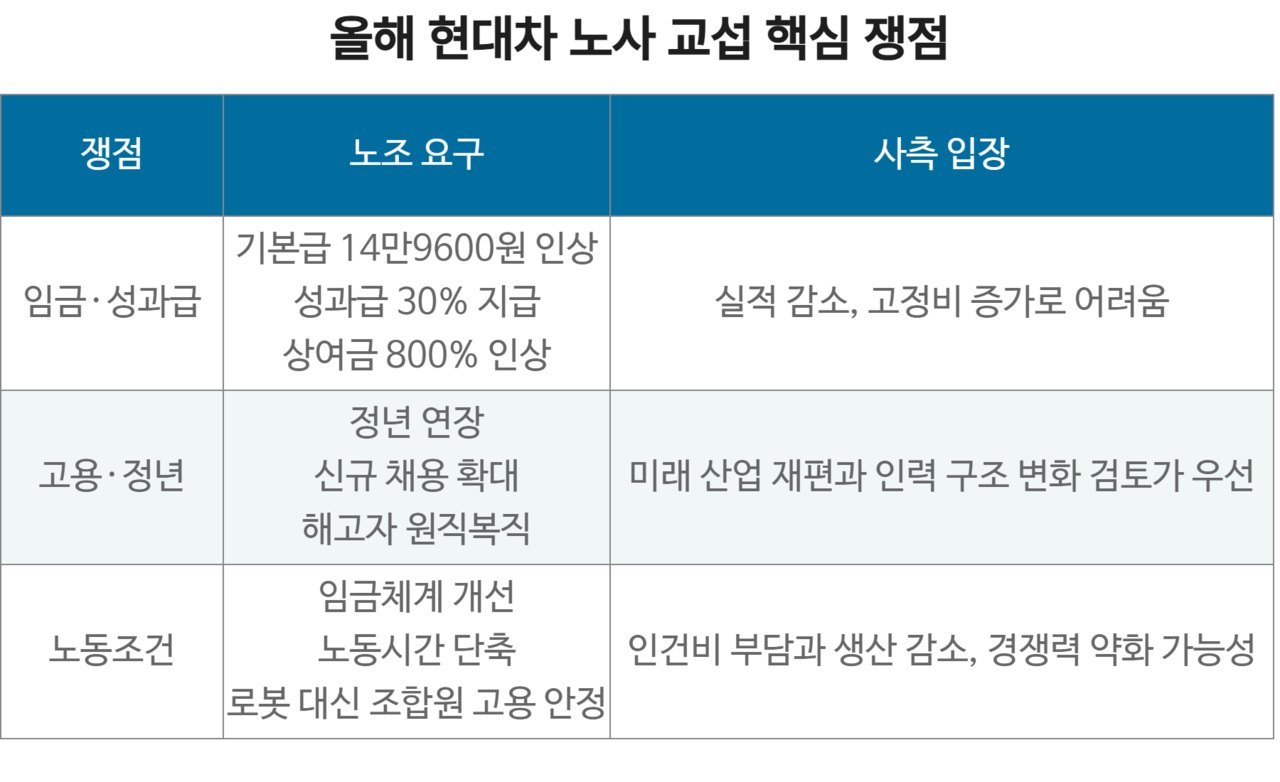
The central issues in this year's negotiations include wage increases, job security and the response to industrial transformation. The union is demanding a base pay raise of 149,600 won ($97) per month, a performance bonus equivalent to 30 percent of salary, and an 800 percent increase in bonuses. Demands also include an extension of the retirement age, expanded new hiring and the reinstatement of dismissed workers.
The union argues that while Hyundai Motor has grown to rank third globally in sales and second in the world in operating profit, the bonuses of its roughly 40,000 members — who drove that growth — have remained frozen for 19 years. "The demand for an 800 percent bonus is not a privilege," the union said. "It is deferred, rightful compensation and the minimum respect owed to the value of labor."
Management says it cannot accept the union's demands as presented, citing global economic uncertainty, potential sales volatility and rising fixed costs. The company has also emphasized the need to optimize its workforce as it navigates the transition to electrification and AI-driven automation.
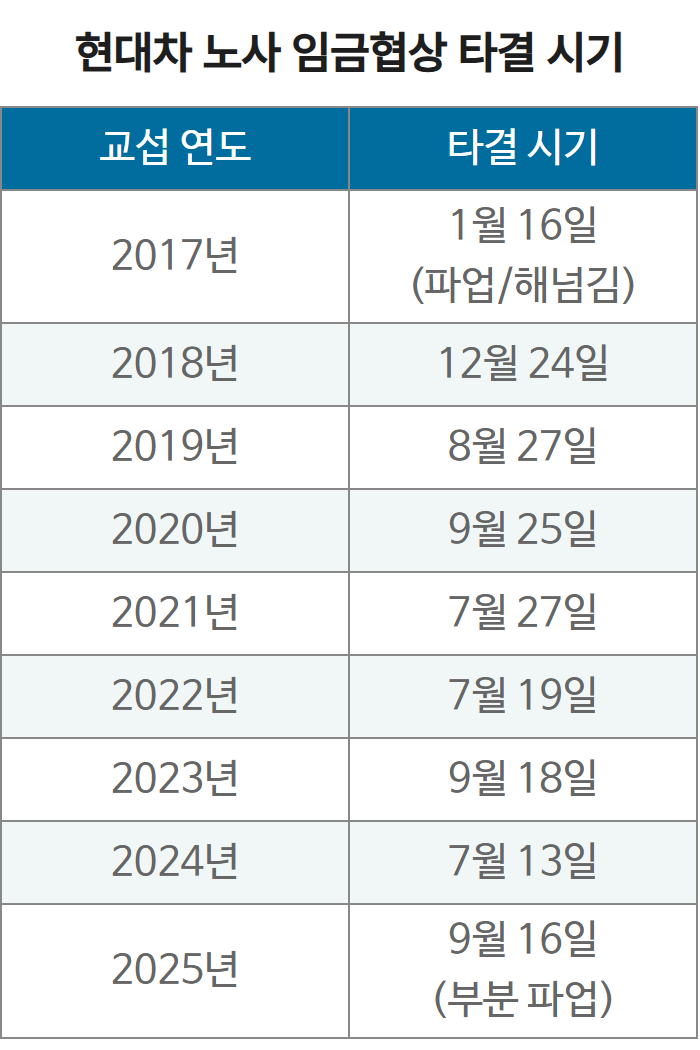
Whether the dispute will actually result in a strike remains uncertain. Even after securing the legal right to strike, the union has frequently used that leverage as a bargaining tool to reach a tentative agreement without walking out. In both 2023 and 2024, the union obtained strike authorization but did not carry out any work stoppage.
Should a strike lead to production line shutdowns, however, the financial impact on Hyundai Motor could be significant. Last year, the company and union staged a partial strike for the first time since 2018 — a seven-year gap — resulting in an estimated 400 billion won in lost production.
The damage was even greater during the 2017 wage negotiations, one of the largest strikes in the company's recent history. The union carried out 24 rounds of partial strikes that year, with production losses estimated at more than 76,900 vehicles worth approximately 1.62 trillion won. The prolonged standoff stretched negotiations over nine months, with a final settlement not reached until Jan. 16 of the following year.
The union's moves could also ripple across the broader Hyundai Motor Group. Affiliates including Kia and Hyundai Mobis are also in the midst of their own wage and collective bargaining talks this year. Subcontractor unions — including irregular workers and refractory maintenance workers at Hyundai Steel — have also been stepping up pressure, meaning the outcome of Hyundai Motor's negotiations is likely to shape labor relations across the group.
kwater@heraldcorp.com