Forged mobile IDs sold openly online; anyone can order a custom fake for a small fee; suspects hard to prosecute as stores tighten checks

"Even in Gangnam and Hongdae, you can get through anywhere except places with young part-timers." "If you want the QR code forged too, you'll need to pay 200,000 won ($130)." "Do you need a fake physical ID as well? I can give you a deal if you bundle them."
Trade in forged mobile IDs is spreading across Telegram and social media platforms, with critics warning that the easy availability of fake identification is encouraging minors to break the law.
Experts say prevention education and greater awareness are needed so that young people understand ID forgery is a clear-cut crime.
Online, searching for terms such as "mobile ID" or "ID for sale" quickly surfaces listings offering forged identification — a setup that allows anyone, including minors, to reach a seller within a few searches.
On June 21, reporters contacted 22 accounts on Telegram, X (formerly Twitter) and open KakaoTalk chatrooms that were advertising forged ID production and sales services.
Within three minutes of making an inquiry, one vendor responded. When asked whether a fake adult mobile ID could be made for someone posing as a second-year middle school student, the seller initially quoted 30,000 won. After the reporter hesitated, the vendor asked how much they had in mind and ultimately offered to do it for 15,000 won.
Sellers promoted the fact that buyers could edit the personal details themselves and that a single purchase could be used to create multiple IDs for multiple people.
Once payment was confirmed, sellers provided a link and a step-by-step manual for producing the forged ID. Buyers entered personal details — name, resident registration number and a photo — and pressing save generated a fake mobile ID within minutes.
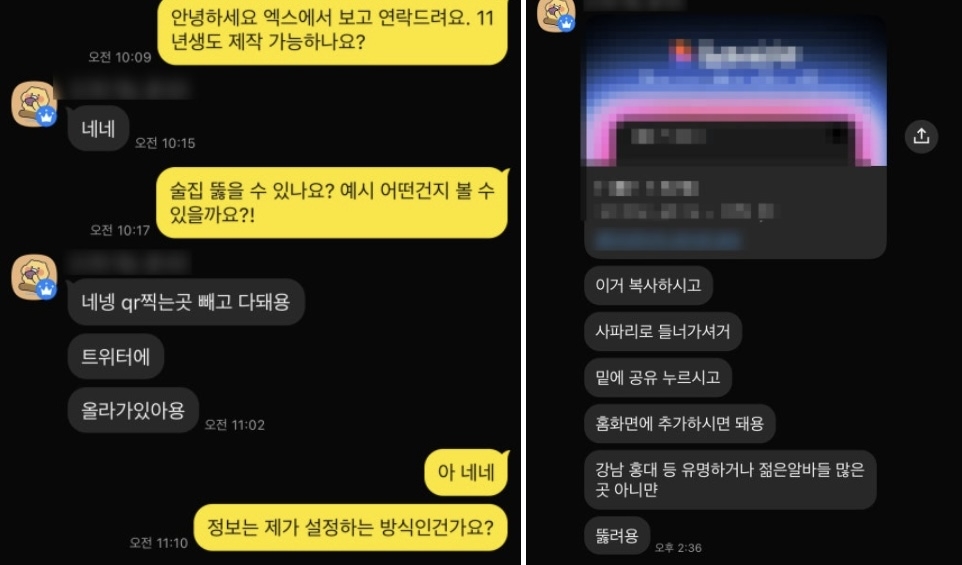
One seller walked buyers through the entire process step by step — from installing a third-party app to disguising it as the government's Jeongbu24 app. Running a link provided by the seller inside the third-party app launched the forged ID screen, and the seller then explained how to rename the app and replace its icon to make it look identical to the real Jeongbu24 mobile ID app.
The result was nearly indistinguishable from the genuine Jeongbu24 mobile ID app from the moment a user opened it on their home screen. The whole process took about two minutes and cost 15,000 won.
The finished forgery was sophisticated enough to be visually indistinguishable from a real mobile ID — the only telltale difference being that its QR code did not actually work.
It even replicated fine details: a countdown timer bar identical to the one on government-issued IDs, and a notice at the bottom of the screen reading "Screenshot prevention system is active."
One seller boasted of having completed more than 200 transactions, claiming the fake IDs "work everywhere — bars, motels, you name it."
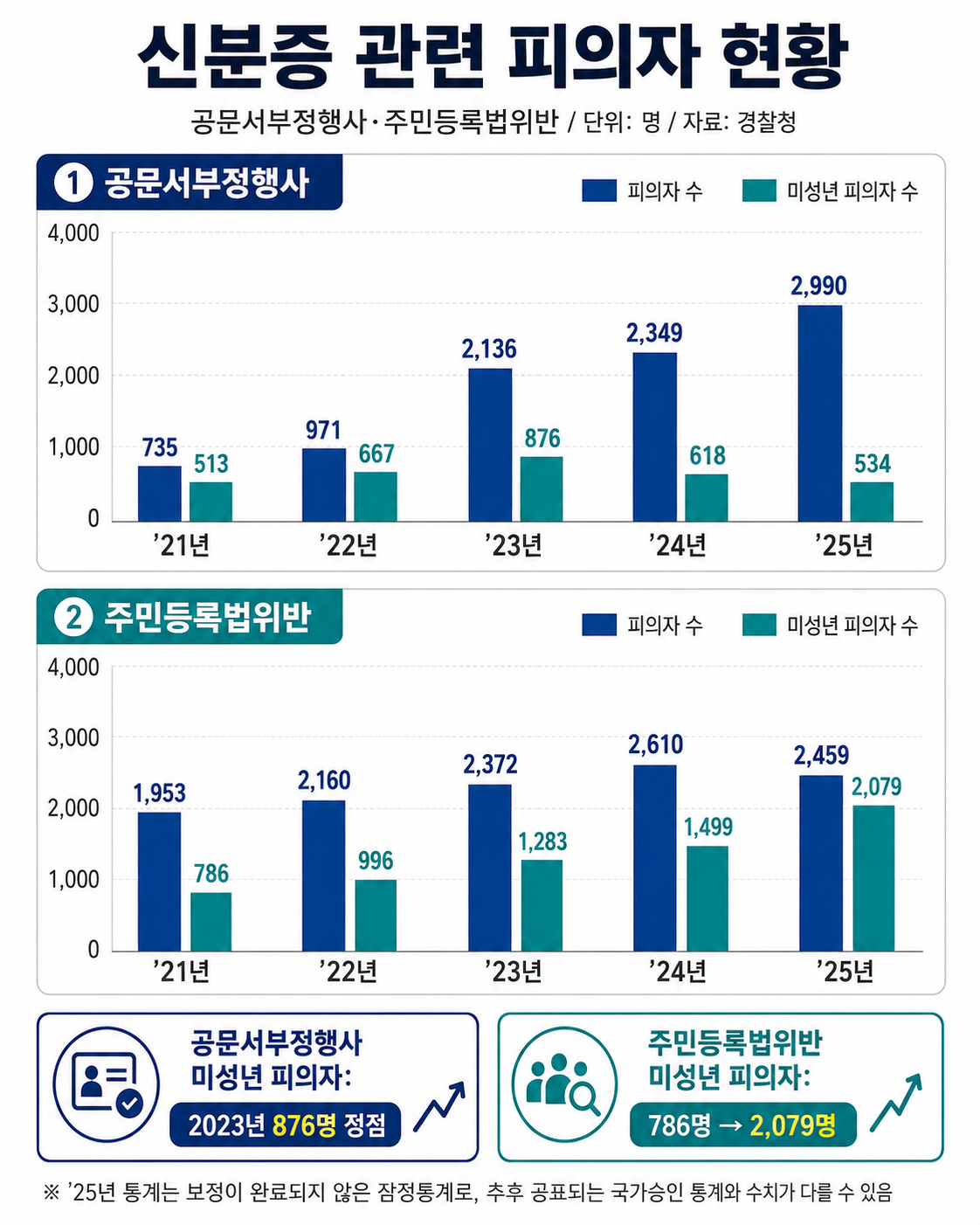
According to the Korean National Police Agency, the number of minor suspects booked for violations of the Resident Registration Act rose from 786 in 2021 to 2,079 in 2025. Hundreds of additional cases involving improper use of official documents were recorded each year over the same five-year period.
Violations of the Resident Registration Act apply when a resident registration card is forged, altered or used fraudulently. Producing a forged mobile ID or using one to pass an identity verification check can constitute such a violation.
The improper-use-of-official-documents charge applies when someone presents a public ID — such as a resident registration card, driver's license or student ID — as their own.
A youth investigator at a local police station said officers are closely monitoring a growing pattern in which minors share algorithms for forging mobile IDs and are caught trying to enter clubs and bars using them. "We are also aware that the number of stores receiving administrative penalties after being reported is increasing," the investigator said.
As forgeries grow more sophisticated, store operators said they cannot afford to let their guard down. Businesses caught selling tobacco or alcohol to minors face administrative penalties or suspension of operations.

According to a Mapo-gu district office official, 27 restaurants received administrative penalties for selling alcohol to minors between 2024 and June 23 — 10 in 2024, 12 in 2025 and five so far in 2026.
When police catch a business selling tobacco or alcohol illegally, the case is referred to the district office, which then issues an administrative penalty or orders a suspension of business.
On the afternoon of June 22, a notice posted on the entrance of a bar on Hongdae Street in Mapo-gu, Seoul, read: "Customers born in 2007 must present a physical ID" and "We will not accept mobile IDs under any circumstances. Bring a physical ID."
Inside the bar, a QR code scanner for verifying mobile IDs was set up on the counter.
Staff at the establishment said they had put preventive measures in place after minors were caught attempting to enter nearby bars and clubs using forged IDs.
"Our rule is that every mobile ID gets a QR code check, no exceptions," said a bar employee surnamed A. "Every now and then, minors try to buy alcohol using forged IDs."
The employee added that on one occasion a minor had presented a forged ID and insisted they were an adult, only to be caught when staff scanned the QR code. "When we tried to call the police, they had the nerve to argue, 'I'm an adult — why won't you let me in?'" the employee said.
An employee surnamed B at a nearby bar said forged IDs are convincing enough to fool a casual glance. "If a buyer looks young, you have to ask for additional verification or take a closer look at the ID app screen," B said.
Minors drawn in by easy access, blind to criminal risk — experts urge awareness first
Experts said minors who have grown up in a digital environment are being lured by the ease of access to forgery tools without grasping the seriousness of the crime.
Yeom Geon-ung, a professor in the department of police and fire administration at U1 University, said ID forgery and theft have long existed as problems, but advances in AI and other technologies have made it easier than ever for minors to produce sophisticated fake mobile IDs.
Observers also note that juvenile justice laws make it difficult to impose severe penalties on minors.
Kim Do-u, a professor in the department of police studies at Kyungnam University, said the normalization of digital life has made it easier for the digitally native generation to forge IDs. "For minors, forging a resident registration card is clearly a crime, but in practice it is difficult to hand down a heavy protective disposition for something like this," Kim said. "A firm shift in awareness — that forgery is a crime — has to come first."
Under the current Resident Registration Act, forging, altering or fraudulently using a mobile ID carries a penalty of up to three years in prison or a fine of up to 30 million won.

kido@heraldcorp.com
young2@heraldcorp.com