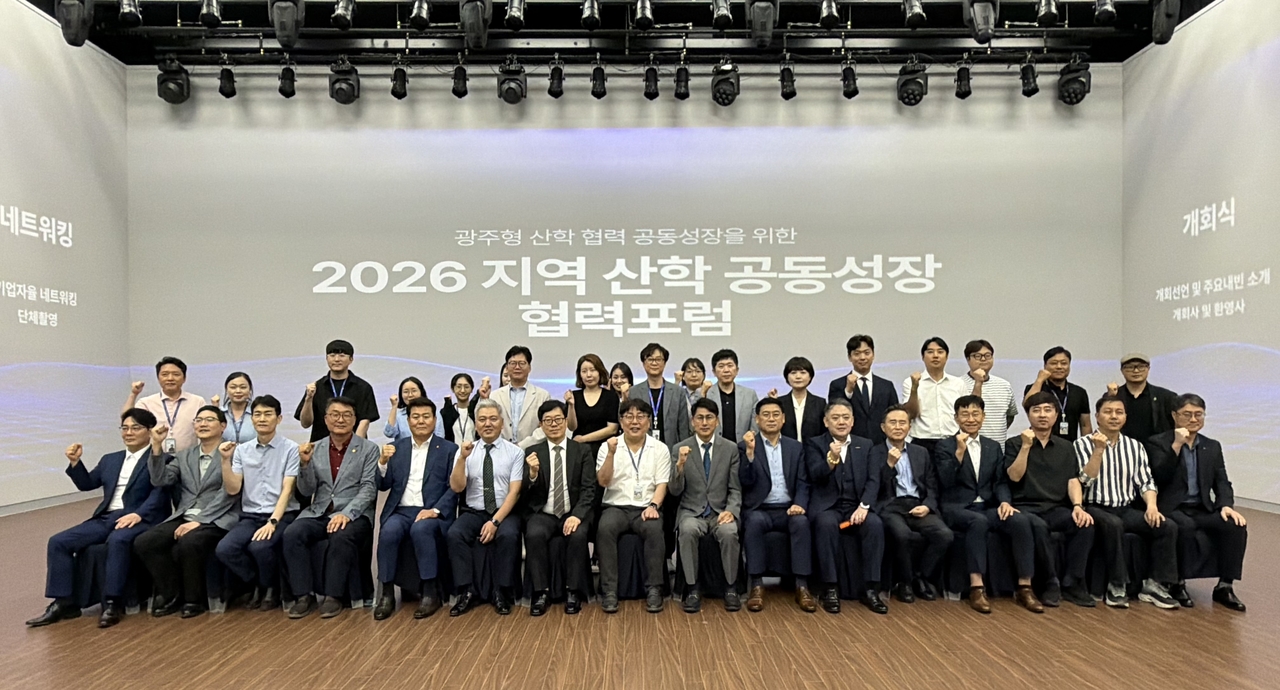
The Gwangju-Jeonnam Venture Business Association, led by President Kim Hyun-su, jointly hosted the "2026 Regional Industry-Academia Co-Growth Cooperation Forum" on Tuesday at the MX Studio on the third floor of the Gwangju Immersive Content Cube. Co-organizers included the Gwangju Institute for Information and Culture Industry, the anchor project teams of Gwangju University, Nambu University and Honam University, and the Korea-China Science and Technology Service Association.
The forum was organized as part of an anchor project for building a regional talent development system, with the aim of strengthening industry-academia cooperation networks among local universities, companies and related institutions.
Participants focused on strategies for successful initial public offerings among promising venture companies and startups, approaches to entering the Chinese market, and ways to build a practical industry-academia ecosystem linking universities' talent development with companies' technology advancement.
About 50 people attended, including Kim Hyun-su, president of the Gwangju-Jeonnam Venture Business Association; Lee Gyeong-ju, head of the Gwangju Institute for Information and Culture Industry; Yun Bong-sik, director of Nambu University's small and medium-sized enterprises industry-academia cooperation center; Lee Jae-sang, head of the Gwangju North branch of the Korea Technology Finance Corporation; Jeong Ung-jae, head of the Korea Credit Guarantee Fund's Gwangju Startup branch; and Park Cheol-hui, standing adviser to the Gwangju-Jeonnam Venture Business Association, along with local venture entrepreneurs and university representatives.
The forum featured a series of special lectures and briefings aimed at strengthening the cooperative capabilities of local startups and universities.
In the first session, Kim Jin-seok, chief executive of Hurum, a company specializing in health functional foods and health biotech, shared IPO success cases and know-how under the theme "Sustainable growth strategies and marketing cases for small and medium-sized enterprises." He presented an open-type research and development model — known as Connect & Development, or C&D — in which the company successfully commercialized products by licensing in external patents on lactic acid bacteria and sleep health technology. He stressed the importance of joint industry-academia research and technology commercialization with universities and research institutions.
In the second session, Kim Un-bong, a director at the Korea-China Science and Technology Service Association, outlined strategies for local startups to enter the Chinese market, presenting a practical global business model tailored to geographic and cultural conditions. He also highlighted the success of Haeshin Co., a marine food biotech company that expanded exports to China with a single sea cucumber product and accumulated sales of 48.8 billion won ($31.7 million) over five years.
In the final session, Hong Seok-jae, head of the external cooperation team at a venture company certification body, held a briefing on the venture company certification system. He introduced recently revised evaluation indicators — including global competitiveness and environmental, social and governance factors — as well as key preferential benefits in taxation, financing and human resources available to certified venture companies.
"This forum will serve as the starting point for a strong industry-academia synergy, combining the excellent infrastructure and talent development systems of local universities with the innovative growth of companies," Kim Hyun-su said. "We will spare no effort in providing systematic support so that local venture companies can move beyond the domestic market and into the global arena."
sij@heraldcorp.com