Foreign equity outflows hit $77.84 billion through May
Global banks, pension funds drive profit-taking, rebalancing
Further outflows seen possible, adding upward pressure on won-dollar rate
Prolonged high exchange rate pushes corporate loan delinquency higher
Petrochemicals, metals flagged 'vulnerable'; retail, real estate on 'watch'
Foreign investors' exit from South Korea's stock market has emerged as a key driver of the won's recent depreciation, with net equity outflows surpassing $77.8 billion through May — a record for a single month. The Bank of Korea said that given the elevated level of domestic share prices, profit-taking and portfolio rebalancing by foreign investors could persist for some time. Markets are also growing concerned that if the high exchange rate drags on, corporate loan delinquency rates — which rebounded after four consecutive quarters of decline — could worsen further.
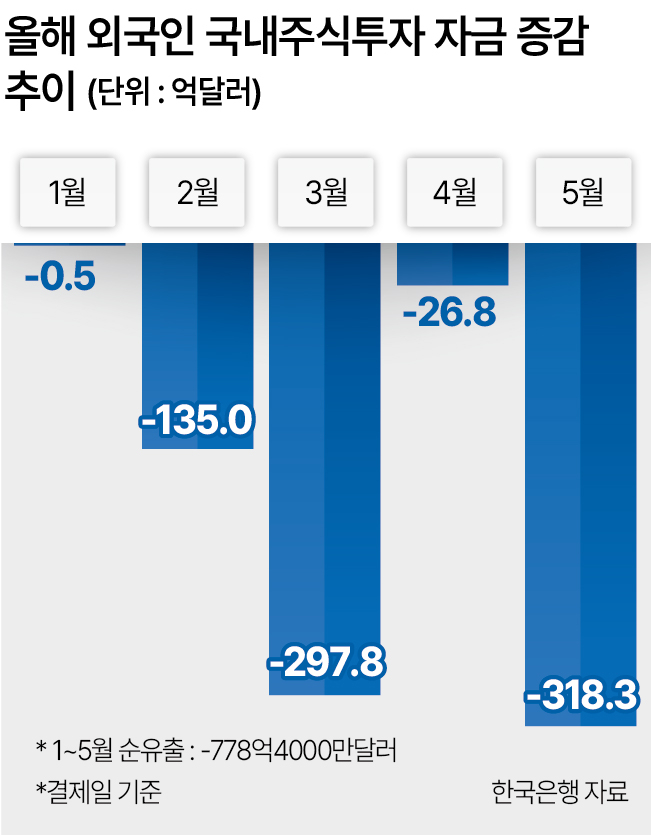
According to the Bank of Korea's Financial Stability Report for the first half of 2026, released Wednesday, net foreign equity outflows totaled $77.84 billion from January through May. Outflows accelerated sharply from February, rising from $13.5 billion that month to $29.78 billion in March, before narrowing to $2.68 billion in April. May alone saw $31.83 billion leave the market — the largest monthly net outflow on record.
Foreign securities flows have diverged between the bond and equity markets so far this year. While equity funds have continued to flow out, bond inflows have been gradually increasing. Bond flows swung back to net inflows in April, when South Korea's inclusion in the World Government Bond Index took effect, after recording a large net outflow in March amid escalating Middle East tensions. The pace of inflows, however, remains somewhat slower than during the same period last year.
The Bank of Korea assessed that the effects of WGBI inclusion are becoming more pronounced in the bond market. From January through May, foreigners net purchased $17.6 billion in government bonds eligible for WGBI inclusion, while net withdrawing $9.9 billion from non-eligible bonds such as monetary stabilization securities. Narrowing the scope to government bonds with remaining maturities of one to 30 years — the WGBI eligibility range — the average monthly net investment in April and May reached $6.8 billion, well above last year's monthly average of $4.1 billion. WGBI-tracking funds led by Japanese pension funds are seen as the primary driver of those inflows.
In the equity market, the profile of sellers varied by investor type. Global investment banks led net outflows in March, while global funds and pension funds drove outflows in February and May. In March in particular, selling by global investment banks intensified as risk-aversion sentiment spread globally in the wake of Middle East conflict and domestic market volatility surged. Once the domestic stock market began setting consecutive all-time highs, global funds and pension funds moved to rebalance their asset allocations and lock in gains.
"Since November last year, foreign equity outflows driven by profit-taking and rebalancing following share price gains have been observed repeatedly," the Bank of Korea said. "Given the recently elevated level of share prices, it is difficult to rule out the possibility of additional short-term outflows." The central bank added that foreign equity outflows exert upward pressure on the exchange rate from a foreign exchange supply-and-demand perspective.
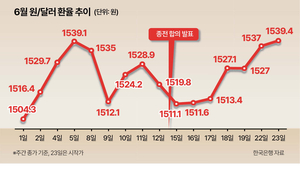
The government has also taken note of foreign profit-taking in equities as a factor behind the won's recent weakness. At a Cabinet meeting Tuesday, President Lee Jae-myung commented on the won-dollar rate climbing into the mid-1,500 won range, calling it "excessive relative to our economic fundamentals." He added: "When our stock market does well, foreign buying should normally bring in dollar supply — but because prices rose so sharply, foreigners found that their Korea allocation had grown too large and needed to be reduced."
The prolonged high exchange rate is also raising alarm for vulnerable industries, as it inflates input costs for companies that rely heavily on imported raw materials, further eroding the debt-servicing capacity of already-stressed sectors. Corporate loan delinquency rates have in fact risen again. The rebound in delinquencies is particularly striking given that overall corporate earnings have improved, pointing to a concentration of debt stress in specific industries.
The delinquency rate on financial institutions' corporate loans — measured across all lenders and covering principal and interest overdue by one month or more — stood at 2.43 percent at the end of the first quarter, reversing a four-consecutive-quarter decline to rise for the first time in a year. The rate significantly exceeds the long-term average of 1.62 percent recorded since 2013.
Among listed companies — based on a sample of 2,854 firms — the operating profit margin rose to 7.3 percent last year from 5.6 percent the year before, and the debt-to-equity ratio improved to 80.6 percent. Yet delinquency rates still climbed, reflecting the drag from a handful of struggling sectors. The Bank of Korea separately classified construction, petrochemicals and metal products as "vulnerable industries," and wholesale and retail trade and real estate as "industries requiring caution." Vulnerable industries are those where both growth and profitability have deteriorated, while cautionary industries are those that have stagnated or gradually declined over several years.
The interest coverage ratio — which measures how well a company can cover interest payments with operating profit — fell for the construction sector to 1.0 times last year from 8.1 times in 2021. Petrochemicals dropped sharply over the same period, from 14.1 times to 1.3 times, and metal products from 15.7 times to 3.2 times. A ratio below 1.0 indicates a company cannot cover even its interest expenses from operating profit — the threshold for classifying a firm as a "zombie company."
The Bank of Korea assessed that this weakness stems not from temporary shocks but from structural problems within the industries themselves. Construction continues to suffer from a prolonged slump in regional real estate markets, compounded by rising material costs driven by the high exchange rate. Petrochemicals and metal products are being squeezed by a supply glut originating from China.
There are also concerns that the deterioration concentrated in vulnerable industries could spread risk to the financial sector. The construction sector's delinquency rate has soared to 5.48 percent as losses from real estate project financing materialized. The cautionary industries — wholesale and retail trade at 2.52 percent and real estate at 3.01 percent — also exceed the overall average. These sectors account for a large share of total corporate lending as well: wholesale and retail trade and real estate together represent 36.5 percent of all corporate loans.
Substandard and below loans at domestic banks — credit classified as likely to go bad — grew to 17.7 trillion won ($11.5 billion) as of the end of March, nearly double the trough of 9.7 trillion won recorded in September 2022 and rising consistently since then. The construction sector sourced 47.3 percent of its borrowings from non-bank lenders such as savings banks and mutual finance cooperatives, while the real estate sector sourced 30.9 percent from the same channels. Because non-bank institutions have a lower capacity to absorb losses than banks, a worsening of bad debt could cause risk to spread rapidly, particularly among more vulnerable non-bank lenders.
For construction, petrochemicals and metal products — all mired in structural decline — the Bank of Korea said restructuring should be "pursued consistently from a medium- to long-term perspective to transform the industrial fundamentals, with financial support to ease liquidity burdens provided in parallel where necessary." For wholesale and retail trade and real estate, which carry large loan balances and elevated delinquency rates, the central bank said financial institutions need to pay particular attention to managing asset quality.
forest@heraldcorp.com
psj@heraldcorp.com