Margin financing balance reaches 39.4 trillion won, up fivefold in a year
Household credit health flashes warning signs as unsecured loans rise 3.5%
Share of vulnerable borrowers grows; multi-property owners face rising default risk
Rate hikes seen amplifying default risks; BOK urges preemptive action

By Kim Byeo-ri, The Herald Business
Securities firm borrowing for stock investment has risen by the largest margin on record this year, driven by a sharp rally in share prices. The Bank of Korea warned that the recent surge in debt-fueled investing — known in Korean as "bittoo," or borrowing to invest — is amplifying volatility in the stock market. Concerns about household financial health are also mounting as defaults spread among vulnerable borrowers and multi-property owners.
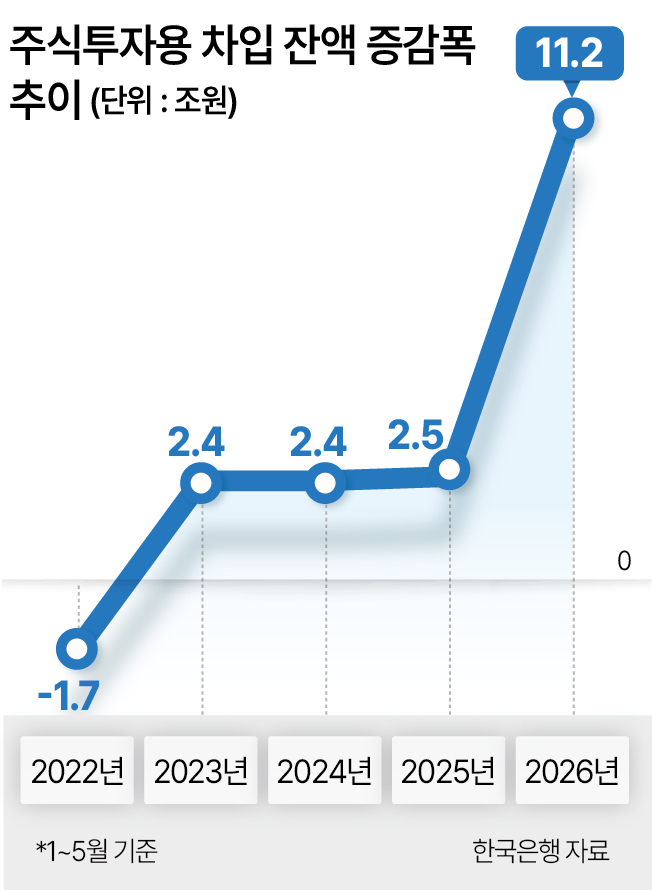
According to the BOK's financial stability report for the first half of 2026, released Wednesday, the outstanding balance of margin financing and unsecured credit used directly for stock purchases stood at 39.4 trillion won ($25.6 billion) as of end-May, up 11.2 trillion won from the start of the year. That is roughly five times the increase recorded in the same period last year (2.5 trillion won) and the largest rise since the data series began in 1999.
Margin financing refers to funds borrowed from securities firms to purchase stocks, while unsecured credit covers shortfalls that brokerages cover on behalf of investors at settlement and recoup later. Both involve investing with borrowed money from a securities firm. The figures reflect a growing number of investors taking on debt to ride the recent stock rally.
Household lending at banks also jumped, driven largely by debt-fueled investing. Household loans at deposit-taking banks rose 6.9 trillion won from the previous month in May, the largest monthly increase in one year and nine months. Other loans — including unsecured credit — surged 3.7 trillion won. According to the office of People Power Party lawmaker Lee Yang-su of the National Assembly's Political Affairs Committee, the four major commercial banks — KB Kookmin Bank, Shinhan, Hana and Woori Bank — had already exceeded their monthly management targets for other loans through May.
Assets in leveraged exchange-traded funds also expanded sharply. Leveraged ETFs track multiples of the movement of an underlying asset, and growing investor appetite for higher returns has fueled inflows. The BOK said total net assets of leveraged ETFs reached 35.4 trillion won at end-May, up 22.6 trillion won since the start of the year.
"During the stock price rally, borrowing directly linked to stock purchases — including margin financing and unsecured credit — as well as leveraged ETF assets have grown rapidly," the BOK said. "A significant portion of the increase in household other loans, which has accelerated since the fourth quarter of last year, may also have flowed into the stock market."
The concern is that this wave of debt-fueled investing could translate into broader financial instability. The BOK said borrowing products used to buy stocks can amplify price swings through forced selling, while leveraged ETFs can do the same through increased redemptions or fund position adjustments. The central bank's own estimates show a correlation coefficient of 0.32 between daily stock price declines of 5 percent or more and net outflows from leveraged ETFs, and -0.16 between such declines and forced selling of unsecured credit positions — the closer to 1 or -1, the stronger the relationship.
Warning signs are also flashing for household financial health. Household credit stood at 1,993.1 trillion won at the end of the first quarter, up 3.5 percent from a year earlier. Household loans have gained further momentum since May, as housing transactions that surged ahead of the reimposition of heavy capital gains taxes on multi-property sales are now feeding through to loan disbursements with a lag, on top of the rise in other loans tied to debt-fueled investing.
The share of vulnerable borrowers rose to 6.7 percent at end-March, up 0.3 percentage point from the end of the third quarter of last year (6.4 percent). Measured by loan amount, the share climbed 0.3 percentage point over the same period, from 4.9 percent to 5.2 percent.
Default risks among multi-property owners have also grown. The average delinquency rate for borrowers holding three or more properties stood at 1.35 percent at end-March, higher than the rates for single-property owners (0.7 percent) and two-property owners (0.52 percent). The rate for borrowers with three or more properties has remained above 1 percent for seven consecutive quarters since surpassing that threshold in the third quarter of last year. The BOK recommended that authorities "strengthen preemptive soundness management and encourage property sales" for multi-property households, given their heightened exposure to market interest rate and housing price fluctuations.
The BOK further warned that the expansion of household debt — centered on debt-fueled investing — could deliver a larger shock now that the economy has entered a full-fledged rate-hike cycle. BOK Governor Shin Hyun-song has signaled the possibility of rate increases on multiple occasions, beginning with the most recent monetary policy meeting. Markets are also pricing in the possibility of two rate hikes within the year.
"Rising market interest rates could in the short term increase volatility in financial markets and heighten default risks in vulnerable sectors," the BOK said. "Policy authorities should preemptively prepare for related risks to maintain financial market stability while continuing to manage defaults in vulnerable sectors."
Hwang Geon-il, a member of the Monetary Policy Board who oversaw the preparation of the report, said defaults among vulnerable borrowers are rising, volatility in domestic financial and foreign exchange markets has increased, housing prices continue to climb, and leveraged asset investment is growing — all of which have revived concerns about household debt expansion. "As financial imbalances accumulate, we need to be mindful of the possibility that deepening polarization across sectors of the economy could become a latent risk to financial stability," he said.
kimstar@heraldcorp.com