National Assembly Budget Office analysis
Global demand rises alongside prices
![An aerial view of Samsung Electronics' Pyeongtaek Campus, the world's largest semiconductor production facility. [Samsung Electronics]](https://wimg.heraldcorp.com/news/cms/2026/06/24/news-p.v1.20260220.200f6549444647c59380833fe8a24154_P1.png)
A booming semiconductor cycle sustained through year-end could lift South Korea's real GDP growth rate by 0.8 percentage points this year, according to a new analysis.
The National Assembly Budget Office said Wednesday in a report titled "Strong Semiconductor Exports and South Korea's Economic Growth This Year" that if the current upswing in semiconductor export prices and volumes continues through year-end, real GDP growth could rise by 0.8 percentage points and nominal GDP growth by 6.6 percentage points.
The strong export performance is being driven by surging AI investment from global technology giants. Amazon, Google, Meta and Microsoft are pouring large sums into AI data centers and infrastructure, fueling a sharp rise in demand for high-performance, high-capacity memory chips.
As the AI industry expands from the training phase into the inference phase, the importance of memory chips — including HBM, DRAM and NAND — is growing. South Korea holds world-class technology and production capabilities in these segments, meaning the surge in AI investment is translating directly into export gains.
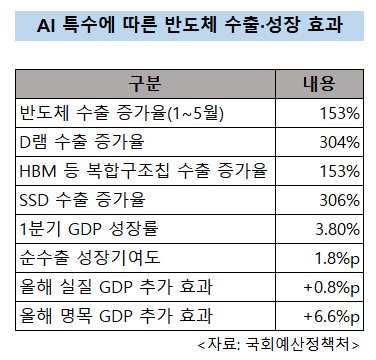
Semiconductor exports from January through May surged 153 percent year-on-year. DRAM exports jumped 304 percent, while shipments of complex-structure chips — a category that includes HBM — rose 153 percent. Driven by demand for AI servers, SSD exports climbed 306 percent and computer and peripheral exports increased 248 percent.
Rising export prices have also contributed to the growth outlook.
The semiconductor export price index rose 163 percent year-on-year as of May, driven in part by higher DRAM prices. Export prices for computers and peripherals, including SSDs, climbed 124 percent. The export deflator for the first quarter rose 23.5 percent year-on-year, reflecting broad improvement in export unit prices.
The export-led strength, centered on semiconductors, is already having a significant impact on the broader economy. Real GDP grew 3.8 percent in the first quarter, with net exports contributing 1.8 percentage points to that figure — accounting for roughly 47 percent of total growth.
Analysts also note that the current semiconductor boom differs from past memory cycles in having a more structural character.
Long-term supply agreements of one to three or more years are becoming more common, and AI chips such as HBM are increasingly sold through custom order arrangements in which production and supply plans are locked in from the design stage. This suggests the export upswing is likely to last longer than previous cycles.
External risks remain, however. A potential rise in global oil prices stemming from the war in the Middle East and US tariff policy could weigh on growth. Analysts also note that the benefits of growth are concentrated among a handful of large export-oriented companies such as semiconductor firms, and that broader diffusion across the economy will take time.
The budget office said the strong semiconductor exports "will have a positive effect on increasing the nation's real purchasing power, expanding tax revenues and easing the government's fiscal burden," adding that "measures are needed to address the widening growth gap between economic actors and industries."
fact0514@heraldcorp.com