
Workers in Seoul's subsidized home-cleaning program say they are left without air conditioning
Labor groups call on Seoul Metropolitan Government to set heat protection standards
![[Created using AI]](https://wimg.heraldcorp.com/news/cms/2026/06/23/news-p.v1.20260623.964c92063db944fa84623e5ef1d5becd_P1.png)
"There are quite a few homes that won't turn on the air conditioner even though they have one. They tell us to clean the bathroom with the door closed, and we feel too uncomfortable to even ask for a glass of water."
As extreme heat intensifies, the risk of heat-related illness among outdoor workers such as delivery and courier drivers has drawn growing public attention — but housekeepers who work inside private homes face serious heat dangers too, labor advocates say.
Housekeepers participating in the Seoul Metropolitan Government's "Seoul-type home service" program say they perform hours of cleaning and organizing without adequate access to air conditioning, and are calling on the city to act.
The Housework and Care Union of the Korean Confederation of Trade Unions' National Solidarity Labor Union, along with the Korea Domestic Workers Association, held a press conference in front of Seoul City Hall on Wednesday to demand that the city establish heat response measures for workers in the program.
According to the union, housekeepers work nonstop for about three hours at each household, cleaning and tidying rooms and bathrooms. Many homes do not run their air conditioners despite having them installed, and workers are often told to clean bathrooms with the door shut. Workers say it is also common to feel too self-conscious to ask for even a glass of water.
The union criticized the city for failing to introduce any meaningful response despite the problem recurring every year. It said Seoul has shifted responsibility onto the program's implementing agencies while failing to establish even basic standards — such as requirements for cooling during heat waves or guidelines to protect workers.
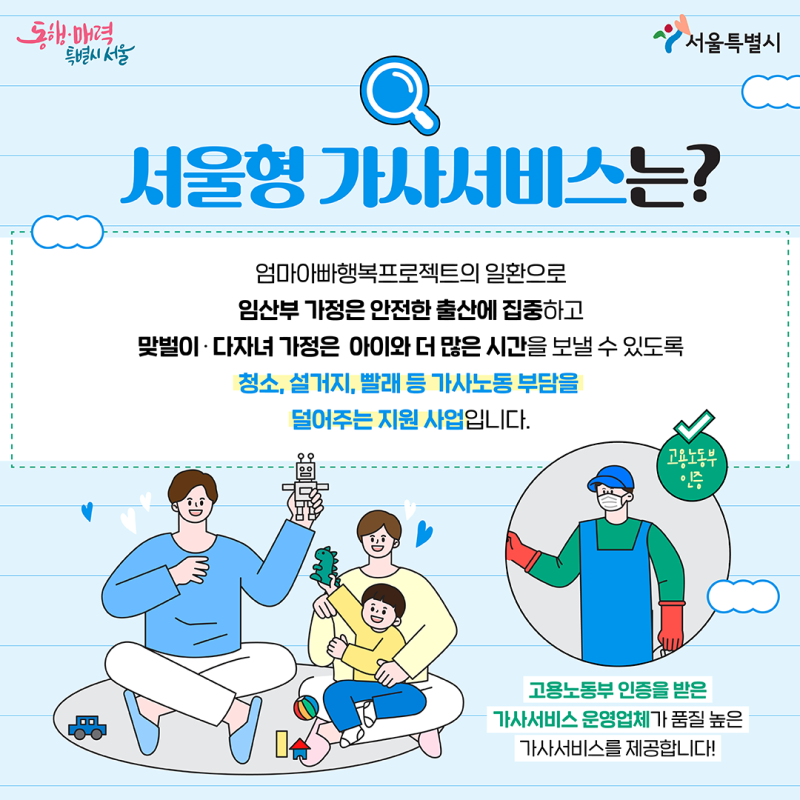
The Seoul-type home service program was launched in 2023 as part of the city's "Mom and Dad Happiness Project," a low birth rate policy initiative. The program subsidizes home-cleaning costs for pregnant women, dual-income households and families with multiple children. Housekeepers affiliated with private agencies selected by the city visit participating households to carry out cleaning and organizing tasks.
While the program has been recognized as a policy that eases the domestic burden on households and improves caregiving conditions, labor groups argue that working conditions for housekeepers have not kept pace with its expansion. The per-visit service duration has been cut from four hours to three since the program launched, raising the intensity of the work — yet basic labor standards such as heat protection remain in effect left to the discretion of individual users and agencies.
"Not only mobile workers on the street but also housekeepers working inside homes are directly exposed to extreme heat," the Housework and Care Union said. "The Seoul Metropolitan Government, as the program's designer and the body ultimately responsible, must establish minimum safety standards."
At the press conference, the groups released the results of a preliminary survey on heat conditions faced by housekeepers and announced plans to formally call on the city to mandate cooling in client households, provide advance education for service users, and guarantee the right to stop work during heat waves.
"Extreme heat is not merely an inconvenience — it is a matter of workers' lives and safety," labor groups said. "Housekeepers must not be left in a blind spot of heat protection simply because they work in the private space of someone's home."
fact0514@heraldcorp.com




