Output falls to 15-year low
Production peaked at 72.5 million tons in 2018, down 14.2% since
10 million tons of output lost in seven years
Domestic consumption at lowest since 2002
Korea risks missing global demand recovery
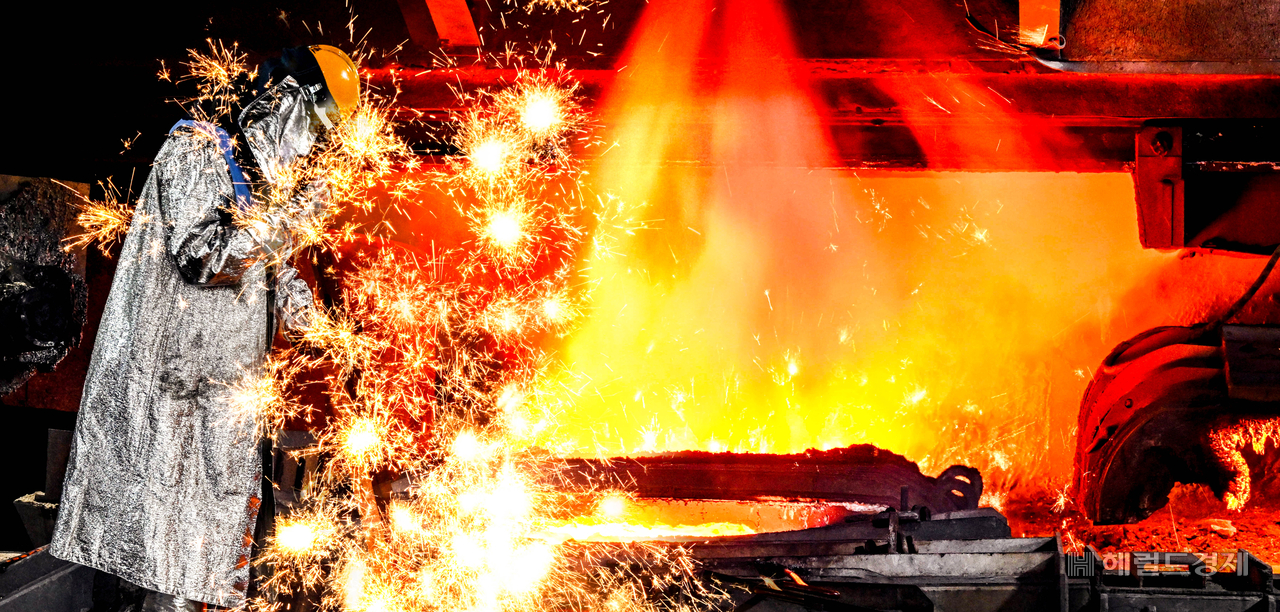
South Korea's steel industry has held its place as the world's sixth-largest producer, but its underlying strength is eroding fast. Output has fallen by more than 10 million tons in the seven years since peaking in 2018, retreating to levels last seen 15 years ago, while domestic consumption has sunk to a 23-year low. As global steel demand attempts a recovery after bottoming out, concerns are growing that Korea could be left behind — squeezed by a construction slump, slowing manufacturing investment and spreading protectionism.
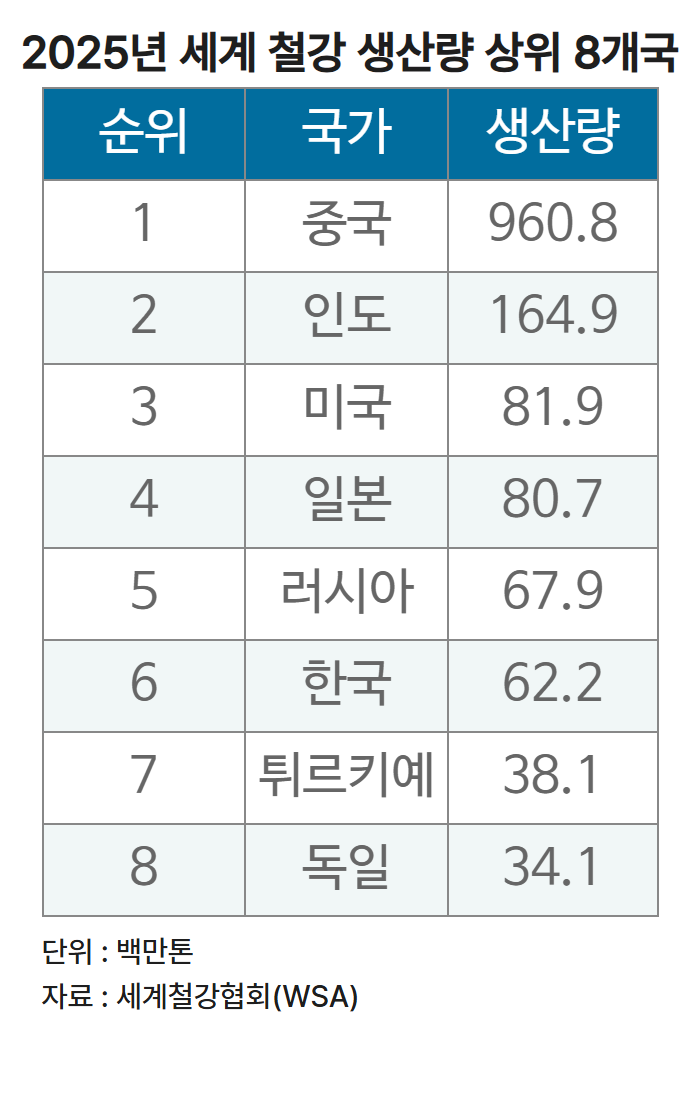
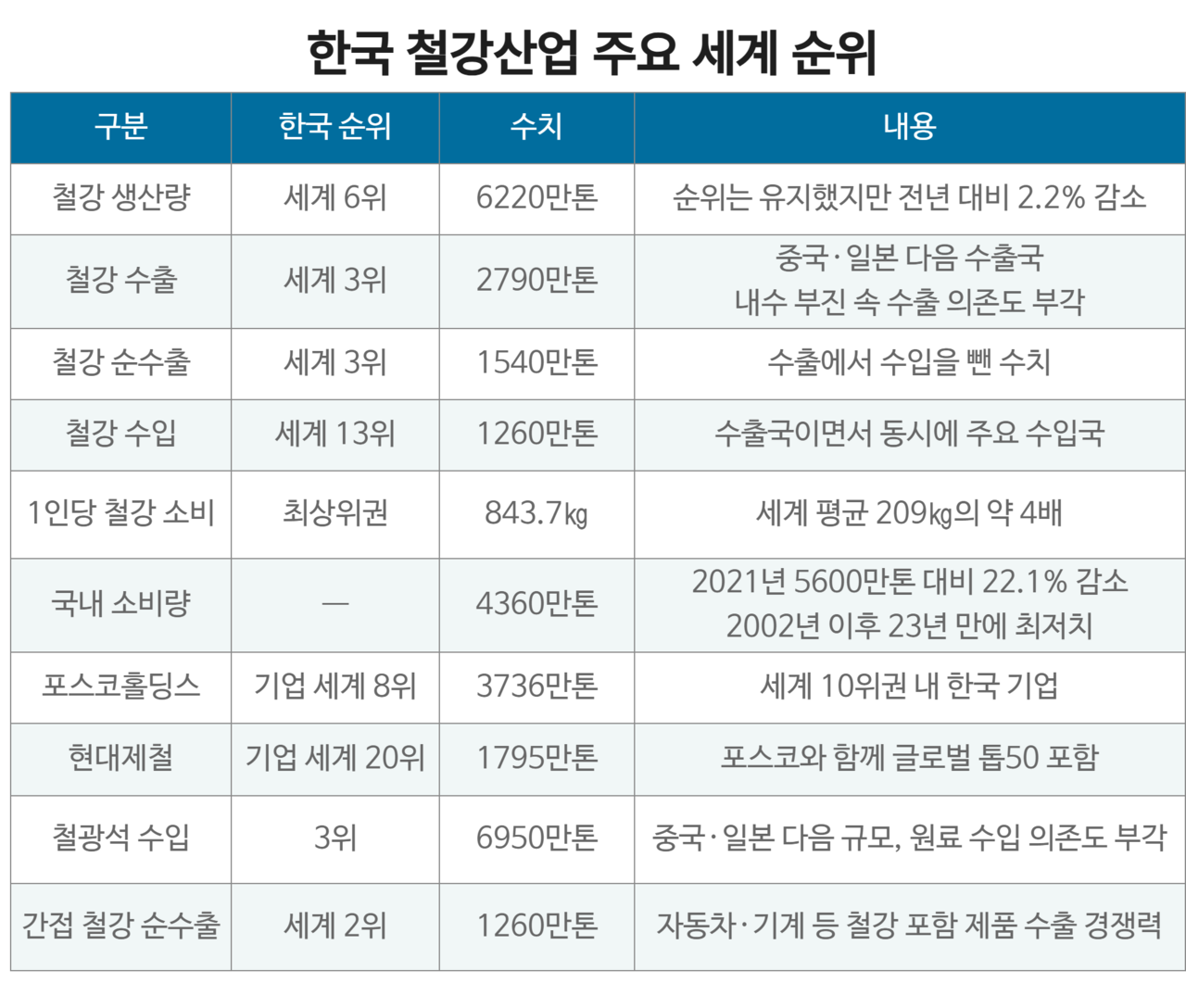
According to the World Steel Association's "2026 World Steel in Figures" report released Tuesday, South Korea produced 62.2 million tons of crude steel last year, ranking sixth globally. That was down about 2.2 percent from 63.6 million tons in 2024, though the country held its ranking. The only countries that outproduced Korea were China, India, the United States, Japan and Russia.
South Korea has consistently ranked fifth or sixth in global steel production since the World Steel Association began compiling the data in 2000. Starting at sixth place with 43.1 million tons that year, Korea climbed to fifth from 2002 to 2005 before being pushed back to sixth by Russia in 2006. It has remained in sixth place ever since, with the exception of two brief returns to fifth in 2014 and 2018.
Gap with India widens from 1.5 times to 2.7 times in five years
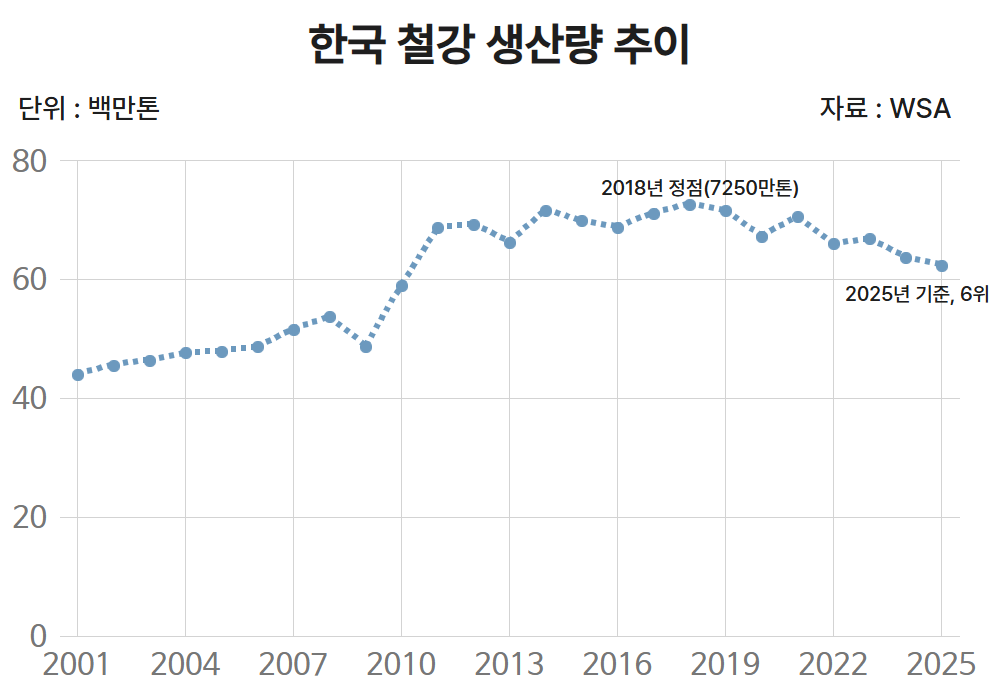
Despite holding its ranking, South Korea's steel output has been on a prolonged slide. After peaking at 72.5 million tons in 2018, production fell to 62.2 million tons last year — a drop of 10.3 million tons, or about 14.2 percent, over seven years. Output briefly recovered to 70.4 million tons in 2021, only to fall back into the mid-60 million ton range and then slip further to the low 62 million ton range last year. That is the lowest level since 2011.
Over the same period, the global steel landscape has shifted dramatically. India's rise has been particularly steep. As recently as 2006, India produced 44 million tons — less than Korea's 48.5 million tons — but after overtaking Korea for the first time in 2007, India has consistently widened the gap. By 2018, it had surpassed Japan to become the world's second-largest steel producer.
The pace of divergence has accelerated sharply. India's output was about 1.2 times Korea's in 2014, and roughly 1.5 times in both 2018 and 2020. Last year, India produced 164.9 million tons while Korea managed only 62.2 million tons — about 2.7 times Korea's total.
Domestic demand hits 23-year low
The steepest challenge facing Korea's steel industry is weak domestic demand. From the late 2000s through the mid-2010s, domestic steel consumption generally held in the 50 million ton range. It climbed to 58.6 million tons in 2008 before plunging to 45.4 million tons in 2009 in the immediate aftermath of the global financial crisis, then recovered back above 50 million tons.
Recent trends tell a different story. Domestic steel consumption fell from 56 million tons in 2021 to 51.3 million tons in 2022, edged up to 52.4 million tons in 2023, then dropped to 47.8 million tons in 2024 and slid further to 43.6 million tons last year. That represents a decline of 12.4 million tons, or about 22 percent, in just four years from 2021. Last year's figure also undercut the 43.7 million tons recorded in 2002, marking the lowest domestic consumption in 23 years.
Exports provide a lifeline, but dependence is a risk
Steel demand is closely tied to the fortunes of key industries including construction, automobiles, shipbuilding and machinery. While the auto and shipbuilding sectors have provided some support, analysts say a construction slump and slowing manufacturing investment are dragging overall steel demand lower.
Exports have at least held the line. South Korea shipped 27.9 million tons of steel last year, ranking third in the world behind China and Japan. Imports stood at 12.6 million tons, good for 13th globally, while net exports — exports minus imports — came to 15.4 million tons, also third in the world.
World rebounds while Korea risks being left behind
With domestic demand shrinking, overseas markets have become the foundation propping up Korea's production base — but that also means the industry's exposure to external risks is growing in tandem. The expansion of low-cost Chinese steel exports, tightening protectionism in the United States and the EU, and carbon regulations are all cited as mounting burdens for Korean steelmakers.
As global steel demand attempts a recovery after two years of decline, Korea risks missing the rebound. The World Steel Association projects global steel demand will rise 0.3 percent this year after two consecutive years of contraction, then recover by 2.2 percent in 2027. Korea's domestic consumption, meanwhile, hit a 23-year low of 43.59 million tons last year, and analysts say a recovery to 45 million tons is unlikely either this year or next.
"China is expected to see six consecutive years of declining steel demand, and Japan is on track to record its lowest demand in 60 years," said Chu Ji-mi, a senior researcher at the Posco Research Institute. "Korea also faces the risk of a prolonged structural demand slump due to the construction downturn and delayed manufacturing recovery, which means the industry needs to pursue differentiated export strategies tailored to the fundamental conditions of each target market."
kwater@heraldcorp.com