![Qatar's Prime Minister Sheikh Mohammed bin Abdulrahman bin Jassim Al Thani (left) greets Pakistani Prime Minister Shehbaz Sharif as US Vice President JD Vance looks on. [AP]](https://wimg.heraldcorp.com/news/cms/2026/06/22/news-p.v1.20260622.909f37be00bc45219085e1850dfef11b_P1.png)
An awkward moment at Iran nuclear talks in Switzerland drew attention Sunday after Qatar's prime minister appeared to snub US Vice President JD Vance on camera, walking past him without a greeting.
Vance arrived at the Bürgenstock Resort on the shores of Lake Lucerne on Sunday for four-way talks with Iran, with Qatar and Pakistan serving as mediators.
The negotiations brought together Qatar's Prime Minister Sheikh Mohammed bin Abdulrahman bin Jassim Al Thani, Pakistani Prime Minister Shehbaz Sharif and Pakistani Army Chief Gen. Asim Munir.
As Al Thani entered the venue, Vance smiled in his direction — but the Qatari prime minister walked straight past him and greeted Sharif and Munir with warm embraces. Vance responded with an awkward smile. When the two men stood side by side for a joint announcement, they exchanged only a brief glance and did not shake hands.
India's Hindustan Times and other foreign media reported that Al Thani had turned away from Vance on camera and warmly embraced Sharif instead.
![Qatar's Prime Minister Sheikh Mohammed bin Abdulrahman bin Jassim Al Thani (right) and Pakistani Prime Minister Shehbaz Sharif clasp hands at the four-way talks on implementing the US-Iran ceasefire memorandum of understanding, held Sunday at the Bürgenstock Resort on the shores of Lake Lucerne, Switzerland. [Reuters]](https://wimg.heraldcorp.com/news/cms/2026/06/22/news-p.v1.20260622.ee60ffd1393049b791dc93ee6c2f834e_P1.jpg)
In a Fox News interview the previous day, Vance said he had seen no evidence that Iran was still keeping the Strait of Hormuz closed, adding that clearing mines from the waterway would take time.
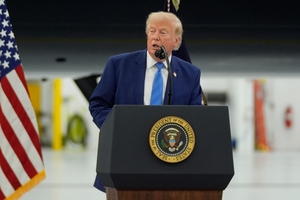
President Donald Trump added fuel to the fire. Trump told Fox News that the United States could "take over" the strait if necessary and would "obliterate" Iran, and warned on Truth Social that if Iran failed to stop Lebanon's Hezbollah from causing trouble, Washington would "hit Iran again, harder than last week."
Trump's combative remarks pushed the talks to the brink of collapse. Iran's state-run IRNA news agency reported that the four-way session, which included mediators Pakistan and Qatar, was suspended after 80 minutes. The Iranian delegation then abruptly walked out, plunging the negotiations into serious difficulty.
Talks later resumed, and the first round concluded with an agreement on a framework for safe passage through the Strait of Hormuz. Discussions on oil exports and the release of frozen Iranian funds made considerable progress, and the mediating countries were expected to issue a joint statement.
Trump warned that if Iran did not immediately stop Hezbollah, its heavily funded Lebanese proxy force, from causing trouble, the United States would strike Iran again.
ygmoon@heraldcorp.com