Micron results seen as bellwether for memory chip sector; semiconductor 'super cycle' faces its next test; PCE inflation data and MSCI review also in focus
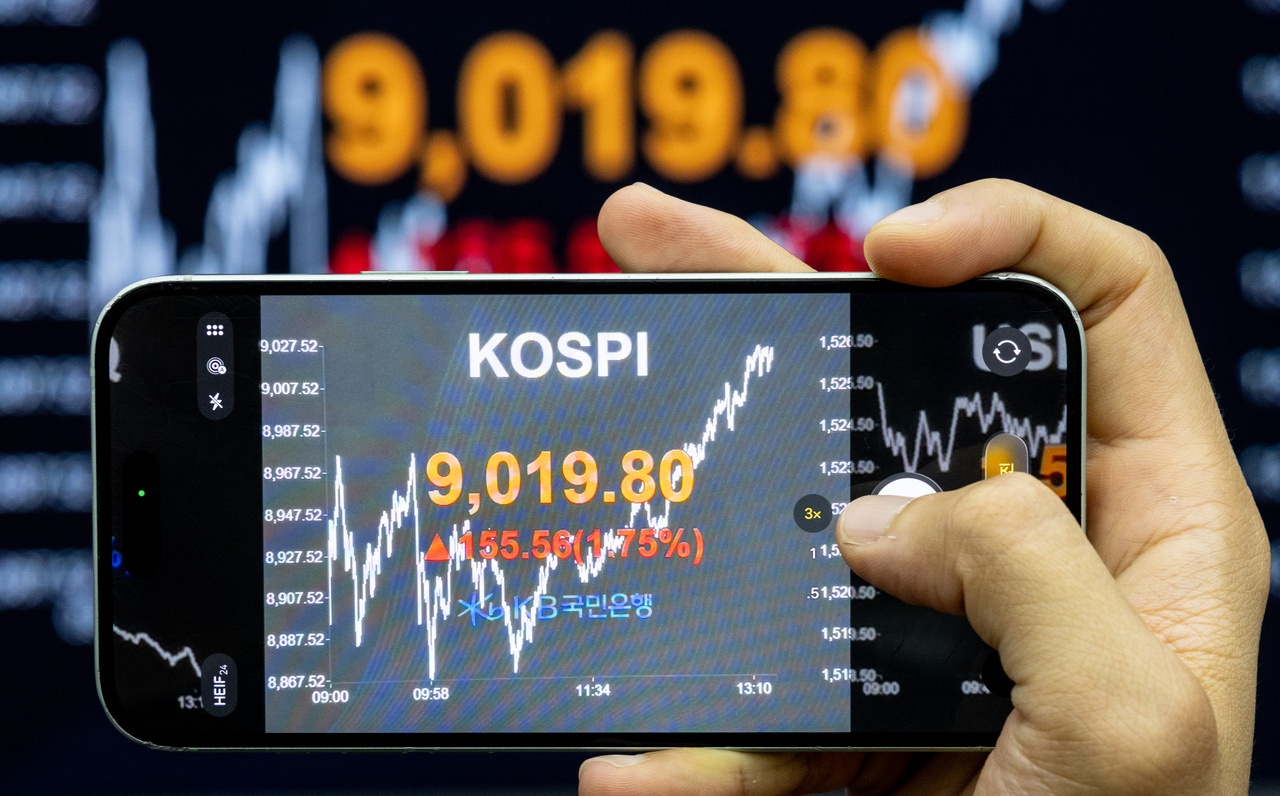
After surpassing the 9,000-point mark for the first time last week, the Kospi is drawing attention for whether it can extend its rally this week and reach the long-awaited milestone of 10,000. The market largely shrugged off rate-hike signals from the US Federal Reserve, but Micron Technology's earnings release Wednesday and the US personal consumption expenditures (PCE) price index due Thursday are seen as the next key tests for the rally's momentum.
According to Korea Exchange, the Kospi closed Friday at 9,052.42, up 928.80 points, or 11.43 percent, from the previous week.
The index climbed from the start of the week after news broke that the United States and Iran had agreed to sign a memorandum of understanding to end hostilities. It crossed the 9,000 mark for the first time on Thursday and surged as high as 9,385.59 intraday on Friday. The index then reversed sharply that afternoon, tumbling more than 550 points to 8,831.72 before recovering to close slightly lower.
The volatility came as profit-taking pressure mounted after six consecutive sessions of gains since June 11, and as the market grew increasingly concentrated in AI infrastructure plays such as Samsung Electronics and SK Hynix.
Foreign investors had been net sellers for a record 24 consecutive trading sessions from early last month through June 11. They returned as buyers once concerns over monetary tightening — driven by high oil prices and inflation tied to Middle East geopolitical risks — began to ease.
During last week's five trading sessions (June 15–19), foreign investors posted net purchases of 2.5587 trillion won (about $1.68 billion) on the main bourse. Retail investors and institutions, meanwhile, net sold 1.9389 trillion won and 243.2 billion won, respectively, booking profits.
The broad selloff late in the week appeared to be triggered by an escalation of armed conflict between Israeli forces and Hezbollah, the Iran-backed Lebanese militant group, which abruptly stalled follow-up negotiations on the US-Iran ceasefire agreement.
This week, the domestic market is expected to take its cues from Micron Technology's earnings, due Wednesday, and the US PCE price index, scheduled for Thursday.
The results will serve as a test of whether market confidence in the semiconductor industry's outlook can hold, and will offer fresh guidance on the Fed's interest rate direction.
Micron's fiscal third-quarter results for the March–May period are considered a major event for investors. Because Micron's performance is widely regarded as a bellwether for the global memory chip market, the figures are expected to have a significant impact on domestic semiconductor stocks as well.
Deutsche Bank estimated last week that Micron posted revenue of $35.1 billion for the quarter, which would exceed the company's own guidance of $33.5 billion.
Micron produces high bandwidth memory (HBM) chips used in AI semiconductors. A strong earnings showing could give AI-related stocks additional upward momentum.
The core PCE price index, which strips out volatile food and energy costs, is forecast to rise 0.3 percent from the prior month. A reading above expectations could increase the likelihood of a Fed policy rate hike.
Dennis DeBusschere, chief market strategist at research firm 22V, said "the tightening cycle is no longer a tail risk — it has become a real risk," adding that such a cycle "would bring with it a rising probability of recession and significant downside risk for equity markets."
He cautioned that "if core PCE continues to move around 0.3 percent month-on-month going forward, there is a meaningful risk that financial conditions tighten significantly."
Also on investors' radar is whether South Korea will be placed on MSCI's developed-market "watch list" — a designation for countries under consideration for inclusion in the developed-market index — in the index provider's annual market classification review, results of which are due early Wednesday morning Korean Standard Time.
Wall Street is expected to trade this week largely on developments from US-Iran negotiations set to take place Sunday in Switzerland, and the Kospi could see heightened volatility depending on how those talks unfold.
anju1015@heraldcorp.com