
Kospi touches record 9,300 for the first time as investment fever grips workers, students and retirees alike; Japan's Nikkei surpasses 70,000; Taiwan's market cap ranks fifth in the world; WSJ says AI boom and chipmaker earnings are overheating investment across East Asia
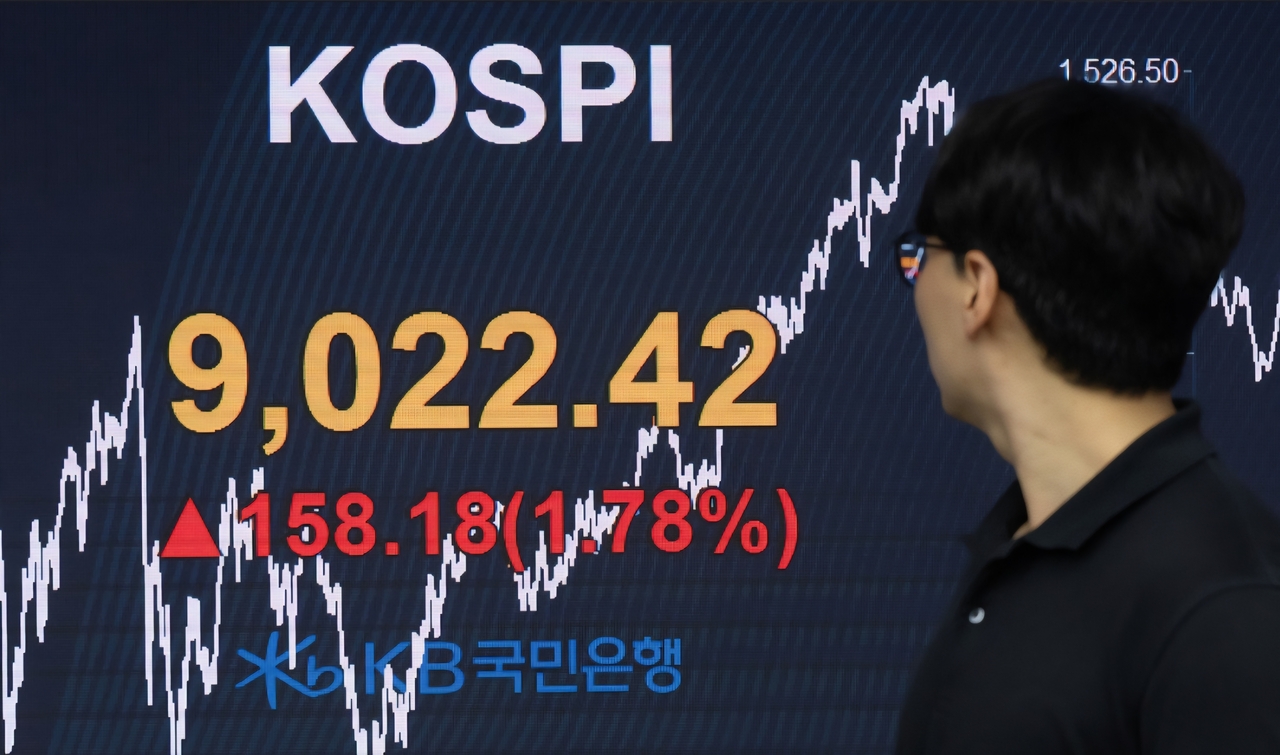
Western media are turning a spotlight on South Korea's stock market after the Kospi broke above 9,300 during intraday trading for the first time in history on Friday. The Wall Street Journal reported Thursday that as major Asian markets surge on the back of AI-driven semiconductor giants, not only office workers but also students in South Korea, Taiwan and Japan are rushing into stocks.
The WSJ said the success of AI-related companies has ignited an investment frenzy across East Asia, with some investors experiencing gains so large they have lost touch with reality.
The Kospi opened Friday up 225.05 points, or 2.48 percent, at 9,288.89 before breaking above 9,300 during trading — a record intraday high — reaching a peak of 9,385.59. The index later reversed course in the afternoon, closing down 11.42 points from the previous session at 9,052.42.
According to the WSJ, Na (24), a South Korean software developer, has poured most of his life savings — $47,000 (65 million won) — into the stock market since January, drawn by the relentless rise in share prices of chipmakers such as Samsung and SK Hynix.
Na also recounted how, when he recently tried to give his mother a gold ring to mark his parents' 30th wedding anniversary, she turned it down and asked for cash instead so she could buy more stocks.
"I can earn or lose a month's salary in a second," he told the WSJ. "After watching some of my holdings more than double, I just can't stop."
![An employee watches a graph of Taiwan's stock market at the Taiwan Stock Exchange office in Taipei on Sunday. [EPA]](https://wimg.heraldcorp.com/news/cms/2026/06/21/news-p.v1.20260621.419218890614444a8f27eda30efe35c8_P1.jpg)
South Korea is not alone in its stock market frenzy. The same phenomenon is playing out in Taiwan and Japan, where chipmakers continue to post strong earnings.
Taiwan's stock market has surpassed those of France, Britain and India to rank fifth in the world by market cap, driven in large part by the strong performance of TSMC, the island's flagship chipmaker.
TSMC accounts for more than 40 percent of Taiwan's benchmark TAIEX index, and its share price has more than doubled over the past year.
The WSJ reported that in Taipei, taxi drivers trade stocks while behind the wheel, lottery tickets offering up to 500 shares of Nvidia as prizes are sold at convenience stores, and working at TSMC has become a calling card for success on blind dates.
Ye Runhao (37), a Taiwanese insurance agent, invests more than half of his roughly $2,100 (3.22 million won) monthly salary in local AI and semiconductor stocks. As a result, the value of his portfolio has quadrupled, enabling him to recently purchase a four-bedroom apartment in Taichung for about $440,000 (670 million won).
"Without semiconductors, none of this would have happened," Ye told the WSJ. "Investing has let me move beyond just surviving and start enjoying the world."
![A pedestrian walks past an electronic stock board showing the Nikkei 225 index surpassing 71,000 in Tokyo on Thursday. [EPA]](https://wimg.heraldcorp.com/news/cms/2026/06/21/news-p.v1.20260621.a7b3ed6baab448d1bba7ad9f8a6d7abf_P1.jpg)
In Japan, the Nikkei has also broken above 70,000 for the first time in history, sparking a frenzied search for "the next Kioxia."
Japanese chipmaker Kioxia has seen its share price surge roughly 50-fold in less than two years since its listing, recently overtaking Toyota and SoftBank Group to become the top company on the Tokyo Stock Exchange by market cap.
Na Ryoki (21), a semiconductor engineering student at a university in Kumamoto, told the WSJ that classmates around him are investing in stocks — though he said he wants to graduate first and secure a stable income before investing himself.
yckim6452@heraldcorp.com



