Manufacturing employment share drops to 14.7%, lowest since current data series began; health and welfare sector closes gap as workforce ages
![Job seekers browse company recruitment information at the "Four Seasons Job Fair" held at a sports complex in Gumi, North Gyeongsang Province. [Yonhap]](https://wimg.heraldcorp.com/news/cms/2026/06/21/news-p.v1.20250809.5f4a13ee8bc147edbf601c32ff052739_P1.jpg)
South Korea's manufacturing sector, long a pillar of the country's labor market, is shrinking rapidly. The share of employed workers in manufacturing has fallen below 15% for the first time since the current statistical series began, while the health and social welfare services sector has consistently expanded its share and is closing in on manufacturing. The proportion of young workers on factory floors has fallen sharply even as workers aged 50 and older surge in number, raising growing concerns about the country's industrial competitiveness.
An analysis of the Ministry of Statistics' economically active population survey and wage employment statistics released Sunday showed that manufacturing employed about 4.295 million workers in May, accounting for 14.7% of the total workforce of about 29.12 million. It is the first time the manufacturing employment share has fallen below 15% since the current data series began in 2013.
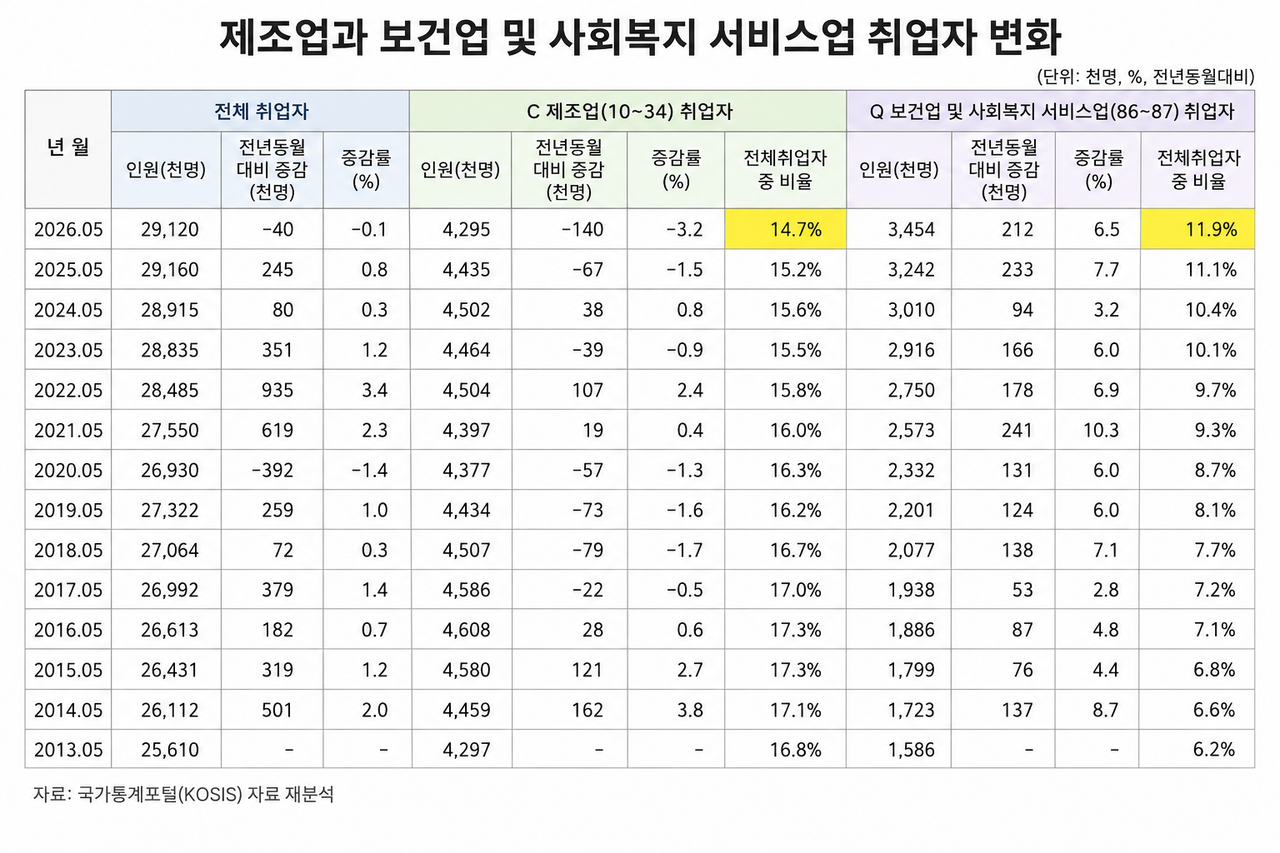
The manufacturing employment share has fallen 2.6 percentage points from 17.3% in May 2016, a decline spanning a decade. The number of manufacturing workers also dropped by 140,000 from the same month last year, the largest year-on-year decrease since February 2019. Manufacturing employment has now fallen for 23 consecutive months.
Manufacturing once accounted for 20 to 30 percent of all employed workers, making it the backbone of job creation in the Korean economy. A structural shift toward a services-led economy, the relocation of production facilities overseas, and the spread of automation have combined to steadily erode the sector's share of the labor market.
Even the semiconductor industry, which has underpinned the Korean economy in recent years, offers limited relief on the employment front. Wage jobs in the semiconductor sector account for only about 4% of total manufacturing employment — far too few to offset the broader decline in manufacturing jobs.
Manufacturing ages as youth jobs disappear
The aging of the manufacturing workforce is equally pronounced.
Among the approximately 4.307 million wage jobs in manufacturing in the fourth quarter of last year, workers aged 40 and under accounted for 64.9% — down 7.2 percentage points from 72.1% in the fourth quarter of 2018. Workers aged 50 and older, meanwhile, rose from 27.9% to 35.2% over the same period, a gain of 7.3 percentage points.
In absolute terms, manufacturing jobs held by workers aged 40 and under fell by 250,000 over the seven-year period, while jobs held by those aged 50 and older increased by 336,000.
Workers in their 20s saw the steepest decline, falling 3.6 percentage points by age group. Those in their 30s dropped 2.9 percentage points and those in their 40s fell 0.8 percentage points, while workers in their 50s rose 1.5 percentage points and those aged 60 and older surged 5.7 percentage points.
The trend mirrors the broader difficulty young people face in finding work across the labor market. As new hiring in manufacturing contracts and the share of older workers on production lines grows, analysts say it is becoming increasingly difficult for young workers to enter the sector.
Health and welfare sector rises to No. 2 employer, displacing manufacturing
The health and social welfare services sector, by contrast, has expanded rapidly.
The sector employed about 3.454 million workers in May, representing 11.9% of the total workforce. Its share has risen 4.8 percentage points over the past decade, up from just 7.1% in May 2016.
As recently as May 2013, the sector ranked seventh among industries by employment share. It has since climbed to second place, trailing only manufacturing.
The primary driver is rising demand for care and medical services as the population ages. The sector itself, however, is also seeing a rapid increase in older workers.
The share of workers aged 50 and older in health and social welfare services jumped 17.1 percentage points — from 38.2% in the fourth quarter of 2018 to 55.3% in the fourth quarter of last year. More than half of all workers in the sector are now aged 50 or older.
Experts say the simultaneous decline in manufacturing jobs and the aging of the workforce are accelerating a fundamental shift in the structure of South Korea's labor market. Without a recovery in manufacturing competitiveness and a renewed influx of young workers, they warn, the foundation of quality employment in the country risks further erosion.
fact0514@heraldcorp.com