Workers 60 and older hold about 2.2 million regular positions, surpassing about 2.12 million among those aged 15–29 for the first time; youth regular employment has fallen for four consecutive years, shrinking nearly twice as fast as the youth population; concerns are growing that debate over raising the retirement age could further suppress new hiring of young workers
![A job-posting board at a university employment center in Seoul, seen as youth employment hits its longest losing streak since the global financial crisis. According to the Ministry of Statistics' April employment survey, the youth employment rate fell 1.6 percentage points to 43.7 percent — the steepest drop since August last year — extending a decline that has now run for 24 consecutive months since May 2024. The slide is the longest since a 51-month streak from September 2005 through November 2009, just after the financial crisis. [Yonhap]](https://wimg.heraldcorp.com/news/cms/2026/06/21/rcv.YNA.20260513.PYH2026051308140001300_P1.jpg)
For the first time, workers 60 and older have overtaken young workers in regular employment — the most stable category of jobs in the labor market. The shift marks a generational reversal not just in the number of employed people but in the quality of employment itself, and comes as debate over raising the mandatory retirement age intensifies, fueling concern that the foundation of youth employment is eroding rapidly.
An analysis of microdata from the Ministry of Statistics' economically active population survey, released Sunday, found that workers 60 and older holding regular positions numbered about 2.2 million as of May. Regular workers aged 15 to 29 stood at about 2.124 million over the same period — the first time since comparable data became available in 2014 that the older cohort has surpassed the younger one.
Regular workers are those on employment contracts of one year or more, making them more job-secure than temporary or daily workers. The category is widely used as a proxy for quality employment, effectively equivalent to full-time permanent positions.
Youth regular jobs shrink for 4th year — faster than population decline
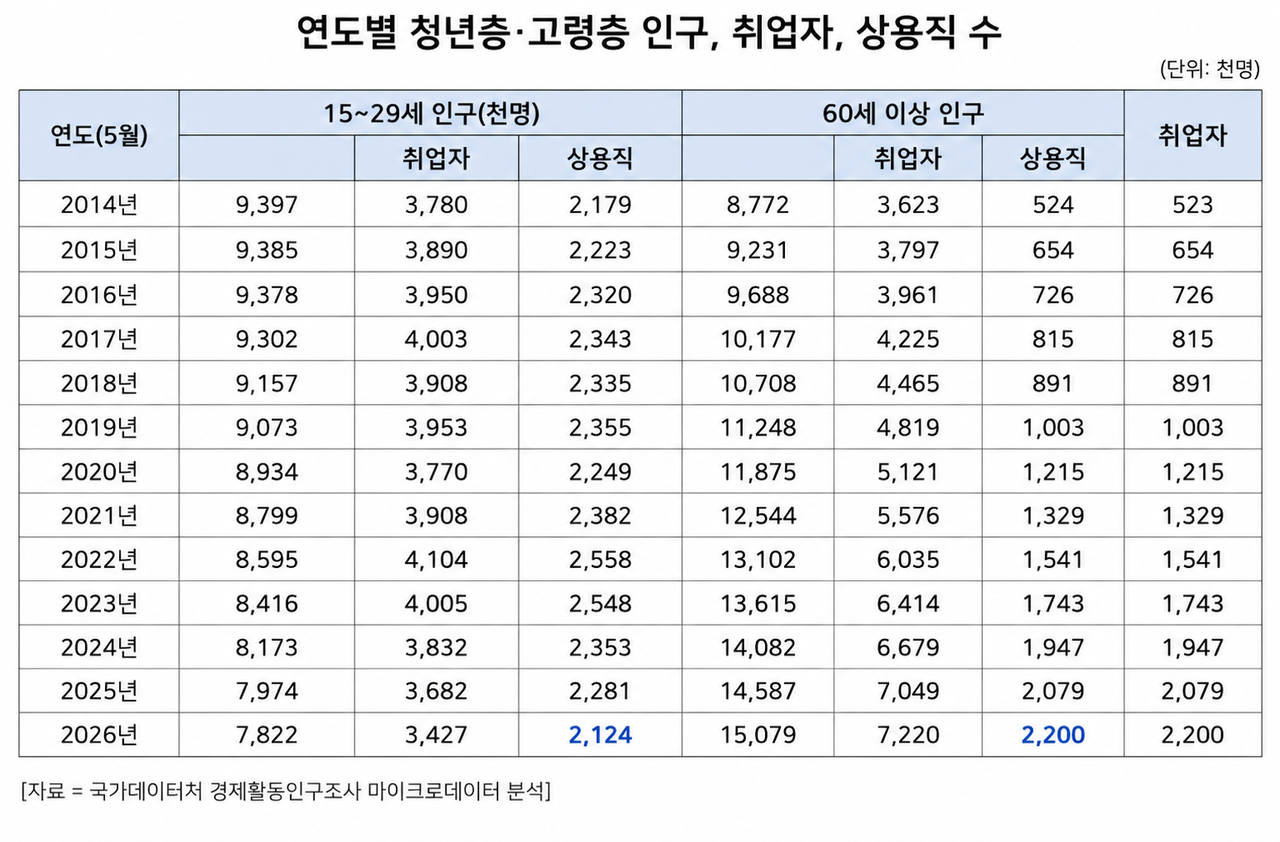
Youth regular employment peaked at about 2.558 million in 2022 and has fallen for four consecutive years. This year's figure of about 2.124 million represents a drop of 434,000, or 17.0 percent, over four years.
Over the same period, the youth population declined by 773,000 — from about 8.595 million to about 7.822 million, a decrease of 9.0 percent. The pace of decline in regular employment was nearly twice that of the population drop.
In May alone, youth regular employment fell 6.9 percent from a year earlier — 3.6 times the 1.9 percent decline in the youth population over the same period.
Workers 60 and older, by contrast, have seen regular employment rise sharply. Over the past four years, the older population grew 15.1 percent, adding about 1.977 million people, while regular employment in that age group surged 42.8 percent, gaining 659,000 positions — a rate 2.8 times the population increase.
The share of regular workers among all employed people 60 and older has also risen consistently, crossing 30 percent for the first time this year. The trend suggests that older workers are moving beyond short-term subsistence jobs into relatively stable forms of employment.
Manufacturing and IT falter while welfare jobs grow
Analysts attribute the shift to a combination of structural changes in industry and evolving corporate hiring strategies.
Manufacturing, the sector where young workers most commonly find entry-level work, has posted 23 consecutive months of employment decline. The information and communications technology sector is also cutting back on junior-level hiring as AI adoption spreads and companies increasingly favor experienced workers.
In May, regular employment in the ICT sector rose among workers in their 30s and older but fell by 59,000 among young workers. Regular youth employment in manufacturing dropped by 33,000.
Meanwhile, health and social welfare services — a sector with a high concentration of older workers — has seen jobs grow consistently, driven by rising demand for care as the population ages. Health and social welfare was also the sector that recorded the largest increase in regular employment among workers 60 and older in May, adding 55,000 positions.
Experts say the declining trend in youth employment must be examined alongside the debate over raising the retirement age. As companies increasingly prefer experienced hires over new recruits, and as older workers remain economically active for longer, barriers to labor market entry for young people could rise further.
The government has responded to the deteriorating employment indicators by launching a joint task force among related ministries and beginning work on youth employment measures. In May, the number of employed young people fell by 255,000 from a year earlier, and the youth employment rate dropped 2.4 percentage points to 43.8 percent.
A Ministry of Economy and Finance official said young people are facing what amounts to a "triple burden" — a shrinking population, an industrial structural shift, ongoing expansion of mid-career spot hiring and growing external uncertainty. "We will mobilize all available resources to improve employment conditions for young people by putting together additional measures," the official said.
fact0514@heraldcorp.com