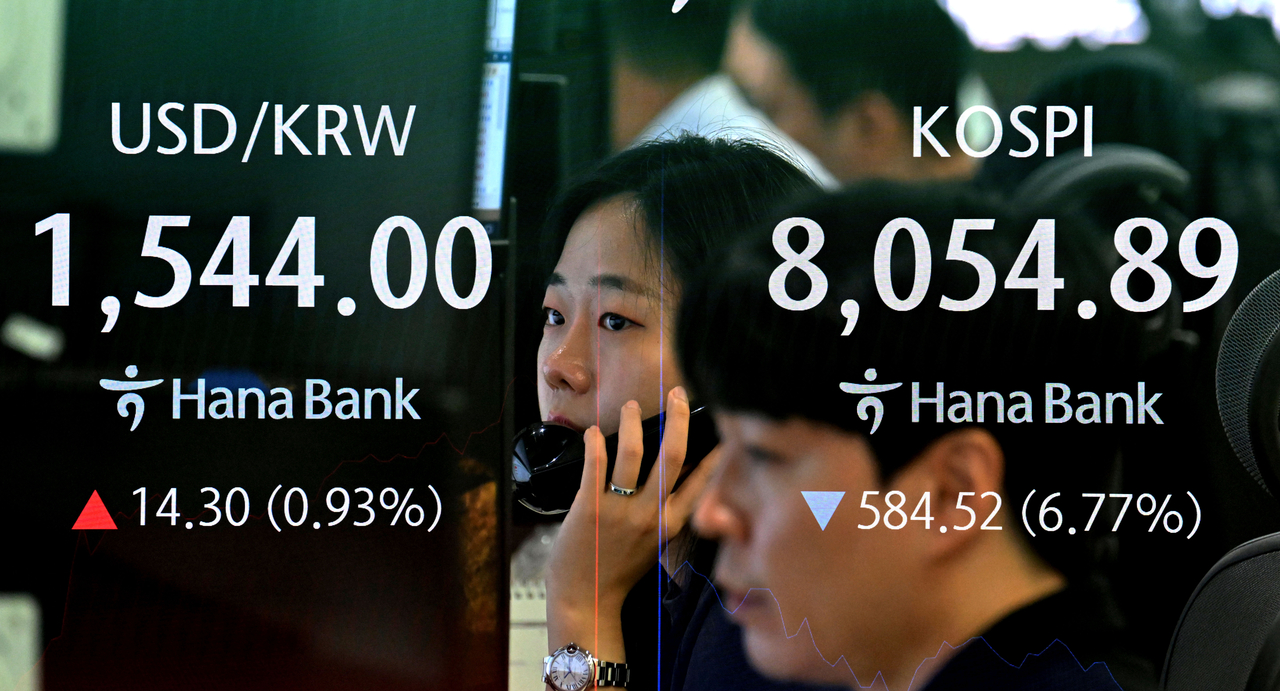
The Kospi's average daily price swing has reached 3.9% so far this month — exceeding even the volatility recorded in March, when war broke out involving Iran. The daily volatility figure measures the ratio of the high-to-low price range within a single trading session.
According to Yonhap Infomax and Kiwoom Securities, the Kospi's average daily volatility from June 1 through June 5 came in at 3.9%. The year-to-date daily average stands at 3 percent.
In March, when war erupted between the United States and Israel on one side and Iran on the other, the average daily volatility was 3.7%. This month's reading has already surpassed that level.
On June 5, when the Kospi suffered a sharp selloff, the daily swing reached 4%. Cases in which the Kospi's average daily volatility exceeded 4 percent have been extremely rare since 1990.
The daily average hit 5.7 percent during the foreign exchange crisis from November 1997 through February 1998, followed by 4.6 percent during the dot-com bubble collapse from June through November 2000, 7.4 percent during the global financial crisis from October through December 2008, and 4.9 percent during the COVID-19 pandemic from March through April 2020.
A key driver of the widening swings is the outsized weight that Samsung Electronics and SK Hynix carry within the Kospi. The two heavyweights together already account for more than 50 percent of the index's total market capitalization.
The recent launch of single-stock leveraged products has flooded the market with Samsung Electronics and SK Hynix leverage instruments, concentrating investor sentiment around the two names. Leveraged products are inherently suited to short-term trading, which amplifies near-term volatility.
The imminent visit to South Korea by Nvidia CEO Jensen Huang also contributed to the Kospi's volatility, as short-term capital flowed into related stocks ahead of his arrival.
High oil prices, a weak won and rising interest rates are also cited as factors stoking Kospi volatility.
Han Ji-young, a researcher at Kiwoom Securities, said all previous instances of daily volatility exceeding 4 percent occurred during sharp market downturns triggered by major crises. "What makes this time unusual is that the volatility is upside volatility occurring within a bull market," Han said, adding that semiconductor-driven earnings momentum and low valuation pressure on the Kospi remain ongoing.
dlcw@heraldcorp.com