Won still surging, threatening 1,550
Iran war fallout drives foreign stock selling
Opaque NDF speculation, Korea-US rate gap weigh
Verbal intervention losing punch; direct action constrained
Won internationalization, other long-term fixes hold the key
![Bank of Korea Gov. Shin Hyun-song speaks at his first monetary policy press conference after taking office, held on May 28. [Bank of Korea]](https://wimg.heraldcorp.com/news/cms/2026/06/05/news-p.v1.20260529.1eda209726364f4aadce72a1c8927c30_P1.jpg)
"I want to use this opportunity to say something clearly and unequivocally."
Bank of Korea Gov. Shin Hyun-song delivered those words with a look of resolve during his first monetary policy press conference after taking office, held on May 28, as he addressed the won-dollar exchange rate's relentless climb. "We will respond to exchange rate overshooting with absolute firmness. We will not tolerate it," he said, repeating the message in forceful terms. He added that the central bank had both the will and the tools to act — a declaration that it would deploy every available instrument to rein in what he called excessive one-way movement in the exchange rate.
Yet the market's anxiety is only deepening. During after-hours trading on Thursday, the won-dollar rate touched 1,540 won for the first time in 17 years. Analysts say the short-term remedies that monetary authorities have long relied on — verbal intervention chief among them — are simply not working.
<style ref="s1">Four main reasons the won-dollar rate is stuck above 1,500</style>
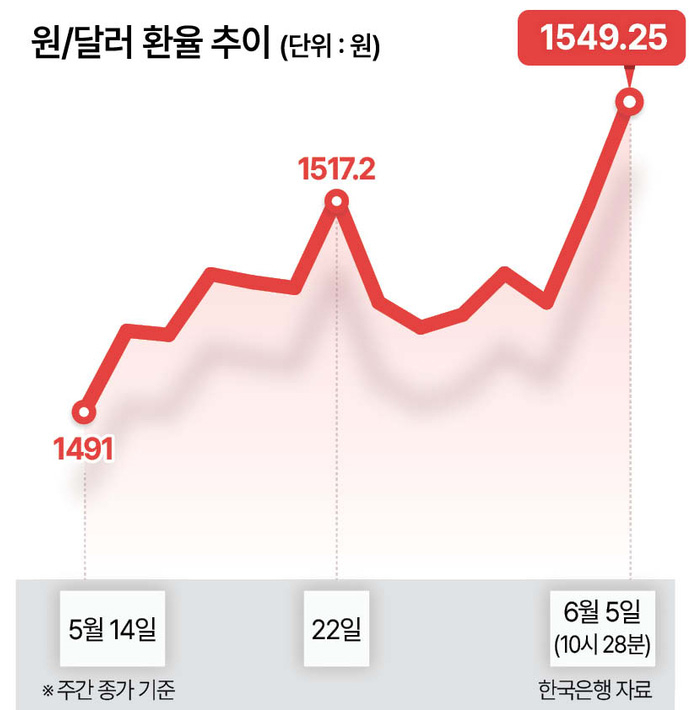
Since the Iran war broke out in late February, the won-dollar rate has been on a sustained upward run. The monthly average rate jumped from 1,448.4 won in February — just before the conflict began — to 1,492.5 won in March, then eased slightly to 1,485 won in April before surging past 1,500 won again in May. Through Thursday, the rate had closed above 1,500 won for 13 consecutive trading sessions on a weekly closing basis. During intraday trading Friday, it hit 1,549.25 won at 10:28 a.m.
At its most basic, the won-dollar rate rises when more people want to buy dollars than want to buy won. The exchange rate is simply the ratio at which the two currencies trade. The more demand there is for dollars, the higher the price of buying them with won — and the higher the exchange rate goes. Conversely, when demand to sell dollars and buy won increases, the rate falls. Excess demand for dollars over won is the fundamental driver of the current high exchange rate.
Foreign exchange authorities have identified four factors behind the recent surge: the supply shock from the Iran war, profit-taking by foreign investors in domestic stocks, trading in the NDF (non-deliverable forward) market, and the interest rate gap between Korea and the United States. All four are working simultaneously to push down the value of the won.
<style ref="s2">Iran war keeps oil prices elevated; foreign selling adds to pressure</style>
The first factor is the spike in oil prices triggered by the Iran war, which is feeding directly into the exchange rate. According to the Bank of Korea, the monthly average price of Dubai crude held in the $62-to-$68.40-per-barrel range in January and February, then nearly doubled to $128.50 in March as the conflict disrupted crude supply. Prices have since retreated — to $105.70 in April and $103.10 in May — as cease-fire signals emerged, but have remained in the mid-to-high $90s so far in June.
Higher oil prices exert both direct and indirect upward pressure on the exchange rate. The Middle East accounts for about 70 percent of South Korea's crude oil imports.
More than 95 percent of that oil is shipped through the Strait of Hormuz, which sits at the center of the Iran conflict. Because crude is priced and traded in dollars, a supply disruption that drives up oil prices means Korea must spend more dollars to import the same volume of crude — boosting demand for dollars and pushing the exchange rate higher.
Rising oil prices also worsen South Korea's current account balance — the difference between money earned abroad and money paid out — and can dampen market expectations for economic growth. That in turn prompts foreign investors to pull capital out of Korea, weakening the won and lifting the exchange rate further.
The most direct and immediate driver of the recent exchange rate rise, however, is the sustained net selling of domestic stocks by foreign investors. As foreigners unload Korean equities in large volumes and convert the won proceeds into dollars, demand for dollars rises and so does the exchange rate. Net selling means the value of shares sold exceeds the value of shares bought. According to Korea Exchange, foreign investors were net sellers on 18 of the 21 trading sessions in the Kospi market between May 4 and Thursday. They also posted 13 consecutive sessions of net selling from June 7 through June 26.
The main reason foreigners have been selling Korean stocks is that the Kospi's sharp rally has generated strong profit-taking demand. The Kospi, which stood in the 4,000s at the start of the year, has climbed to within sight of 9,000 in just four months. As foreign ownership of Korean equities grew, investors moved to rebalance their portfolios by cashing out a portion of their gains. Kim Yong-beom, the presidential chief policy secretary at Cheong Wa Dae, touched on this dynamic in a recent social media post, describing the triple burden of high interest rates, high inflation and a high exchange rate as "the inevitable cost of success as the Korean economy leaps to a new level."
<style ref="s3">NDF market 'wagging the dog'; Korea-US rate gap also a drag</style>
Foreign exchange authorities are keeping a close watch on the NDF market. An NDF is a derivative instrument that does not involve the direct exchange of currencies; instead, only the difference between the contracted forward rate and the settlement rate is paid out at maturity. No physical delivery of foreign currency or exchange of principal takes place — only the net difference is settled in the designated currency.
Authorities believe NDF trading has been destabilizing the won-dollar rate. Derivatives such as NDFs allow investors to take positions worth dozens of times their initial deposit, meaning a relatively small amount of money can have an outsized impact on the foreign exchange market.
If an investor bets on won weakness with 20-times leverage and the won instead strengthens by 5 percent, a margin call forces the investor to sell even more won to cover the position — deepening the very weakness they had wagered on. In short, leverage built up in the comparatively small NDF market is shaking the entire onshore spot foreign exchange market.
Gov. Shin has repeatedly described this dynamic as "the tail wagging the dog." A further complication is that because NDF trading takes place offshore, authorities find it difficult to gauge its scale or assess the risks it poses.
South Korea's interest rates being lower than those in the United States is another underlying factor pushing the exchange rate higher. The Bank of Korea's benchmark interest rate currently stands at 2.50 percent annually, while the US Federal Reserve's benchmark rate is 3.50 to 3.75 percent — a gap of up to 1.25 percentage points. This differential weakens the won through two channels.
Investors can borrow in a low-rate currency and invest the proceeds in higher-yielding assets elsewhere, pocketing the rate differential. With Korea's benchmark rate below that of the United States, demand is growing to borrow won cheaply and invest in dollar-denominated assets. That process involves selling won and buying dollars, pushing the exchange rate up.
A wider Korea-US rate gap also reduces the incentive for domestic investors to hedge their currency exposure, which in turn lifts the exchange rate. Currency hedging involves entering a contract to buy or sell dollars at a predetermined rate to guard against exchange rate losses. When a domestic investor enters such a hedge, it generates a transaction to sell dollars and buy won at maturity. The wider the rate gap, the more expensive hedging becomes, leading investors to leave their dollar assets unhedged and exposed to exchange rate risk. That reduces future demand to convert dollars back into won, weakening the won further.
<style ref="s4">Short-term tools losing their edge — what options remain</style>
The United States and Iran are in final-stage negotiations toward a cease-fire memorandum of understanding, though uncertainty is growing as Iran's Islamic Revolutionary Guard Corps has carried out attacks on US Air Force facilities in Kuwait and the US Navy's Fifth Fleet base in Bahrain. Gov. Shin said the most important factor behind the won's recent weakness is the situation in the Middle East, adding that a rapid easing of tensions there "leaves room for the won to strengthen considerably."
Foreign exchange authorities also expect the pace of foreign stock selling to slow. Gov. Shin said the won's weakness during foreign investor rebalancing out of Korean equities "is a temporary phenomenon." A senior official at the authorities said that once the end of May passed, foreign rebalancing would be largely complete, and that if foreign investors decided to increase their Korean holdings again, the selling pressure would ease.
Authorities are expected to deploy every available tool to counter the one-sided market move. However, analysts note that the instruments immediately at hand are limited, while the remaining options are medium-to-long-term undertakings — leaving no clear short-term path to stabilizing the exchange rate effectively.
The most immediate and direct tools available are verbal intervention, smoothing operations, and the national pension fund's foreign exchange swap arrangement with the Bank of Korea. Verbal intervention means authorities publicly signal their willingness to step into the market to stabilize the rate when it moves sharply.
Despite repeated verbal intervention by foreign exchange authorities in recent weeks, the exchange rate has barely budged. A senior official at the authorities said that unlike in the past, foreign exchange markets now run largely on computer-driven trading, which means verbal intervention carries far less punch than it did when humans executed the trades.
A smoothing operation involves the Bank of Korea selling dollars from its reserves and buying won in the spot market, while the national pension swap arrangement allows the pension fund to obtain dollars directly from the Bank of Korea without entering the foreign exchange market — both of which help push the exchange rate down. These measures, however, are designed to counter temporary overshooting and cannot address the underlying causes.
The remaining options are longer-term in nature. One approach is to bring NDF trading under a regulatory framework, improving transparency in foreign exchange transactions and curbing speculative activity — what is broadly called "won internationalization." The core idea is to draw offshore transactions into the domestic supervisory system by extending foreign exchange trading hours and expanding overseas settlement. Gov. Shin described the goal as "bringing NDF trading into the light."
Raising the benchmark interest rate to narrow the Korea-US rate gap is another option. Gov. Shin said that if the Bank of Korea proceeds with rate increases as suggested by its dot plot, "the rate gap will narrow and the pressure on the won will ease considerably."
The Bank of Korea's Monetary Policy Board formally signaled a shift toward rate hikes at its May 28 policy meeting. Two of the seven board members voted for an immediate rate increase, and the policy statement said the board would "determine the timing of benchmark interest rate increases" in managing future policy. Gov. Shin himself said a rate increase "will be needed at an appropriate time."
The dot plot released that day showed all seven board members leaving open the possibility of a rate hike within six months, with at least three members projecting two additional increases. If that trajectory materializes and the Korea-US rate gap narrows, downward pressure on the exchange rate is expected to grow accordingly.
By Kim Byeo-ri
kimstar@heraldcorp.com