Real estate policy
Lee vows 'escape from speculator's republic' in social media campaign
Supply push and tax overhaul loom as biggest variables in year two
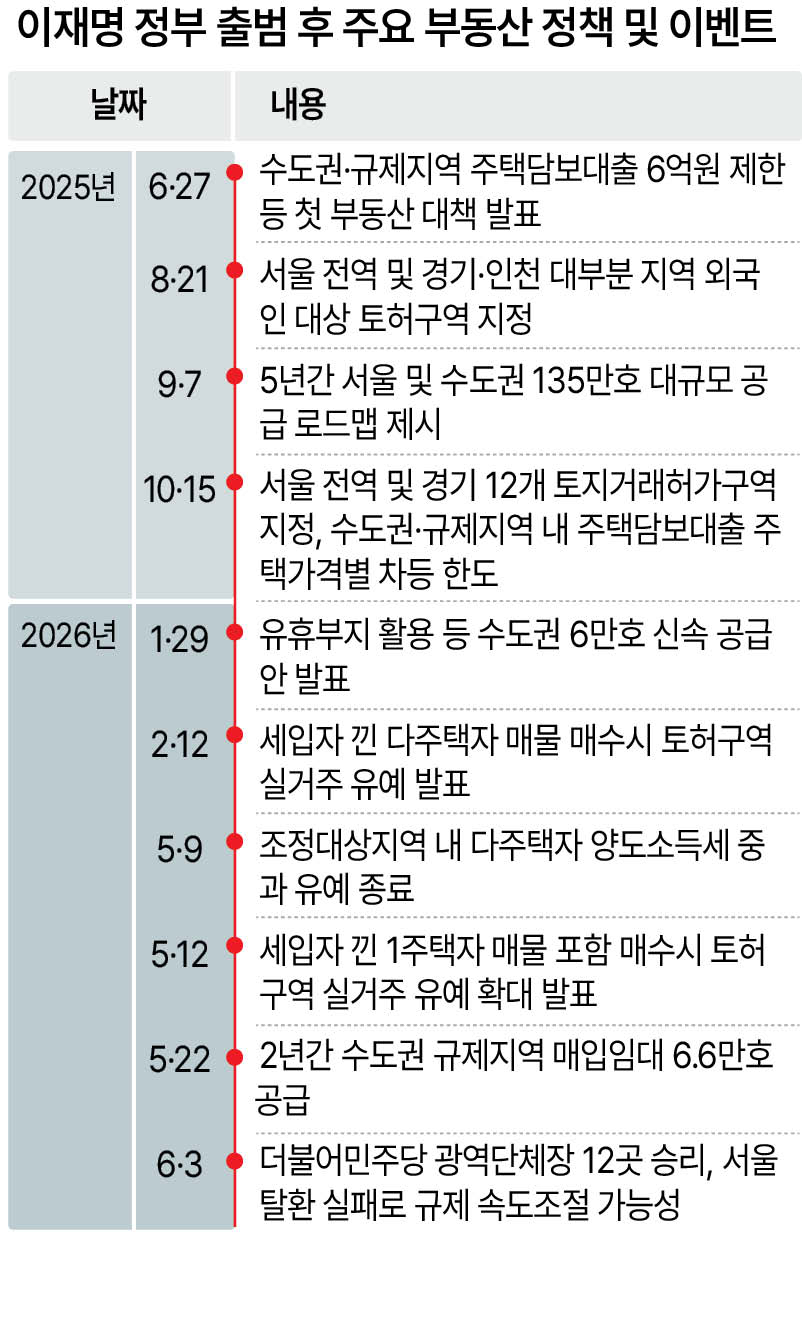
The Lee Jae Myung administration's real estate policy over its first year can be summed up as demand suppression and a restructuring around owner-occupancy. From the moment it took office, the government rolled out loan restrictions and other measures to curb rising home prices, with President Lee himself joining the public messaging campaign to apply pressure on all fronts.
The sustained offensive did bring some cooling to prices in Seoul's prime districts, but instability in the rental market deepened. The ruling camp's failure to recapture the Seoul mayoral seat in the June 3 local elections signaled a cold verdict from voters on the administration's housing policies. Experts say the pace of new supply and the direction of tax reform will be the key variables shaping the market going forward.
From its first month in office, the Lee Jae Myung government moved to tighten mortgage lending. Since taking office on June 4 last year, it has announced four major real estate packages. As Seoul home prices climbed sharply in the early weeks, the government on June 27 capped mortgage loans at 600 million won (about $397,000) in the Greater Seoul area and designated regulated zones.
Markets responded quickly. According to the Korea Real Estate Board, the monthly rate of increase in Seoul apartment prices slowed from 1.44 percent in June last year to 1.09 percent in July and 0.48 percent in August. Nationwide, the monthly gain compressed from 0.17 percent in June to 0.15 percent in July and 0.04 percent in August. As the effect of the June 27 measures faded, the government followed up with a Sept. 7 package that included a plan to supply about 1.35 million homes in the Greater Seoul area over the next five years. The Oct. 15 package designated all of Seoul and 12 Gyeonggi Province districts as regulated zones and land transaction permit areas, and tightened mortgage caps — to 400 million won for homes priced between 1.5 billion and 2.5 billion won, and to 200 million won for homes above 2.5 billion won. This year, a Jan. 29 package introduced a plan to build 60,000 homes in the Greater Seoul area using idle land and other sites. In roughly eight months, the administration delivered four rounds of measures combining demand suppression with supply expansion.
President Lee also stepped directly into the public debate. The pattern became especially pronounced this year: of 65 posts he published on X (formerly Twitter) in January, eight concerned real estate policy. After announcing on Jan. 23 that the temporary suspension of the capital gains tax surcharge on multi-home owners would end, he widened his target. Multi-home owners, rental business operators and non-resident single-home owners all came under scrutiny, and listings increased in the run-up to the May 9 expiry of the surcharge suspension. In some prime areas, including Gangnam, price gains began to ease.
Lee has kept up the combative tone this month, declaring on Sunday that he would "definitely escape the ruinous real estate unearned-income republic," and on Tuesday — election day — that "South Korea must achieve escape from the real estate speculation republic, a great transformation into a startup nation, and development into an irreplaceable core nation."
With the capital gains tax surcharge on multi-home owners back in effect, rental market anxiety has resurfaced in Seoul. A "triple rally" — simultaneous rises in purchase prices, jeonse and wolse — has emerged. Supply expansion and tax reform are expected to dominate the housing agenda in the administration's second year. The government announced last month that it would supply 90,000 purchase-rental homes in the Greater Seoul area over the next two years, with 66,000 units concentrated in Seoul and regulated Gyeonggi Province districts to offset the shortage of apartment supply.
Tax reform discussions are also moving into high gear. The government is reviewing changes to the long-term holding special deduction for capital gains tax and options for strengthening property holding taxes. Market attention is focused particularly on the possibility of a heavier tax burden on non-resident single-home owners and holders of high-value properties.
Some analysts argue, however, that expanding the supply of non-apartment housing or tightening taxes alone will not be enough to stabilize prices or ease rental market anxiety. The local election outcome is also seen as adding significant political risk to pushing through sweeping tax reform.
lucky@heraldcorp.com