
Financial basic rights research group officially launched
Four pillars — counseling, insurance, loans and savings — proposed as 'basic finance'
Kim calls for legislation to enshrine financial rights in law
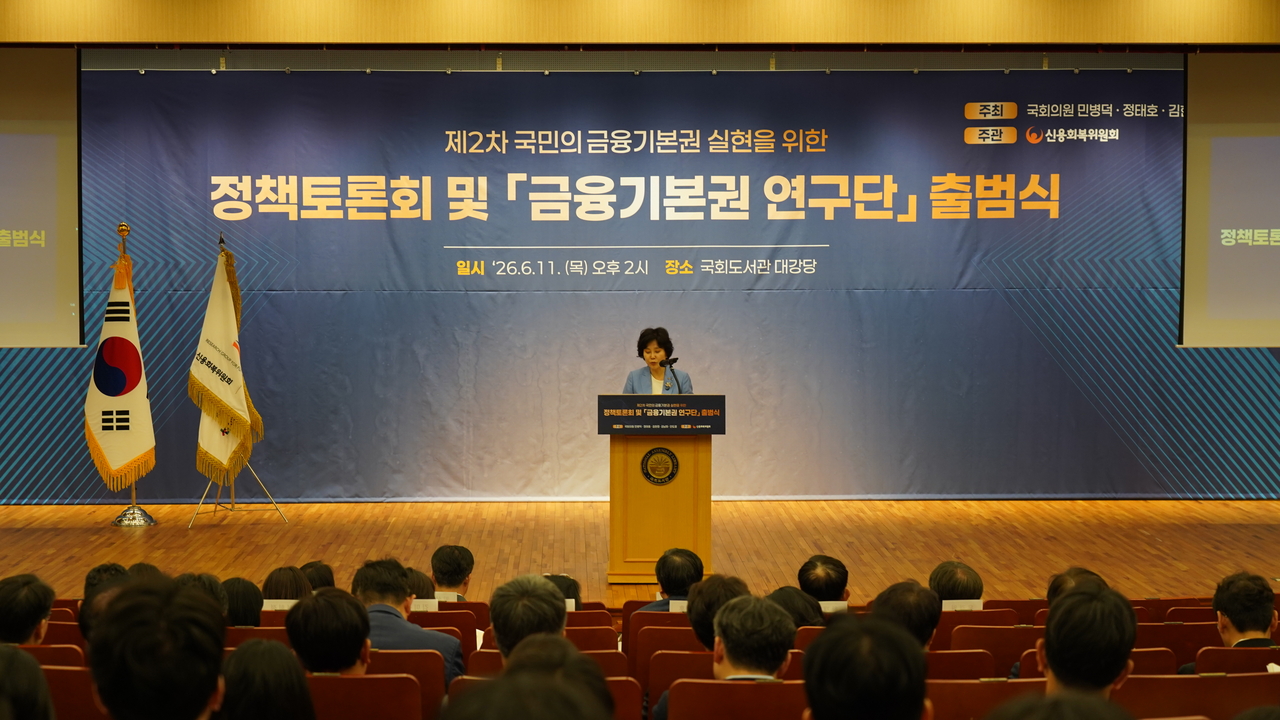
A research group tasked with advancing the concept of "financial basic rights" — guaranteeing every citizen a minimum level of access to financial services — has officially launched.
The Credit Counseling and Recovery Service held its second policy forum on realizing citizens' financial basic rights and inaugurated the financial basic rights research group at the National Assembly Library auditorium on Thursday.
Kim Eun-kyung, chairwoman of the Credit Counseling and Recovery Service and president of the Korea Inclusive Finance Agency, used her commemorative address to call for a fundamental shift in how financial services are viewed. "Finance must now be recognized not as a form of charitable protection but as a universal right that every citizen is entitled to enjoy," Kim said. "In a modern society where finance has become an essential part of daily life, being excluded or marginalized from it goes beyond mere economic hardship — it threatens the very minimum foundation needed to live a dignified life."
Kim also presented findings from a survey on economic burden conducted among users of the illegal private lending prevention loan program and a control group of non-users, offering concrete evidence for the need to protect vulnerable borrowers.
According to the Korea Inclusive Finance Agency survey, users of the illegal private lending prevention loan said they spent 60 percent of their monthly expenditure on loan repayments — far exceeding the 15.03 percent reported by the control group. The share of users who experienced a delinquency in the past year reached 79.7 percent, also well above the control group's 17 percent.
Notably, vulnerable borrowers using policy-based microfinance wanted debt restructuring more than additional loans. Among eight support services surveyed, users of the illegal private lending prevention loan gave debt adjustment the highest desirability score — 3.88 out of 5. Based on these findings, Kim said she intends to enshrine a "debt restructuring before lending" principle in future legislation.
The research group defined financial basic rights as "the right of every citizen to access financial services — the essential infrastructure of modern society — without discrimination, and to use the minimum funds necessary for a dignified life under fair conditions."
Kim said current laws, including the Microfinance Act and the Individual Debtor Protection Act, fall short because they remain rooted in the concept of charitable assistance. She outlined plans to translate the abstract rights embedded in the Constitution into concrete, universal legal rights through the enactment of a Basic Financial Security Act. The proposal is modeled on the 1999 National Basic Living Security Act, which elevated South Korea's welfare paradigm from charity to statutory entitlement.
Kim proposed five core rights for realizing financial basic rights: the right to access finance on fair terms, the right to a minimum standard of financial life, the right to self-reliance, the right to restart after failure, and the right to build assets for a stable future. She also proposed a four-stage "basic finance" framework to put those rights into practice, progressing from basic counseling to basic insurance, basic loans and basic savings.
On funding the initiative, Kim indicated that both private and public resources would be tapped. "The profits that financial companies earn by lending only to high-credit borrowers can ultimately be seen as the result of excluding low-credit borrowers," she said, adding that she plans to broaden the funding base to cover the financial investment sector and virtual asset companies.
On the potential "quasi-tax controversy" that such a scheme could trigger, Kim said "social consensus is needed" but added that she intends to establish a proper legal basis through the Basic Financial Security Act rather than resorting to compulsory levies. The bill is expected to be led by Democratic Party of Korea lawmaker Min Byeong-deok, who is set to introduce it in August, and a lawmaker-led legislative support group is also to be formed.
Kim reaffirmed her commitment to functionally integrating the Credit Counseling and Recovery Service and the Korea Inclusive Finance Agency. She acknowledged that many people experience inconvenience during counseling due to the fragmented operations of the two bodies, but noted that "no specific timeline has been set yet." She also identified administrative immunity and ex officio debt restructuring — stronger debtor rehabilitation measures discussed at the forum — as urgent issues the research group must address going forward.
The newly launched financial basic rights research group comprises four divisions: financial basic rights research, data analysis, policy planning, and external cooperation. The divisions will be led respectively by Im Jeong-ha, a professor at the University of Seoul; Yoo Kyung-won, a professor at Sangmyung University; Han Jae-jun, a professor at Inha University; and Kang Kyung-hun, a professor at Dongguk University.
won@heraldcorp.com




