DX division deploys 517 servers at Sangam data center
Virtual verification cuts development time; computing speed up sixfold
Linked to 'AI autonomous factory' transition target by 2030
Humanoid robots planned for manufacturing processes
Samsung Electronics' DX (Device Experience) division officially launched its in-house high-performance computing (HPC) service Monday, the company announced. The division said it will use the infrastructure to drive product development innovation through digital twin technology.
Industry analysts say the HPC buildout significantly strengthens the foundation for Samsung Electronics' broader AI transformation, known internally as AX. The company also plans to link the service to its goal of converting all domestic and overseas factories into AI autonomous factories by 2030.
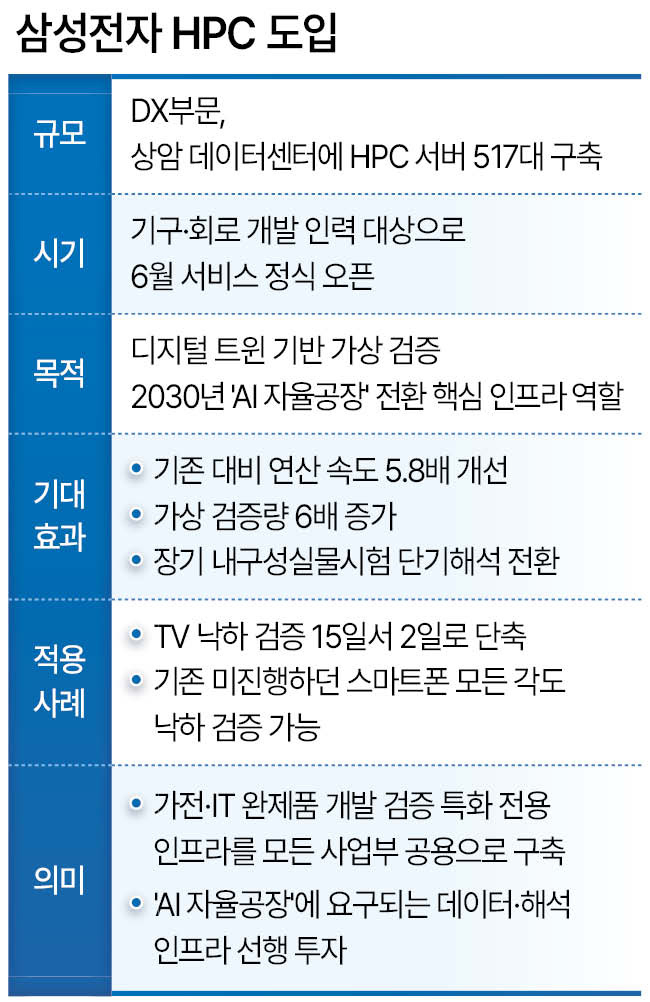
The DX division installed 517 HPC servers at its Sangam-dong data center and this month formally launched the HPC service for engineers working on mechanical and circuit development, with the aim of bolstering digital twin-based development capabilities.
Digital twin technology creates a digital virtual environment that mirrors the real world, enabling simulations of real-world scenarios to predict outcomes before physical production begins.
The newly built HPC infrastructure — comprising servers equipped with high-performance CPUs — delivers nearly six times the computing speed of the previous setup and increases virtual verification capacity by roughly the same factor. The company expects the system to streamline pre-development validation, including converting long-term durability tests that previously required physical prototypes into short-cycle simulations.
Across business divisions, the HPC infrastructure will support a range of verification tasks: all-angle drop testing for smartphones in the MX (Mobile Experience) division; drop and heat dissipation testing for TVs in the VD (Visual Display) division; long-term diaphragm durability verification and collision testing for washing machines and robot vacuums in the Digital Appliances division; and heat dissipation verification for radio units in the Networks division.
Samsung Electronics expects the system to accelerate new product launch cycles and expand the scope of verification. Product quality and reliability are also expected to improve.
In terms of time savings, TV drop verification that previously took 15 days is expected to be completed in two days, while washing machine drop verification is projected to fall from 15 days to five.
The new infrastructure also makes possible tests that were previously ruled out by physical constraints. All-angle smartphone drop verification — which had never been conducted before — can now cover 700 cases in a single day. Long-term washing machine diaphragm verification, which had relied entirely on physical testing, can now be completed within two days.
A defining feature of this buildout is that the HPC infrastructure — purpose-built for validating finished consumer electronics and IT products such as smartphones, TVs and washing machines — is shared across all business divisions rather than siloed within individual units.
Business circles say the newly launched HPC service carries significant strategic weight because it aligns with Samsung Electronics' broader push to convert all its factories into AI autonomous facilities. The company announced in March that it would complete the transition at all domestic and overseas production factories by 2030.
An AI autonomous factory applies AI across every stage of the manufacturing process. The core concept involves introducing digital twin-based simulation from raw material intake through production and shipment, while strengthening data-driven analysis and pre-verification through AI agents overseeing quality, production and logistics.
Samsung Electronics envisions factories that go beyond simple automation — ones where AI understands conditions on the factory floor and makes decisions independently. As part of that vision, the company is also pursuing a phased rollout of humanoid manufacturing robots across its production processes.
Because the newly launched HPC service handles digital twin functions at the product development stage, analysts expect it to accelerate the broader transition to AI autonomous factories.
Analysts also note that the HPC-based simulation capabilities carry strategic significance beyond near-term development efficiency, representing an early investment in the data and analytical infrastructure that the AI autonomous factory era will demand by 2030.
jeongwan@heraldcorp.com