Outline of final US-Iran war-ending MOU emerges, covering 14 points including Hormuz opening and nuclear and sanctions negotiations; HEU dilution on Iranian soil accepted; US maritime counter-blockade to be lifted; $300 billion reconstruction fund and US troop withdrawal included; Iranian missiles and proxy forces left to follow-on talks; 60-day window secured but hard road ahead on nuclear program and frozen funds
![A woman waves an American flag and a banner bearing a pro-Donald Trump slogan at a boat parade held Saturday in West Palm Beach, Florida, to mark Flag Day and the birthday of President Donald Trump. [Reuters]](https://wimg.heraldcorp.com/news/cms/2026/06/15/news-p.v1.20260615.38ff72dd85874e7fb9f97b343d1a789a_P1.jpg)
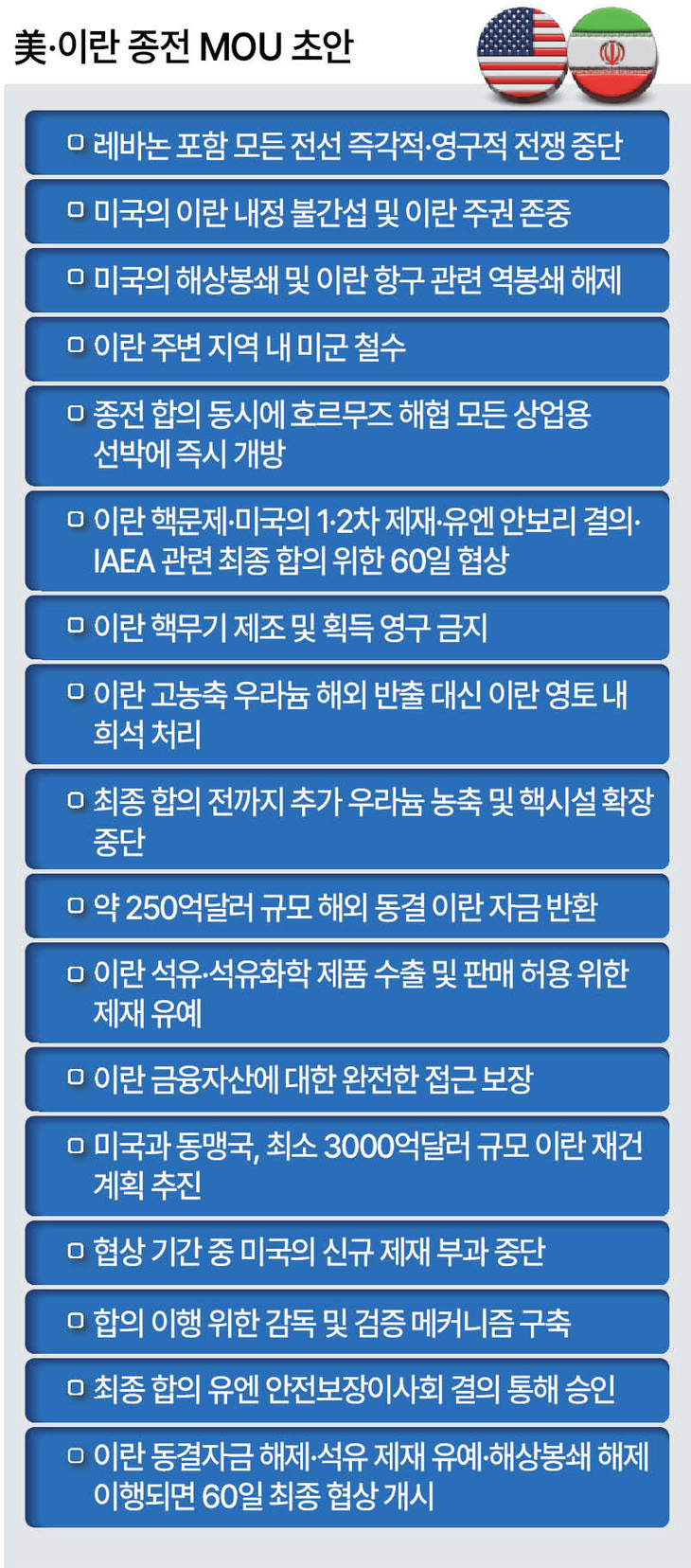
As the United States and Iran move toward signing a memorandum of understanding to end their war, the outlines of both a draft and a near-final version of the agreement have emerged. The two sides are said to have reached a preliminary agreement to open the Strait of Hormuz immediately and to dilute Iran's stockpile of highly enriched uranium on Iranian soil. The US is also reported to have accepted returning roughly $25 billion in frozen Iranian assets held abroad and suspending oil sanctions.
Reuters reported Saturday, citing a senior Iranian official, that the near-final MOU being coordinated between Washington and Tehran includes the immediate opening of the Strait of Hormuz and measures to limit Iran's nuclear program. The same day, Iran's semi-official Mehr News Agency published a 14-point draft MOU, citing Mehdi Mohammadi, a strategic adviser to Mohammad Baqer Qalibaf, speaker of the Iranian parliament and the country's chief negotiator.
The details disclosed represent a description of the agreement at a stage just before final signing and may differ in some respects from the actual text. Because the draft account was presented from the Iranian side, it could also conflict with the US version. According to the near-final text, Iran would pledge not to manufacture or acquire nuclear weapons and would immediately open the Strait of Hormuz to all commercial vessels. In return, the US would lift its maritime blockade on ships calling at Iranian ports and suspend oil sanctions for a set period. Both sides also agreed not to impose new sanctions on Iran until a final deal is reached.
Economic compensation for Iran is also part of the framework. The MOU is said to specify the return of approximately $25 billion (about 33.5 trillion won) in Iranian funds frozen abroad. The funds could be transferred through direct remittance, financial credit lines, or regional inter-bank cooperation.
The draft released by the Iranian side contains more specific demands. It calls for an immediate halt to hostilities on all fronts, including in Iran and Lebanon, and requires the US and Israel to provide guarantees against further military action. Iran has said the structure of the US serving as guarantor of a truce on Israel's behalf is an unprecedented achievement.
The draft also states that US maritime restrictions on Iran would be lifted upon signing and that shipping activity would be normalized to pre-war levels within 30 days. Measures to ensure the US does not interfere with Iranian vessel operations are also said to be included.
Differing interpretations remain over the operation of the Strait of Hormuz. While the near-final text reported by Reuters focuses on the strait's immediate opening, Iran maintains that the existing navigation and safety service fee system will remain in place. Tehran said authority over those fees rests with Iran and Oman and will not change regardless of any future agreement.
The draft is also said to include a plan to establish a $300 billion development and reconstruction fund and a US commitment to withdraw its military forces from the region around Iran — which Tehran interprets in effect as compensation for war damages. Iran also said the framework includes discussion of lifting both primary and secondary sanctions if a final agreement is reached.
The most closely watched shift involves the nuclear question. Washington had long insisted that Iran's highly enriched uranium must be removed from the country, rejecting even transfers to Iranian allies such as China or Russia. The near-final text reported by Reuters, however, is said to allow for the dilution of highly enriched uranium on Iranian soil — a significant retreat from the US position.
Highly enriched uranium is considered a key material for nuclear weapons production. The US had argued that physically removing the uranium was the only way to foreclose the possibility of rearmament, while Iran had regarded any export of the material as a violation of its sovereignty. The two sides appear to have settled on a compromise: lowering the enrichment level without shipping the uranium abroad.
Differences over the dilution process remain. Iran says the diluted nuclear material would be stored domestically and could be re-enriched within a short period if needed. The US, by contrast, is expected to demand a verification regime capable of in effect eliminating any possibility of military use.
The harder work begins now. Over the next 60 days, the two sides are expected to engage in intense negotiations over the handling of Iran's nuclear program and the release of frozen funds. Because the MOU is primarily a political agreement aimed at stopping the fighting, most of the core issues have been deferred to follow-on talks.
The negotiating agenda is expected to cover a halt to uranium enrichment, the disposal of highly enriched uranium stockpiles, the easing of sanctions on Iran, and a post-war economic reconstruction program. The ballistic missile program and Iran's regional proxy forces — both of which Israel regards as security threats — are likely to be excluded from the scope of negotiations. Iran has also made clear that any addition of new agenda items would require its consent.
sjy@heraldcorp.com