
Interview with Kim Yu-jae, head of Woori Bank's Corporate Succession Support Center
Baby boomer business owners now approaching retirement age
16% of business closures in 2023 cited succession failure and CEO aging
Woori Financial targets succession consulting for 2,500 firms over five years
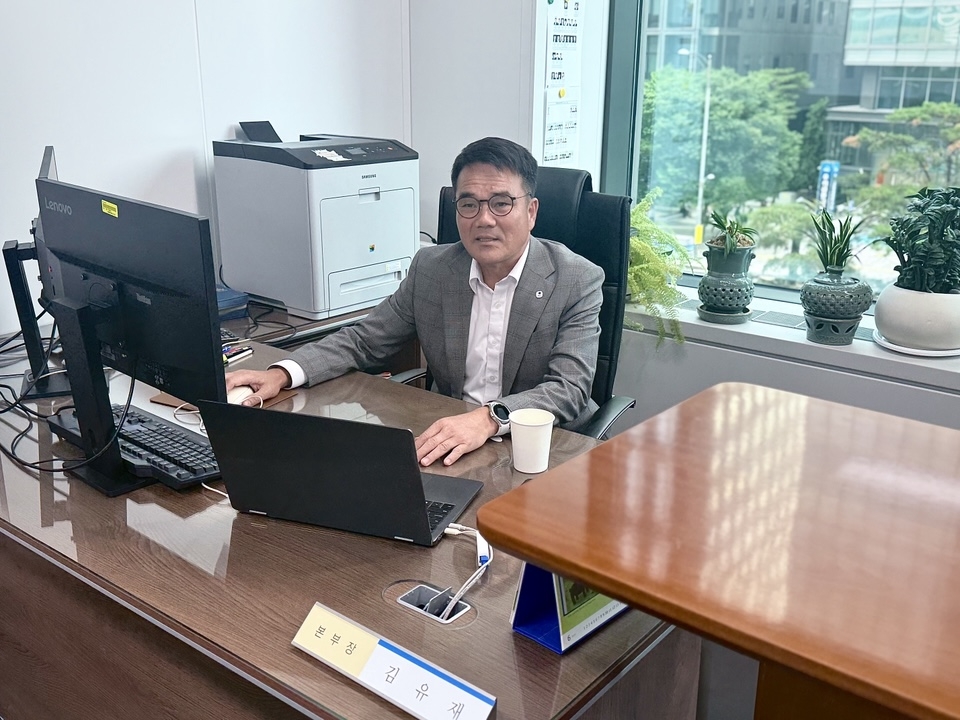
"Small and medium-sized enterprises are the cogs that keep our economy turning. I believe there is no more important form of productive finance than ensuring they keep functioning reliably over time."
Kim Yu-jae, head of Woori Bank's Corporate Succession Support Center, made the remarks during an interview on June 8, saying the most pressing challenge facing South Korea's economy today is ensuring that retiring business owners can properly pass their knowledge and expertise to the next generation.
Woori Bank established the Corporate Succession Support Center in February — the first dedicated unit of its kind in the Korean banking sector — staffing it with specialists in accounting, taxation and mergers and acquisitions to help small and mid-sized companies navigate ownership transitions.
Kim describes the center as a "business closure prevention center." Succession failures that end in shutdowns are common enough that the bank felt compelled to step in with preventive support. "In Korea, many baby boomers built their businesses from scratch — and the owners now in their 60s and 70s are exactly that generation," he said. "The moment of their retirement is arriving right now."
Data bear out the concern. According to the Ministry of Statistics, 791,000 businesses closed in 2023, and 15.8% cited succession failure and CEO aging as the reason. More broadly, 52.4% of all domestic companies have a CEO aged 50 or older.
"You have to instill a management mindset in the next generation, and you need time to handle the tax obligations," Kim said. "Succession typically takes 10 to 15 years. If the children decline to take over, you have to move quickly to find a buyer. If you can't find one either, closure is the only option."
Companies without a clear successor inevitably face questions about their long-term viability. That uncertainty functions as an ownership risk and a discount on firm value — making it harder to attract outside investment, dragging down productivity, and setting off a downward spiral in which the company's worth erodes steadily.
The consequences extend across the broader economy. When a business closes because succession failed, employees lose their jobs and proprietary technology risks falling into the hands of foreign capital.
Kim cited a concrete example: a parts supplier to a major shipbuilder whose owner was in his mid-70s and had yet to identify a successor. "If that company stopped producing parts, it would have created problems not just for employment but for the entire supply chain," he said. "Ultimately, a large conglomerate stepped in and acquired it."
![Woori Bank President Jeong Jin-wan delivers opening remarks at a press briefing on productive corporate succession held at Woori Bank's headquarters in Jung-gu, Seoul, on June 1. [Woori Bank]](https://wimg.heraldcorp.com/news/cms/2026/06/14/news-p.v1.20260613.47123ef8c58947c7a6e21bb4dfec99ee_P1.png)
The Corporate Succession Support Center has so far signed MOUs with 554 companies. For owners who want to pass the business to their children, the center provides consulting on inheritance tax payments and related planning. For those who do not, it helps develop third-party succession strategies such as management buyouts and employee buyouts.
Kim said this kind of succession support is precisely the "productive finance" that financial institutions should be delivering. "Productive finance requires business expansion through a financial firm's investment and lending — but if the owner isn't prepared to hand things over, what good does it do to build up the facilities?" he said.
According to research by Woori Financial Management Institute, if Woori Bank successfully facilitates the succession of 100 companies per year over the next five years — 500 companies in total — the cumulative economic impact would include preserving 10,000 jobs, protecting a sales base of 10.7 trillion won (about $7.01 billion), generating 469.9 billion won in production-inducing effects, and creating 193.4 billion won in value-added effects.
Corporate succession is emerging as a new business model for financial institutions worldwide. Japan's Mizuho Financial Group has expanded its succession support framework into a one-stop package combining loans, mezzanine financing, equity investment and trust services. Domestic banks are also entering the succession market through partnerships with accounting firms. "Unlike other banks, we placed the Corporate Succession Support Center within the broader corporate group structure," Kim said. "Our approach puts the emphasis on preserving a company's core value — its technology, its workforce and the stability of its supply chain."
Significant obstacles remain. While there have been domestic employee and management buyout cases — Korea General Technology in 2017 and BHC in 2018, for example — third-party succession is still largely unfamiliar territory in South Korea. Japan offers tax deferral incentives for third-party acquisitions, but comparable mechanisms have yet to be introduced here.
Woori Bank has set a target of providing succession consulting to 500 companies a year — and more than 2,500 over the next five years — drawn from among its corporate clients with strong employment records and technological capabilities. The bank also plans to commit 3 trillion won in funding to support those efforts. "Companies are entering a generational transition, so demand for succession support will only grow," Kim said.
hyuk@heraldcorp.com



