
Total ETF market cap peaked at 514 trillion won ($377 billion) before falling to 470 trillion won; retail investors net purchased 9.1 trillion won in ETFs from June 1 through June 11
By Jung Yoon-hee, The Herald Business
Net assets in South Korea's exchange-traded fund market are on the verge of recovering the 500 trillion won mark after an eight-day slide, as the domestic stock market's roller-coaster swings drove sharp volatility in ETF valuations.
Even during the period when net assets fell below 500 trillion won, retail investors bought more than 9 trillion won worth of ETFs, helping cushion further declines.
The combined market capitalization of South Korea's roughly 1,130 listed ETFs stood at 499 trillion won as of Friday's closing price, according to the Korea Financial Investment Association. During intraday trading, the total briefly recovered above 500 trillion won and climbed as high as 510 trillion won.
Because ETF net assets closely track market capitalization, net assets are estimated to have approached 500 trillion won as well. The last time net assets were near that level was June 4, when they stood at 512 trillion won — eight calendar days, or six trading sessions, earlier.
ETFs had crossed the 500 trillion won threshold for the first time in history on May 27, then swelled to a record closing high of 514 trillion won on June 1 — the same day the Kospi closed at 8,788.38.
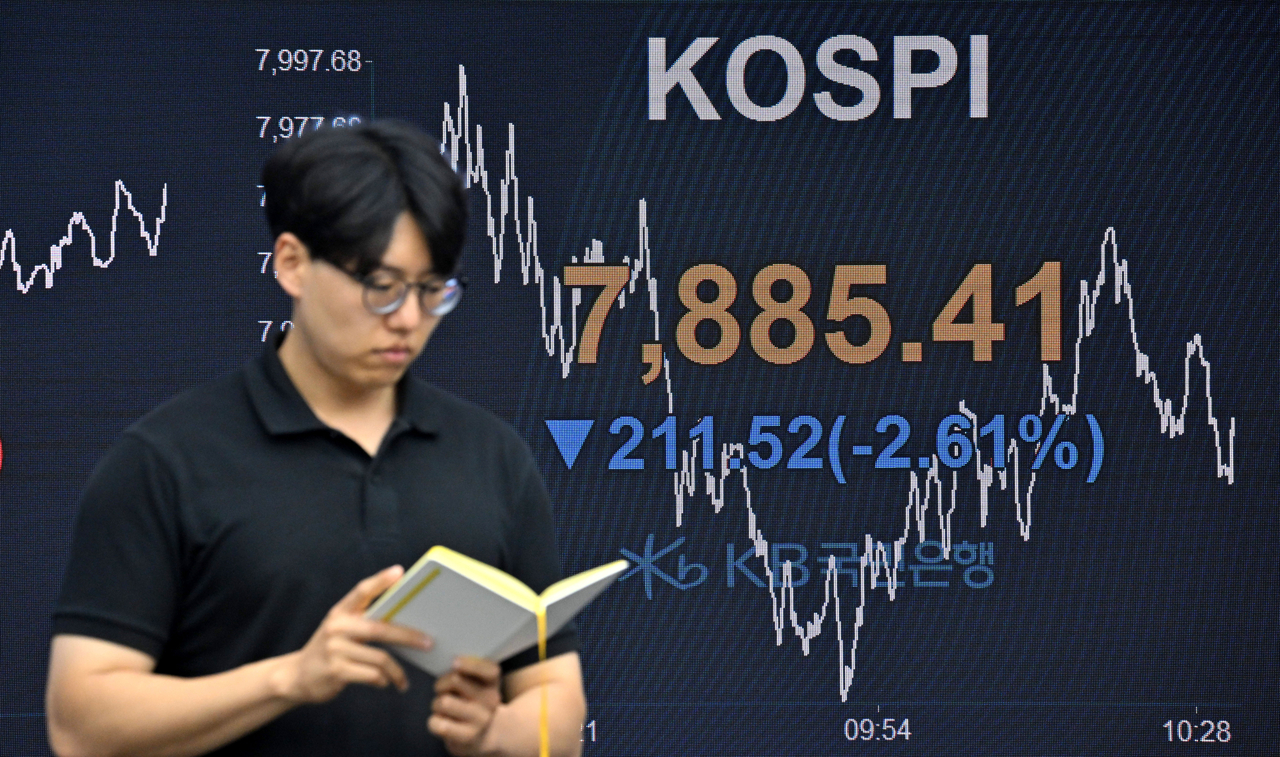
From June 4 onward, however, renewed tensions in the Middle East, rising oil prices and sustained foreign net selling sent the Kospi into a steep decline, dragging ETF net assets down with it.
On June 8, when the Kospi fell below the 7,500 level to close at 7,484.41, ETF net assets shrank to 470 trillion won. As the domestic market gradually recovered and pushed back above 8,000, net assets climbed toward 500 trillion won again.
Even as the Kospi fell, the decline in ETF net assets was proportionally smaller than the index's drop.
From June 1, when net assets stood at 514 trillion won, to the June 8 low of 470 trillion won, net assets fell 8.5 percent. Over the same period, the Kospi dropped 14.8 percent, falling from 8,788.38 to 7,484.41.
From June 1 through June 11, retail investors net purchased 9.1855 trillion won worth of ETFs. Foreign investors, who had been net sellers in the broader equity market throughout the period, still net bought 379.1 billion won worth of ETFs during the same stretch.
The most heavily net purchased ETF among retail investors over that period was the KODEX Samsung Electronics Single Stock Leveraged product, which drew 1.4 trillion won in net buying. Leveraged products occupied all six of the top spots in retail net purchases.
Excluding leveraged products, KODEX 200 attracted the most retail net buying at 501.1 billion won, followed by KODEX 200 Target Weekly Covered Call at 492.7 billion won and TIGER US S&P500 ETF at 359.9 billion won.
On the selling side, HANARO Fn K-Semiconductor saw the heaviest retail net selling at 289.9 billion won. KODEX Semiconductor Leveraged and TIGER Semiconductor TOP10 Leveraged were also net sold at 274 billion won and 240.6 billion won, respectively, as funds flowed out of semiconductor-related ETFs.
The 9.1855 trillion won in net ETF purchases by retail investors from June 1 through June 11 amounted to roughly 30 percent of the 30.8248 trillion won they poured into the broader equity market over the same period.
Investor deposit balances — cash parked on the sidelines awaiting deployment — fell about 5.2 trillion won over the same period, from 132.5992 trillion won to 127.3718 trillion won.
Margin financing balances, a gauge of leveraged investing, also declined by more than 1 trillion won, dropping from 37.6811 trillion won to 36.6564 trillion won.

yuni@heraldcorp.com




