
The world's greatest endurance race runs nonstop for 24 hours
62 cars share one track — class-by-class competition adds to the spectacle
186 drivers take turns behind the wheel
The car that covers the most distance in 24 hours wins
Genesis qualifies both cars in the top 10 in its hypercar debut
Even finishing the race would mark a milestone for Korea's 'racing national team'
![The start of the 24 Hours of Le Mans at the Circuit de la Sarthe in Le Mans, France, on June 14, 1975. [Getty Images]](https://wimg.heraldcorp.com/news/cms/2026/06/12/news-p.v1.20260612.33d7db2a9b71455ebc34dc2239c8906e_P1.jpg)
If soccer has the World Cup, motorsport has the 24 Hours of Le Mans. The name may be unfamiliar to some, but its standing in the world of motorsport is equally towering. It is not simply a race to find the fastest car — it is the world's most prestigious endurance race, one that tests the limits of the car, the driver, the pit crew and the strategy team across a full 24 hours.
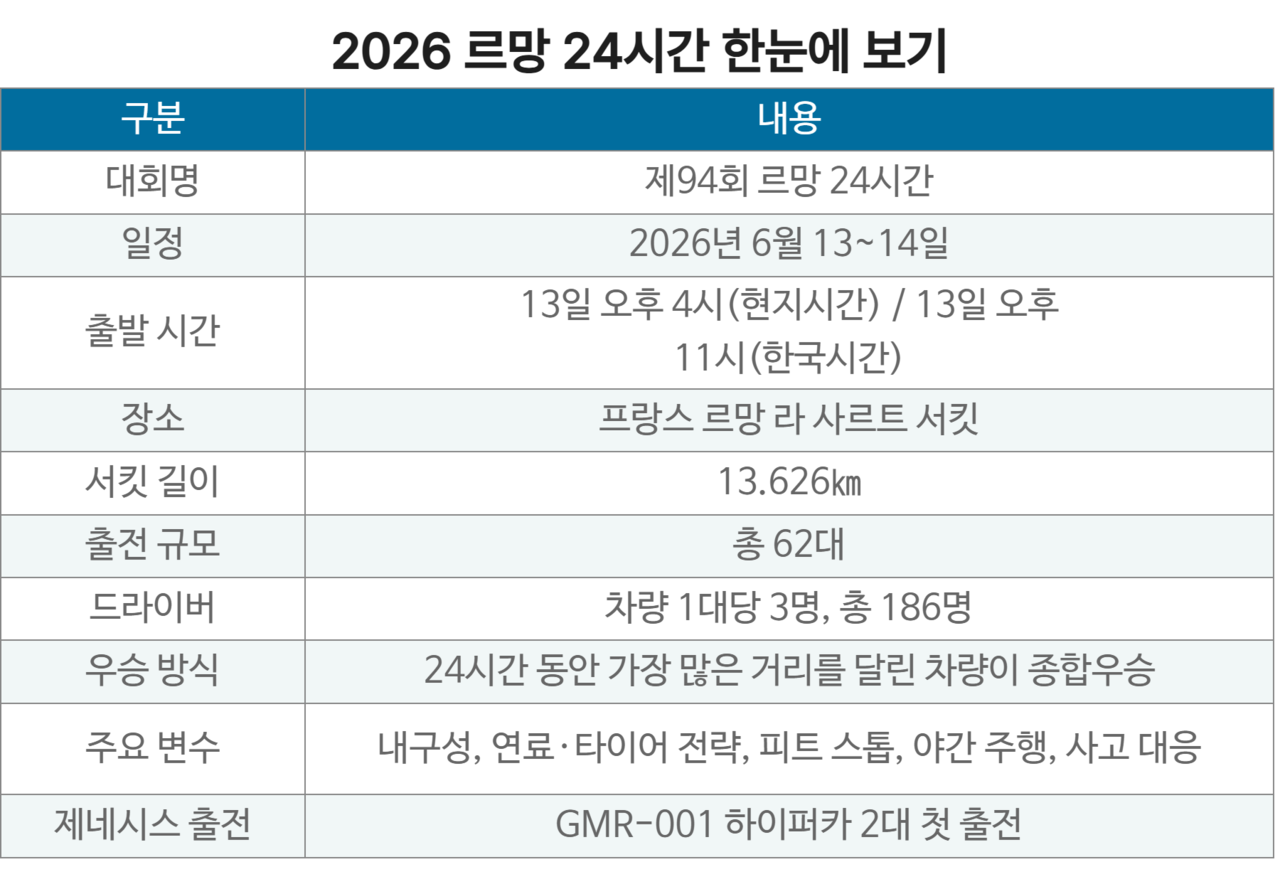
The race gets underway Saturday at 4 p.m. local time at the Circuit de la Sarthe near Le Mans, France — 11 p.m. Korean Standard Time.
First held in 1923, the race has run for more than a century and now serves as the centerpiece of the FIA World Endurance Championship (WEC), organized by the Fédération Internationale de l'Automobile.
Although it counts as a single round of the WEC season, Le Mans carries a symbolic weight all its own. That weight shows up in the championship's points structure: far more points are on offer at Le Mans than at any other WEC round, making it a stage that can reshape the entire season standings. A Le Mans victory is therefore seen not merely as a single-race win but as a watershed moment that can define a manufacturer's or team's season goals.
A 24-hour war covering more than 5,000 km
This year's race features 62 entries. With three drivers assigned to each car, 186 drivers will take turns at the wheel over the course of a single day. Cars do not race to a set number of laps — they compete to see who can cover the most distance in 24 hours. The car that completes the most laps when the race ends takes the overall victory.
That is why raw speed alone cannot win Le Mans. With a typical race distance exceeding 5,000 kilometers, fuel management, tire strategy, mechanical reliability, driver fitness and pit-stop execution all have to come together. Teams refuel roughly every hour, and tire changes are timed according to track conditions and team strategy. A single pit-stop error, a minor mechanical fault or a misjudgment in an incident can dramatically alter the standings.
![Cars race during the Ferrari Challenge at the Circuit de la Sarthe in Le Mans, France, on June 9, 2023. [Getty Images]](https://wimg.heraldcorp.com/news/cms/2026/06/12/news-p.v1.20260612.f8051a3cc7164f749dd8525ff5c44c00_P1.jpg)
The Circuit de la Sarthe itself is exceptional. At 13.626 kilometers, it is far longer than a conventional circuit, and portions of the track run on public roads. The uneven surface and numerous high-speed sections place enormous stress on the cars. The circuit's signature stretch, the Mulsanne Straight, once saw cars exceed 400 kilometers per hour, cementing its status as a symbol of Le Mans. Chicanes have since been added for safety, but it remains a defining test of engine and chassis durability.
Hypercars to GT3 — multiple classes racing on the same track at once
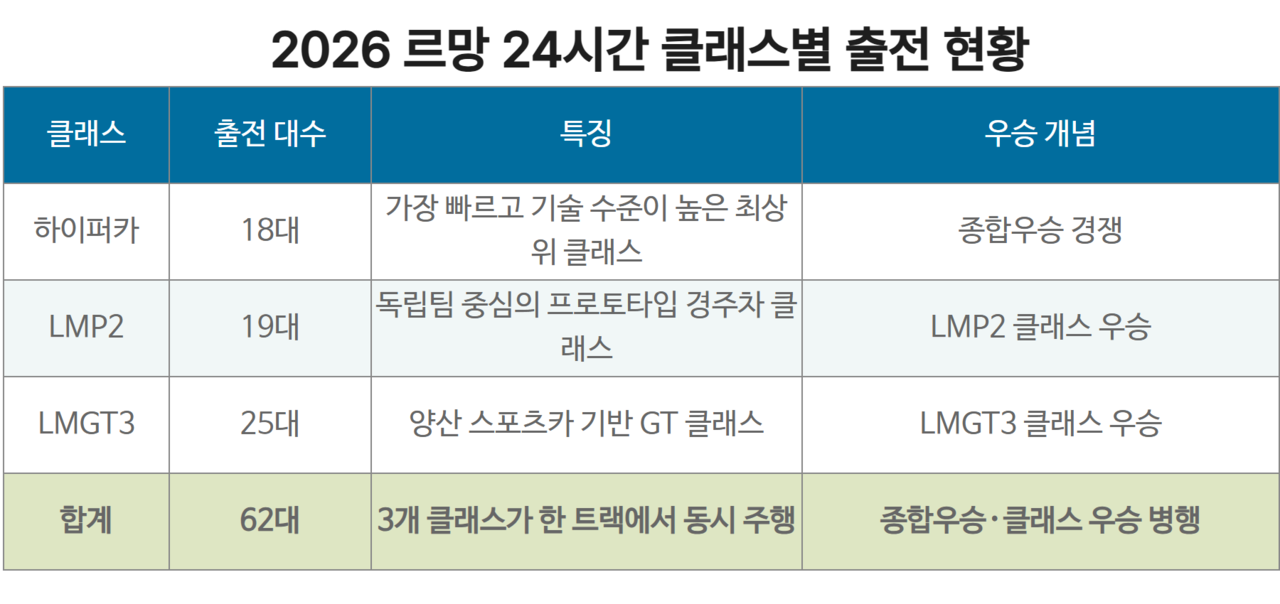
To get the most out of watching Le Mans, it helps to know that cars of different classes race simultaneously on the same circuit. This year's field comprises 18 Hypercars, 19 LMP2 cars and 25 LMGT3 cars. While the top-tier Hypercars chase the overall win, LMGT3 cars — based on production sports cars — fight for honors within their own class. Faster cars must overtake slower ones, while slower cars must yield to higher-class traffic while still competing among themselves. It sounds complicated at first, but this multi-class format is precisely what makes Le Mans so compelling.
Within the Hypercar class, two distinct types of machinery compete side by side. The LMH (Le Mans Hypercar) is developed more extensively by the manufacturer, while the LMDh uses a set of common components to reduce costs. Because the two concepts start from different technical foundations, organizers adjust power output and weight to keep performance within a defined range. This system is known as the Balance of Performance, or BoP — a mechanism designed to prevent any single brand from pulling away on the strength of technology or budget alone.
Driver management is another core element of Le Mans strategy. Each car carries three drivers; no single driver may spend more than four hours behind the wheel within any six-hour window, and total accumulated driving time cannot exceed 14 hours. Deciding who drives when, who rests and when to deploy the fastest driver are all part of the strategic equation. Le Mans is as much a battle of people and team management as it is a battle of machinery.
On-track incidents and mechanical failures add further variables. Le Mans uses not only the traditional safety car but also slow zones — which restrict speed in specific sectors — and the virtual safety car, which controls the pace of the entire field. Whether to pit under these conditions or stay out and gain track position can swing the standings dramatically, keeping tension alive until the final hours.
![The start of the 24 Hours of Le Mans at the Circuit de la Sarthe in Le Mans, France, on June 22, 1964. Drivers sprint across the track to their cars in the traditional Le Mans start. In the foreground, pole-sitter John Surtees heads for the No. 19 Ferrari 330P while Richie Ginther makes for the No. 11 Ford GT40 Mk.1. [Getty Images]](https://wimg.heraldcorp.com/news/cms/2026/06/12/news-p.v1.20260612.5f37cc6c1f5e4891a03022ef367eee86_P1.jpg)
Victory at Le Mans comes in two forms. A car that finishes first within its own class claims a class win. The car that completes the most laps of all 62 entries over 24 hours takes the overall win — which in effect always comes from the top-tier Hypercar class, where the fastest and most technically advanced machinery in Le Mans and WEC competition battles it out.
That is the stage Genesis has entered. Genesis Magma Racing is competing in the Hypercar class for the first time, fielding the GMR-001 hypercar in a bid for overall honors at Le Mans and in the FIA World Endurance Championship. The GMR-001 was developed under the LMDh technical regulations, which allow manufacturers to express their own engine and design capabilities while using a specified chassis and a common hybrid system.
Genesis faces Ferrari and Toyota — and makes its presence felt in qualifying
The Hypercar class field this year is formidable. Ferrari has been dominant at Le Mans in recent years and is chasing a fourth consecutive victory. Toyota ruled the race from 2018 through 2022 and returns this year with an updated hypercar in pursuit of another title. BMW, Cadillac, Peugeot, Alpine and Aston Martin have also entered the fray. Porsche is absent from the Hypercar class this year, though the Porsche 911 GT3 R will compete for class honors in LMGT3.
![British motorsport legend Stirling Moss recreates the traditional Le Mans start during the Legends Race ahead of the 24 Hours of Le Mans at the Circuit de la Sarthe in Le Mans, France, on June 16, 2001. [Getty Images]](https://wimg.heraldcorp.com/news/cms/2026/06/12/news-p.v1.20260612.09fc4e6432114457a5e5d352c694f994_P1.jpg)
Qualifying is a spectacle in its own right. Le Mans uses practice sessions and qualifying rounds to set the grid, with the top positions decided in a final shootout called Hyperpole. Lap time matters, but it is only the beginning — the real test is sustaining that pace for 24 hours, keeping the car alive and executing pit strategy without error. At Le Mans, race management ability counts for far more than qualifying position.
Genesis delivered a stronger-than-expected qualifying performance Thursday. Genesis Magma Racing advanced through Hyperpole 1 and then competed in Hyperpole 2, the final qualifying session, with both cars finishing in the top 10. Car No. 19 will start sixth and Car No. 17 ninth. For a team making its Le Mans debut in its first season of competition, the result demonstrated the GMR-001's single-lap pace in convincing fashion.
![The Genesis Magma Racing GMR-001 hypercar runs during the 2026 FIA World Endurance Championship Le Mans test at the Circuit de la Sarthe in Le Mans, France, June 4–7. [Genesis]](https://wimg.heraldcorp.com/news/cms/2026/06/12/9/news-p.v1.20260612.5ec9545977c44ea5bc4029853c50ebd4_P1.jpg)
The goal for a first attempt: finish the race — and set a new benchmark for a Korean brand
This is not the first time a Korean brand has attempted Le Mans. KGM — then known as Ssangyong — entered pre-qualifying in 1996 with a WR LM94 carrying its badge, and Genesis itself built endurance racing experience last year through an LMP2 class program.
But 2026 carries a different significance. It is the first year Genesis has entered the full FIA World Endurance Championship season, and the first time it has competed in the top-tier Hypercar class — where the overall win is decided — with its own purpose-built race car, the GMR-001. This is Genesis's first season competing head-to-head on the same stage as Ferrari, Toyota, BMW and the other global manufacturers, having moved beyond the stage of gaining experience in lower classes — and that gives it considerable symbolic weight.
![The start of the 24 Hours of Le Mans at the Circuit de la Sarthe in Le Mans, France, on June 13, 1970. The No. 10 Ferrari 512S of Helmut Kelleners' North American Racing Team leads ahead of Alfa Romeo T33/3 cars. [Getty Images]](https://wimg.heraldcorp.com/news/cms/2026/06/12/news-p.v1.20260612.5d73e761b70d4121a95a072b23af94cb_P1.jpg)
Given all that, finishing the race and gathering data are the realistic goals for this first attempt rather than an outright win. Experience is everything at Le Mans. Temperature and track conditions shift through the night, and sudden rain, accidents or safety car periods can upend any plan. Cars that have been running well have stopped in the final hours more times than anyone can count. It is why the saying at Le Mans goes: just finishing is history.
Genesis has become the first Korean automotive brand to enter the top class of the world's greatest endurance race. The car carries with it the design identity and engineering capability of a Korean brand. Just as the national soccer team takes the field at the World Cup representing the country, at Le Mans it is the race car that carries a nation's automotive technology and brand image around the circuit.
![Hyundai Motor Group Chairman Euisun Chung (right) poses for a photo with Toyota Group Chairman Akio Toyoda at the Toyota Gazoo Racing service park at Toyota Stadium in Nagoya during the 2024 WRC Rally Japan in November 2024. [Hyundai Motor]](https://wimg.heraldcorp.com/news/cms/2026/06/12/news-p.v1.20241125.ad850a26630f43fe835f620bf37932e0_P1.jpg)
Behind this push stands a decision by Hyundai Motor Group Chairman Euisun Chung. Luc Donckerwolke, the group's chief creative officer, recalled at the "Genesis Motorsport Premier" event last year that he had proposed bringing Genesis into motorsport to senior management and received a response within three days. "The answer was: let's do it," he said.
Chung had signaled his commitment to high-performance vehicles as far back as the 2018 Consumer Electronics Show, where he said the company needed cars that could do more than pull a carriage — cars that could fight in battle or run a race. Genesis's Le Mans campaign is, in that sense, part of Hyundai Motor Group's long-term strategy to build its identity as a high-performance brand, not simply a one-off racing entry.
Endurance racing like Le Mans also feeds directly into road car development. Sustaining high-speed running for 24 hours subjects the engine, motor, battery, brakes, cooling system and tires to extreme conditions. The data gathered can be applied to improving the durability, thermal management, handling stability and efficiency of high-performance production cars. For an automaker, it also offers the chance to demonstrate technology validated under extreme conditions to fans and consumers worldwide — a powerful tool for reinforcing a high-performance brand image.
As the world's automotive brands gather to contest 24 hours of technology, endurance and strategy, a Korean brand has taken its place among them. Just as fans cheer on the national team at the World Cup, it is now time to watch Genesis — Korea's racing representative — take on Le Mans.
![마그마 오렌지 입은 제네시스…첫 르망 24시 ‘새 얼굴’ 공개 [여車저車]](https://wimg.heraldcorp.com/news/cms/2026/06/02/news-p.v1.20260602.d2646f8f84d740268a8de1b458f31b0b_T1.jpg)
kwater@heraldcorp.com



