Excess profit → excess tax revenue → excess profit
President, ministers speak with different voices
'The concept itself is flawed, causing confusion'
Deliberate messaging to spark debate also possible

The term "excess profit," first floated by Cheong Wa Dae, has resurfaced in yet another form — cycling through President Lee Jae Myung's framing as "excess tax revenue" before returning as "excess profit" — leaving the public confused. Experts say the government's inability to settle on a single term stems from a fundamental flaw in the concept itself.
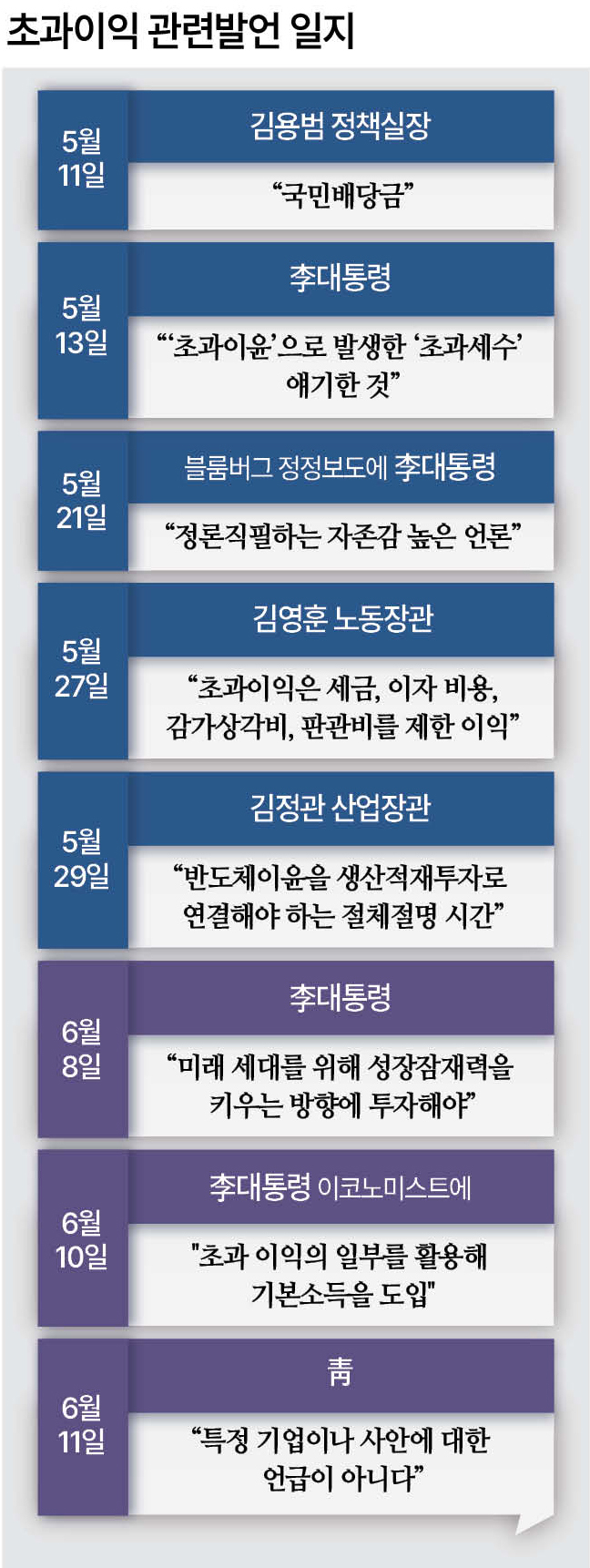
The controversy began at Cheong Wa Dae. Policy chief Kim Yong-beom wrote on Facebook on May 11 that "a portion of the fruits of the AI infrastructure era must be structurally returned to all citizens," arguing that excess tax revenue secured from chipmakers should be distributed to society under the name "national dividend."
In the more than 7,000-character post, however, Kim used the terms "excess tax revenue" and "excess profit" interchangeably — at one point writing, "How should structural excess profit be institutionalized socially? In this piece, I will provisionally call that principle the 'national dividend.'"
As the controversy grew, President Lee stepped in. On May 13, in a post titled "No fake news fabricated to manipulate public opinion," Lee said Kim's remarks were about "reviewing a plan to distribute to citizens the excess tax revenue generated by excess profits in the AI sector." He accused some media outlets of distorting the statement into a claim that "Kim argued for reviewing a plan to distribute corporate excess profits directly to citizens." The episode eventually led Bloomberg to issue a correction after its initial report, which focused on the "excess profit" framing, was blamed for contributing to a sharp drop in South Korean stocks.
Cabinet ministers continued to weigh in. Employment and Labor Minister Kim Young-hoon said on May 27 that he would "explore the possibility of a Korean-style social solidarity wage — a discussion on how to redistribute the excess profits of large corporations." He added that while excess tax revenue represents the government's share to distribute, excess profit refers to net profit after taxes, financing costs, and selling, general and administrative expenses have all been deducted.
Just two days later, Trade, Industry and Energy Minister Kim Jung-kwan struck a different note, saying it was "a critical moment to channel the semiconductor industry's profits into productive reinvestment for the future" and stressing that South Korea must "leverage the AI boom to secure a growth engine for an industrial leap forward." His remarks were widely interpreted as favoring the use of both excess profits and excess tax revenue for reinvestment in future industries.
Cheong Wa Dae moved to smooth over the divergence, saying the labor minister had spoken from a labor perspective and the industry minister from an industry perspective.
Amid the ongoing debate, President Lee again raised the excess-profit issue during his European tour. In an interview published Wednesday by The Economist, Lee said the rise of industries generating enormous excess profits may require a reexamination of existing tax and distribution systems, and that using a portion of those excess profits to introduce a basic income — supporting consumers' spending capacity — could be a highly useful policy option.
Cheong Wa Dae said the remarks were "not a reference to any specific company or issue" but rather addressed "the challenges of the era that may one day be confronted in order to sustain and maintain the capitalist market order amid the great transition to the AI age."
In political and business circles, the shifting language has drawn two competing readings: that it reflects genuine policy disagreement within the government, or that the administration is deliberately stoking public debate on the issue.
Kang Sung-jin, an economics professor at Korea University, said the very notion of "excess profit" cannot be applied to the private sector. "What is the benchmark for calling something 'excess'?" he said. "The reason the government cannot even agree on a single term is that the term itself is problematic."
He added, however, that "there may be some degree of implicit consensus forming" and that the government "may be wrestling with how to actually put it into practice."
By Yoon Ho and Jeon Hyeon-geon
youknow@heraldcorp.com
rimsclub@heraldcorp.com