
Transformer and switchgear demand seen rising as semiconductor factories are built
"Building a single chip factory needs at least hundreds of billions of won in power equipment," industry official says
Competition for orders among domestic power equipment makers expected to intensify
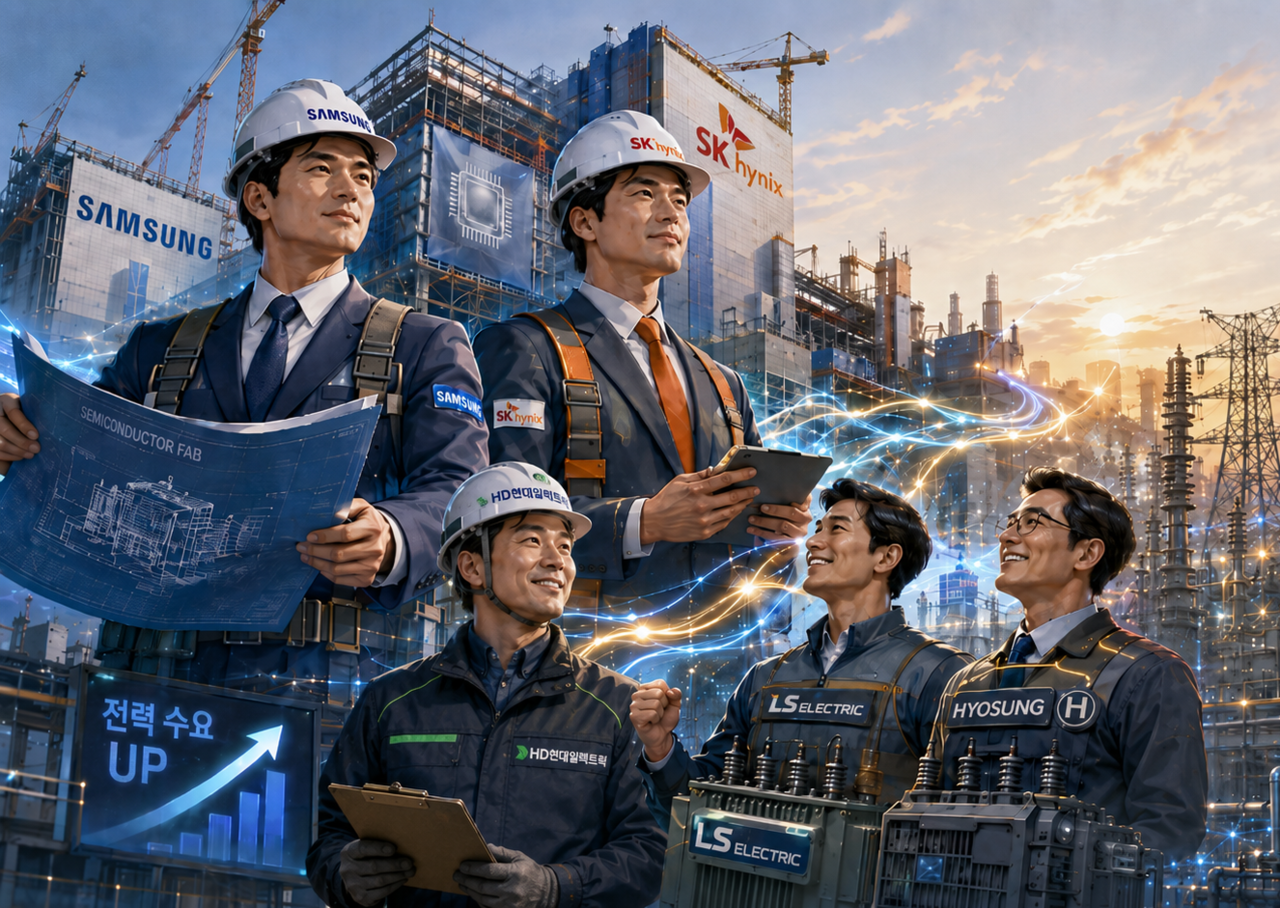
Expectations are rising among South Korea's power equipment manufacturers as Samsung Electronics and SK Hynix consider expanding their semiconductor investments into the Honam and Chungcheong regions. Should the chipmakers move forward with factory construction, orders for power equipment could run into the hundreds of billions of won.
Industry sources said Thursday that power equipment makers stand to be among the biggest beneficiaries if Samsung Electronics and SK Hynix proceed with semiconductor investments in the Honam and Chungcheong regions.
Domestic power equipment companies have until now focused heavily on overseas markets, driven by the surge in large-scale AI investment concentrated in the United States and Southeast Asia. The relatively sound state of South Korea's domestic power infrastructure compared with other countries has also pushed them to look abroad.
![Transformers undergo assembly at HD Hyundai Electric's smart transformer factory in Dong-gu, Ulsan. [Provided by HD Hyundai Electric]](https://wimg.heraldcorp.com/news/cms/2026/06/12/news-p.v1.20250717.2d5d9c25878249e498d5b8000b234f8a_P1.jpg)
Domestic revenue accounted for roughly 20 percent of HD Hyundai Electric's total sales in the first quarter of this year. Over the same period, the domestic share of Hyosung Heavy Industries' heavy industry division was 36 percent. LS Electric had a comparatively higher domestic share at 48 percent, though it still fell short of a majority.
Domestic power equipment companies that have focused on overseas markets may now be able to count on large-scale orders at home. When semiconductor factories — which require enormous amounts of electricity — are built, demand for transformers, switchgear and other power equipment can surge sharply. "It varies widely depending on the scale and characteristics of the factory, but building a single semiconductor plant requires at minimum hundreds of billions of won worth of power equipment," an industry official said.
Orders for the power infrastructure needed at semiconductor factories are expected to be placed by Korea Electric Power Corp. and the chipmakers themselves. KEPCO is expected to handle procurement for the transmission infrastructure needed to deliver power from other regions to the factory sites. The chipmakers will directly select the transformers, switchgear and other power equipment required to operate their facilities.
![An exterior view of the second production building at LS Electric's Busan plant. [Provided by LS Electric]](https://wimg.heraldcorp.com/news/cms/2026/06/12/news-p.v1.20251204.bd5b540139154191b75fbb03abe24cd8_P1.jpg)
KEPCO is likely to spread orders across multiple suppliers in the interest of fairness, but chipmakers are expected to take a different approach. Semiconductor manufacturing requires a stable power supply around the clock, so chipmakers are expected to select suppliers through competitive bidding to secure the best solution available.
"Just because a chipmaker is Korean doesn't mean it necessarily prefers power equipment made by Korean companies," another industry official said. "They also use products from global firms such as Germany's Siemens and Schneider Electric of the United States."
![A Hyosung Heavy Industries 765kV ultra-high-voltage transformer installed on the US transmission grid. [Provided by Hyosung Heavy Industries]](https://wimg.heraldcorp.com/news/cms/2026/06/12/news-p.v1.20260210.0b809533b94b4a06a74e855c3c2047a1_P1.jpg)
Domestic power equipment makers are expected to broaden their product portfolios to gain an edge in the competition for orders. HD Hyundai Electric has been building up its switchgear capabilities to reduce its dependence on transformers, completing a switchgear campus in Cheongju late last year as part of that effort. Through the new facility, the company plans to double its medium- and low-voltage circuit breaker production capacity to 13 million units by 2030.
LS Electric, a leader in switchgear, completed a new factory in Busan last year to expand its transformer production capacity — lifting its annual ultra-high-voltage transformer output from 200 billion won ($131 million) to 600 billion won. Hyosung Heavy Industries, meanwhile, is accelerating development of high-voltage direct current technology, a solution for transmitting large volumes of power over long distances with greater stability.

yeongdai@heraldcorp.com




