Democratic Party of Korea tables amendment to Urban Improvement Act
Land Ministry warns of administrative confusion from overlapping authority
Experts say move undermines decentralization principles
Controversy over centralization grows after land transaction permit zone dispute
A bill that would transfer the authority to designate urban redevelopment zones from metropolitan governors to the minister of land, infrastructure and transport is under National Assembly review — but the Ministry of Land, Infrastructure and Transport has effectively come out against it. The ministry argues that overlapping designation powers could create administrative confusion and slow redevelopment projects, which are a key channel for housing supply. Experts are warning against the political use of housing policy, noting that the push follows an earlier move to centralize authority over land transaction permit zones.
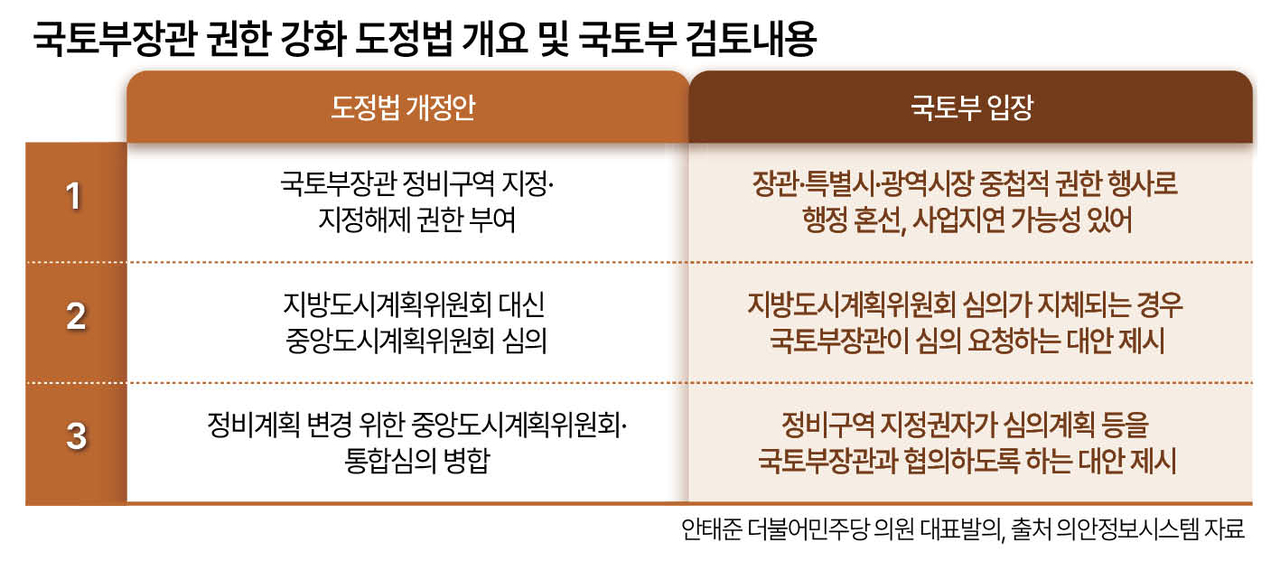
According to the National Assembly's Land, Infrastructure and Transport Committee on Wednesday, Democratic Party of Korea lawmaker Ahn Tae-jun introduced a bill in January that would allow the land minister to directly designate or lift designations on urban redevelopment zones in areas where the process has stalled. The bill — an amendment to the Act on the Improvement of Urban Areas and Residential Environments, commonly known as the Urban Improvement Act — would also allow such zones to be reviewed by the Central Urban Planning Committee rather than solely by local urban planning committees.
The amendment was referred to the Land, Infrastructure and Transport Committee in April and has undergone one round of deliberation. The ministry is understood to have submitted a "careful review" opinion on the bill — effectively signaling opposition — even while expressing sympathy with its stated goal of boosting housing supply.
The ministry's concern is that expanding licensing authority in this way could actually slow redevelopment projects rather than accelerate them. "If the land minister and metropolitan city mayors exercise overlapping authority to designate redevelopment zones, administrative confusion could in fact delay projects," the ministry said.
The ministry also pointed to the ongoing management demands of redevelopment projects after a zone is designated — including changes to zone boundaries and project implementation approvals. "Given the licensing framework in which the current zone-designation authority handles follow-up management after designation, overlapping authority at that stage could also delay projects," it said.
As an alternative, the ministry proposed a mechanism under which district mayors and other local officials could report to the land minister when a local urban planning committee delays its review, allowing the minister to then request that the designating authority push the committee to act. The proposal amounts to a compromise that would give the minister a tool to accelerate stalled projects without directly taking over the licensing function.
A ministry official said in a phone interview that "there is a shared understanding within the government that the central government can step in and help mediate in areas that are deadlocked, but directly handling the licensing itself would not be easy." Experts share that concern, warning that transferring redevelopment zone designation authority to the central government could cause significant disruption in the housing market. The authority was fully transferred to metropolitan and provincial governors in 2003 under the Roh Moo-hyun administration's decentralization road map.
The transfer reflected a judgment that local governments, with their deeper knowledge of their own communities, were better placed to directly designate and manage redevelopment projects — given the complex competing interests involved, including residents' property rights and the risk of speculative activity.
Lee Ji-hyun, head of the urban improvement division at the Korea Housing Industry Research Institute, said that in cities with populations of 500,000 or more, local governments draw up residential environment improvement plans. "The reason local governments do this is to manage the overall volume of redevelopment and demolition," she said. "If the ministry's plans start to be inserted into that process, it will cause confusion."
Even setting aside this particular bill, the ruling camp has been steadily pursuing policies that shift housing authority from local governments to the central government.
A prime example is the Special Act on Mixed-Use Development of Aging Public Buildings, announced as part of the Sept. 7 real estate supply package, which includes direct development authority for the land minister. Under the act, the minister can designate idle public land held by the state, local governments and public institutions as mixed-use development zones and select project operators. If agreement with local governments and relevant agencies is not reached within 30 days, the consultation is deemed complete and the process moves to the next stage.
A bill amending the Act on Real Estate Transaction Reporting — which would transfer to the land minister the authority that metropolitan and provincial governors currently hold to designate land transaction permit zones within a single local government's jurisdiction — is also awaiting a full plenary vote.
The government has used an existing provision allowing the minister to designate land transaction permit zones that "span the jurisdictions of two or more cities or provinces" to bundle all of Seoul and 12 areas of Gyeonggi Province into a single zone. The government and the ruling party say they intend to amend the law so the minister can designate individual Seoul districts as land transaction permit zones without that condition.
A professor who asked not to be named said the original purpose of land transaction permit zones was to block speculative capital inflows and serve as a tool for local government heads to closely monitor their areas. "If this kind of authority is used for political ends, it could ultimately throw the housing market into turmoil — including a triple rise in jeonse and monthly rent prices as well as sale prices," the professor said.
hss@heraldcorp.com