Season 3 Physical AI Frontier Nation New Technology Strategy Forum co-hosted by lawmakers from both parties
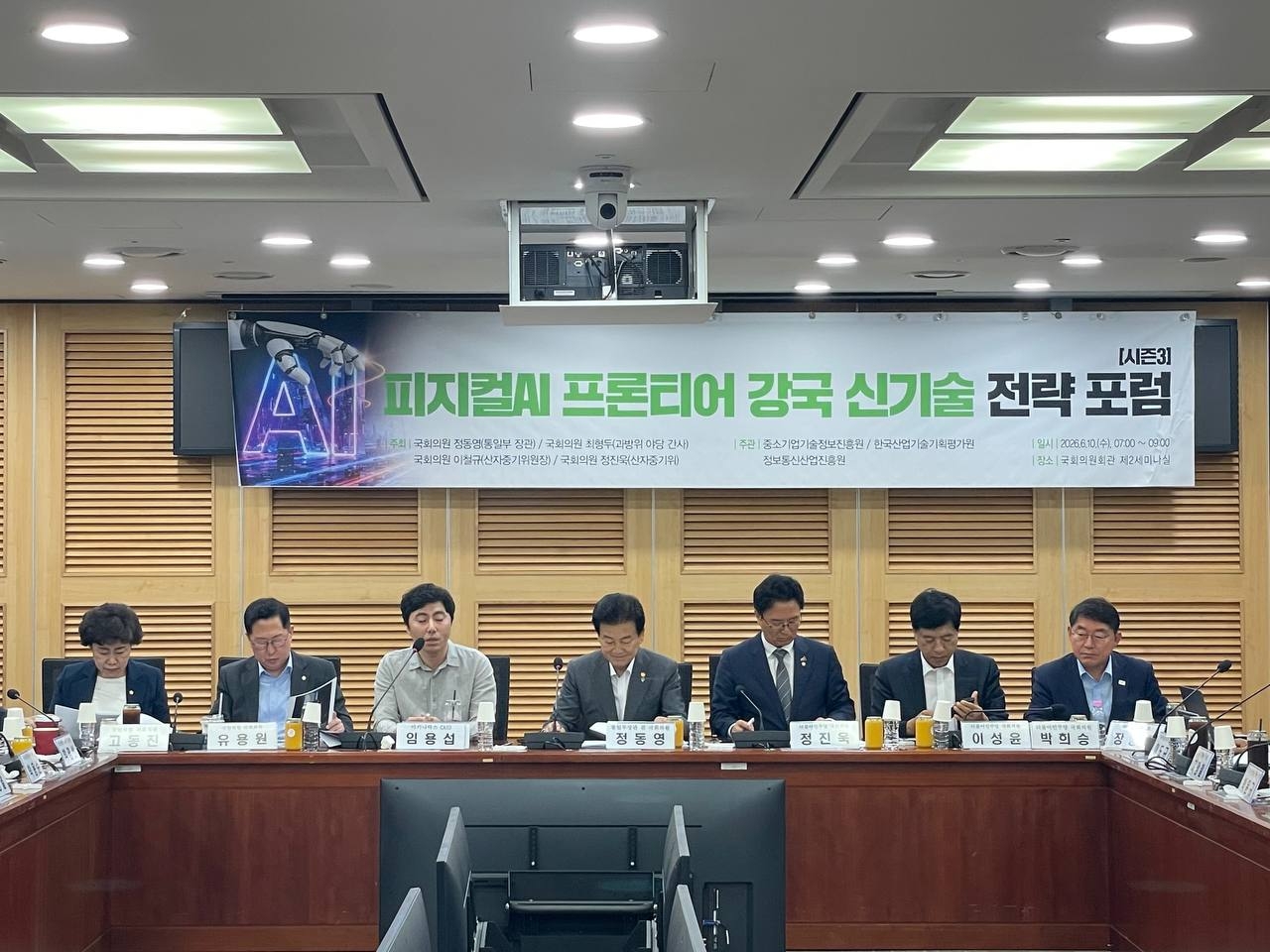
"Two years ago, there was deep anxiety about the future of AI in South Korea — but now, physical AI is becoming a reality right before our eyes," said Rep. Jeong Dong-young.
The Season 3 Physical AI Frontier Nation New Technology Strategy Forum was held Wednesday at 7 p.m. in Seminar Room 2 of the National Assembly Members' Office Building. The event was co-hosted by four lawmakers — Democratic Party of Korea Reps. Jeong Dong-young (minister of unification, Jeonju Byeong, North Jeolla Province) and Jeong Jin-uk (Gwangju Dong-gu Nam-gu Gap), along with People Power Party Reps. Choi Hyeong-du (Changwon Masanhappo-gu, South Gyeongsang Province) and Lee Cheol-gyu (Donghae, Taebaek, Samcheok and Jeongseon-gun, Gangwon Province) — and organized by the Korea SMEs and Startups Agency, the Korea Evaluation Institute of Industrial Technology and the National IT Industry Promotion Agency.
In his opening remarks, Rep. Jeong said the government "is swiftly advancing its national policy goal of making Korea the mecca of physical AI by 2030," expressing confidence in the sector's rise. He added that the multi-ministry forum, organized by the Korea SMEs and Startups Agency and including the Ministry of SMEs and Startups, would serve as "a solid catalyst for small and medium-sized enterprise innovation through in-depth discussion of physical AI."
Im Yong-seop, chief AI officer at Machina Rocks, presented the achievements of "multi-agent" technology in the keynote address. He said the key to successful AI adoption lies in "collaboration between AI specialist firms and frontline workers," and stressed that broad industrial infrastructure support enabling the convergence of technology and the factory floor is essential for the continued advancement of physical AI.
Jang Yeong-jae, CEO of Daim Research, then introduced a case study from DH Autolead, a manufacturer of automotive steering wheels. He said the company's adoption of "Kairos" — an AI-powered unmanned factory platform developed by KAIST — cut manufacturing time per steering wheel by 30 minutes and boosted productivity by 7.4 percent.
During the discussion, Yoo Tae-won, a director at Impactive AI, said small and medium-sized enterprises are being slowed in adopting physical AI despite holding vast amounts of data, simply because they lack the know-how and technical expertise to use it. He called on the government to issue "data standardization guidelines" so that AI systems can learn from and apply that data immediately.
Park Moon-won, CEO of MICube Solution, said the government has been steadily supporting AI deployment on factory floors, but companies are extremely reluctant to share manufacturing data for AI training and testing out of fear that proprietary production know-how could leak. He urged that legislative and administrative procedures for data protection and utilization are urgently needed so that companies can use their manufacturing data with confidence.
Kim Tae-yong, chief operating officer at SolverX, said that even companies eager to embrace AI transformation frequently abandon the effort because generating simulation data at scale carries enormous costs. He called for full-scale government support so that small and medium-sized enterprises are not stopped by the cost barrier of data production.
Park Jeong-yun, CEO of InterX, said South Korea must clarify its national strategy on which domain — hardware, operating systems or applications — it intends to dominate. He said commercialization of AI is impossible unless issues with communications and security infrastructure are resolved first.
Reps. Lee Seong-yun (Jeonju Eul, North Jeolla Province), Park Hee-seung (Namwon, Jangsu-gun, Imsil-gun and Sunchang-gun, North Jeolla Province) and Yoo Yong-won (proportional representation), who also attended the forum, pledged bipartisan cooperation, vowing that "the National Assembly will be the most reliable catalyst for physical AI to take root across the factory floors of small, medium and mid-sized enterprises — the backbone industries of our economy."
bigroot@heraldcorp.com