
Spain BSA factory begins operation this month
Hungary plant for Mercedes-Benz fully running since March
Slovakia launches EV drivetrain mass production
First-quarter European sales hit all-time high
![An exterior view of the Hyundai Mobis electric vehicle battery system assembly (BSA) factory in Spain, which began operations this month. [Hyundai Mobis]](https://wimg.heraldcorp.com/news/cms/2026/06/10/news-p.v1.20260610.1afe3f03a45d40afaeddf99a6c238807_P1.jpg)
Europe is emerging as the key market that will define Hyundai Mobis's global performance this year. Three major European facilities — in Spain, Hungary and Slovakia — have come online in the first half of 2026 alone. Analysts say the company, which has been expanding orders from non-affiliate automakers with a focus on electrification components, is treating Europe as its testing ground for a push into the ranks of the world's top-tier auto parts suppliers.
Hyundai Mobis began operating its BSA factory near Pamplona in Spain's Navarra region early this month, according to industry sources. The plant, completed in December last year, entered mass production after a period of equipment stabilization and trial runs.
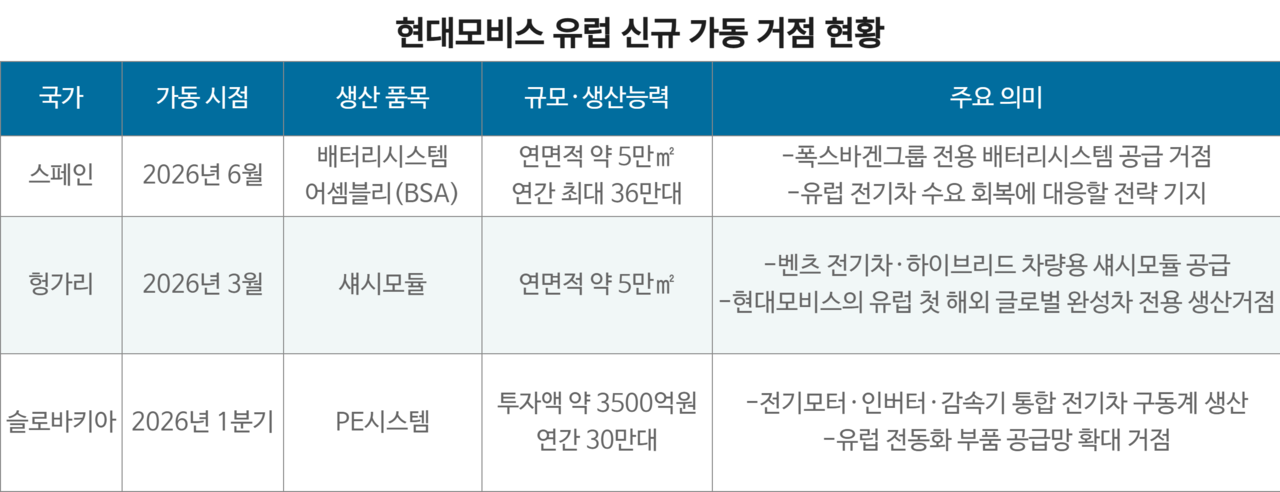
The factory serves as a dedicated battery system supply base for the Volkswagen Group. With a total floor area of roughly 50,000 square meters, it has an annual production capacity of up to 360,000 units. Its location about 10 kilometers from a Volkswagen assembly plant gives it a logistics advantage as well.
A BSA is a finished product that integrates a battery pack with control units and other electronic components, and is considered one of the most critical parts in an electric vehicle. With EV demand in Europe showing signs of recovery this year, the Spain BSA plant is expected to serve as a strategic base for Hyundai Mobis to respond to battery supply chain restructuring by local automakers and broaden its order pipeline over the medium to long term.
![Workers at the Hyundai Mobis factory in Hungary produce chassis modules for Mercedes-Benz electric and hybrid vehicles. [Hyundai Mobis]](https://wimg.heraldcorp.com/news/cms/2026/06/10/news-p.v1.20260610.a17ed861cb9b4c468babd7382bb4951f_P1.jpg)
Hungary plant supplies dedicated chassis modules for Mercedes-Benz
Hungary is another pillar of Hyundai Mobis's European strategy. The company brought its new plant in Kecskemét fully online in March, marking its first European production base built exclusively to supply a global automaker. The facility covers roughly 50,000 square meters — equivalent to seven soccer fields.
The Hungary plant supplies key chassis modules for Mercedes-Benz electric and hybrid vehicles. A chassis module bundles the major underbody components — steering, braking and suspension systems — into a single large assembly. The plant operates on a just-in-sequence basis, receiving real-time production schedules from the customer and delivering parts in the exact order needed.
Hyundai Mobis chose Hungary for its first Europe-based plant dedicated to a global customer, citing the country's vehicle production base and logistics efficiency. Hungary has recently emerged as a hub for automotive and battery manufacturing, with numerous global automakers operating production facilities there. The company plans to use the Hungary plant as a springboard to raise the share of non-affiliate sales from around 10 percent currently to 40 percent by 2033.
![An aerial rendering of the Hyundai Mobis electric vehicle drivetrain factory in Nováky, Slovakia. [Hyundai Mobis]](https://wimg.heraldcorp.com/news/cms/2026/06/10/news-p.v1.20260610.1317170b191646dfb936330144ea13eb_P1.jpg)
Slovakia becomes key European hub for PE systems
In Eastern Europe, Slovakia is taking shape as a core production base for EV drivetrains. Hyundai Mobis invested roughly 350 billion won ($231 million) to build its first PE system factory in Europe in the Nováky area and began full mass production in the first quarter of this year. A PE system integrates an electric motor, inverter and reducer into a single EV drive unit. The plant has an annual production capacity of 300,000 units.
Slovakia is home to a cluster of global automakers including Kia, Volkswagen, Stellantis and Jaguar Land Rover. Hyundai Mobis's decision to establish a drivetrain production base there is seen as a preemptive move to capitalize on the European EV market's recovery.
Synergies with existing European facilities are also growing. In Nošovice, Czech Republic, Hyundai Mobis produces battery systems for electric vehicles in tandem with Hyundai Motor's local assembly plant. After launching a new BSA factory there in August 2023, the company completed a new logistics center called TM1 last year, introducing an automated system capable of stacking heavy batteries vertically up to five tiers high — boosting both production and logistics efficiency across Europe.
Record first-quarter European sales; orders on track
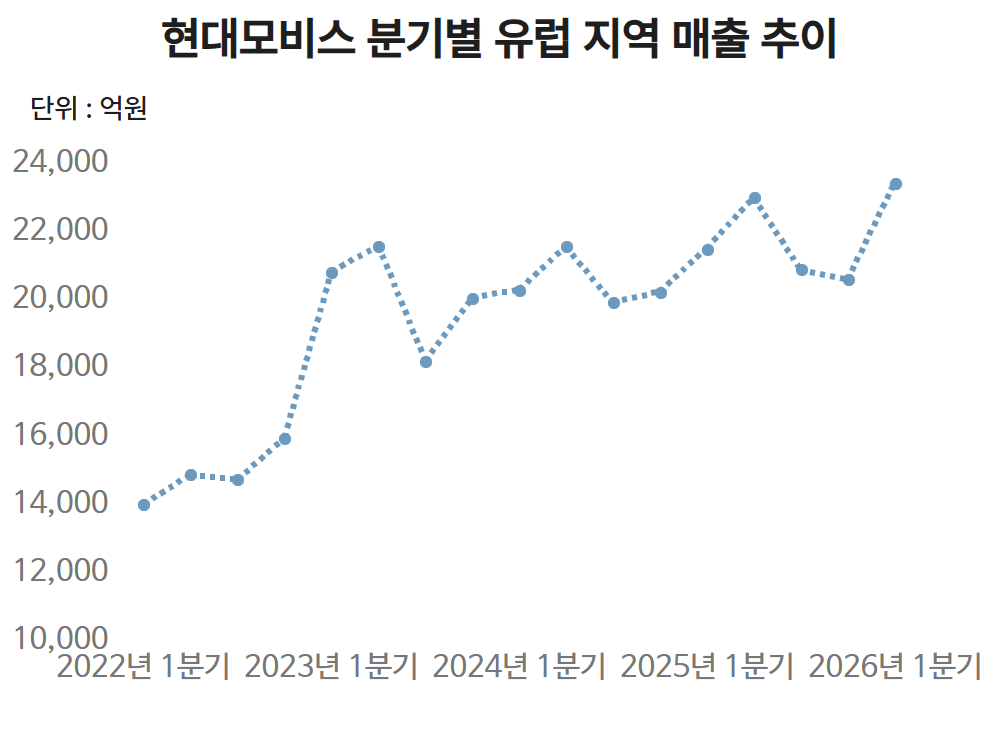
The European expansion is showing up in earnings. Hyundai Mobis posted European sales of 2.3303 trillion won in the first quarter of this year, an all-time high and a roughly 9.0 percent increase from 2.1377 trillion won in the same period a year earlier. The gain is attributed to higher supply of high-value products including electrification components and chassis modules.
Europe is also accounting for a growing share of orders from non-affiliate customers. In the first quarter, Hyundai Mobis secured orders from major European automakers for steering products and braking products. The steering products will be manufactured at its Changwon factory in South Korea, while the braking products will be produced at its Wuxi factory in China.
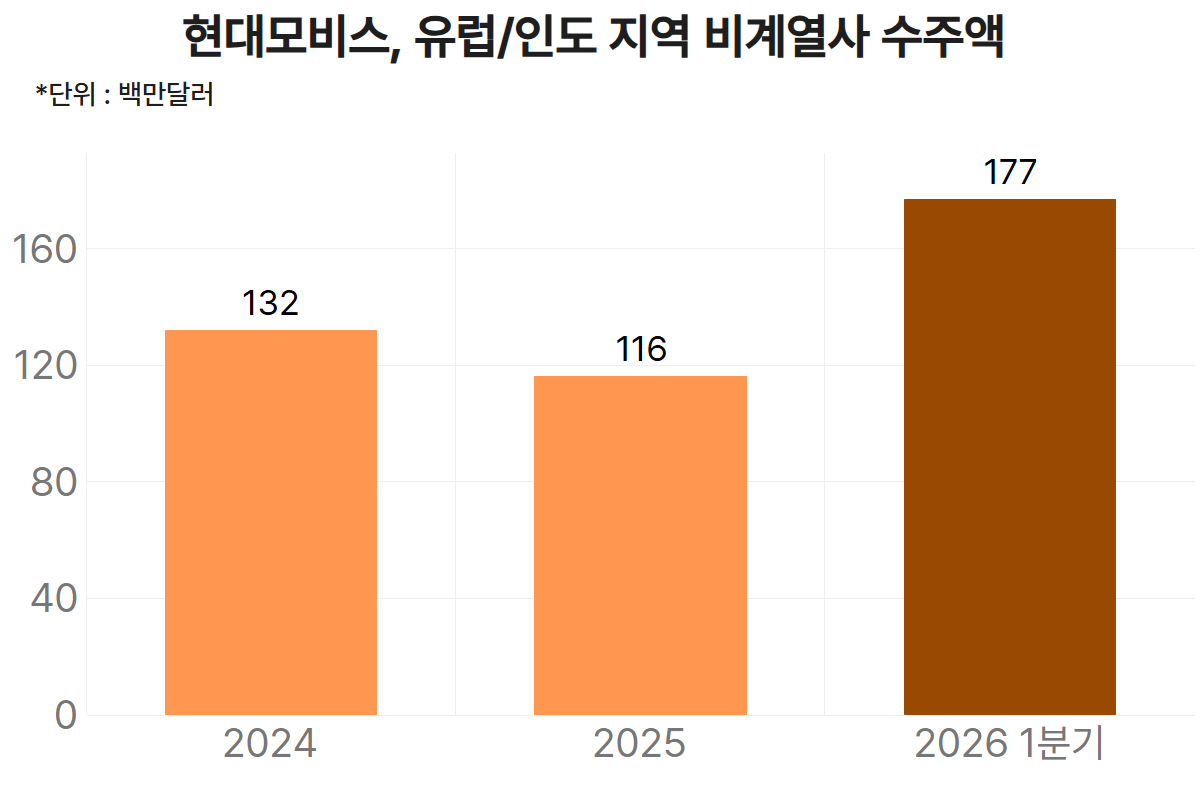
The outlook for European earnings is also brightening. Non-affiliate orders from Europe and India totaled $177 million in the first quarter, already surpassing the full-year figures of $132 million in 2024 and $116 million last year. Europe accounted for the largest share of the total first-quarter order value of $316 million. That figure represents only about 9 percent of the full-year target of $1.901 billion, however, leaving additional order wins as a key challenge for the remainder of the year.
Hyundai Mobis's European strategy is shifting beyond simply expanding production capacity toward winning more non-affiliate automaker customers. Having grown on the back of stable volume from Hyundai Motor and Kia, the company must now prove its independent competitiveness against global automakers such as Mercedes-Benz and Volkswagen.
"Hyundai Mobis is maintaining strong profitability thanks to robust aftermarket demand in the Americas and Europe, as well as the tailwind from a stronger dollar," said Lee Byeong-geun, an analyst at LS Securities. "Even as vehicle sales by automakers decline, growth in non-affiliate sales and expansion of parts manufacturing revenue centered on electronic components continues." He added that an increase in European EV sales in the second half of the year would translate into improved earnings for the electrification segment.
kwater@heraldcorp.com




